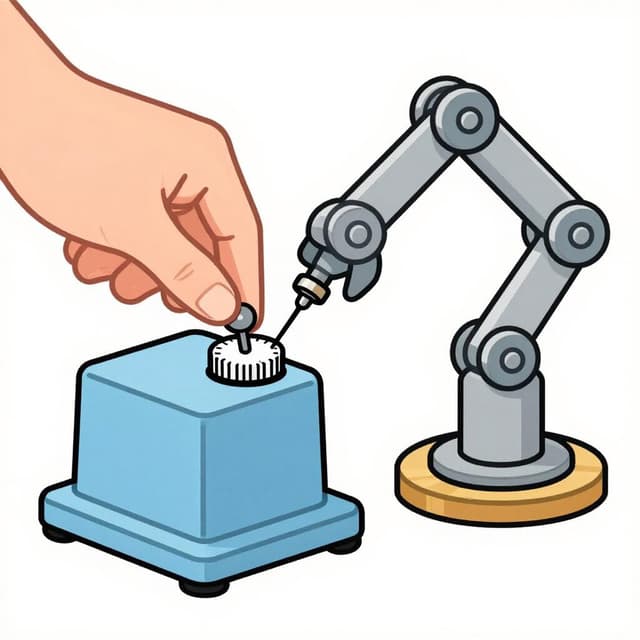
Koniugacja ajustar Tryb rozkazujący (przeczący)
ajustar — to adjust
Negative commands for 'ajustar' use the present subjunctive: no ajustes (tú), no ajuste (usted), no ajustemos (nosotros), no ajusten (ustedes), no ajustéis (vosotros).
Formy ajustar Tryb rozkazujący (przeczący)
Kiedy używać Tryb rozkazujący (przeczący)
Use the negative imperative to tell someone *not* to do something. It's always formed using 'no' plus the present subjunctive form.
Uwagi dotyczące ajustar w czasie Tryb rozkazujący (przeczący)
Ajustar is regular in the negative imperative, following the standard pattern of using the present subjunctive forms with 'no'.
Przykładowe zdania
No ajustes la temperatura tan rápido.
Don't adjust the temperature so quickly.
tú
Por favor, no ajuste el volumen tan alto.
Please, don't adjust the volume so loud.
usted
No ajustemos el presupuesto sin consultarlo.
Let's not adjust the budget without consulting it.
nosotros
No ajusten los espejos antes de empezar.
Don't adjust the mirrors before starting.
No ajustéis la silla así.
Don't adjust the chair like that.
vosotros
Częste błędy
Błąd: Using the infinitive with 'no' for commands.
Poprawnie: Use 'no ajustes' for 'don't adjust!' (tú), not 'no ajustar'.
Dlaczego: Commands, even negative ones, require a conjugated verb.
Błąd: Confusing the 'tú' and 'usted' forms.
Poprawnie: Use 'no ajustes' for informal 'you' and 'no ajuste' for formal 'you'.
Dlaczego: Spanish distinguishes between informal and formal commands.
Opanuj hiszpańskie czasowniki w kontekście
Zapamiętywanie tabel to dopiero początek. Przeczytaj ponad 200 ilustrowanych i udźwiękowionych hiszpańskich historii, aby zobaczyć czasowniki takie jak 'ajustar' używane naturalnie — w czasach, których się uczysz.
Powiązane czasy
Czas teraźniejszy
yo: ajusto
The present tense of 'ajustar' (ajusto, ajustas, ajusta, etc.) is used for current actions, habits, and general truths.
Czas przeszły prosty
yo: ajusté
The preterite of 'ajustar' is regular: ajusté, ajustaste, ajustó, ajustamos, ajustasteis, ajustaron.
Czas przeszły niedokonany
yo: ajustaba
The imperfect of 'ajustar' (ajustaba, ajustabas, ajustaba, etc.) describes ongoing or habitual past actions.
Czas przyszły
yo: ajustaré
The future tense of 'ajustar' (ajustaré, ajustarás, ajustará, etc.) indicates actions that will happen later.
Tryb warunkowy
yo: ajustaría
The conditional of 'ajustar' (ajustaría, ajustarías, etc.) is used for hypotheticals ('would') and polite requests.
Tryb Subj. teraźniejszy
yo: ajuste
The present subjunctive of 'ajustar' (ajuste, ajustes, ajustemos, etc.) follows expressions of doubt, desire, emotion, or uncertainty.
Tryb Subj. przeszły niedokonany
yo: ajustara
The imperfect subjunctive of 'ajustar' (e.g., ajustara, ajustaras) is used for past hypotheticals or wishes.
Tryb rozkazujący (twierdzący)
yo: ajusta
Imperative commands for 'ajustar': ajusta (tú), ajuste (usted), ajustemos (nosotros), ajusten (ustedes), ajustad (vosotros).