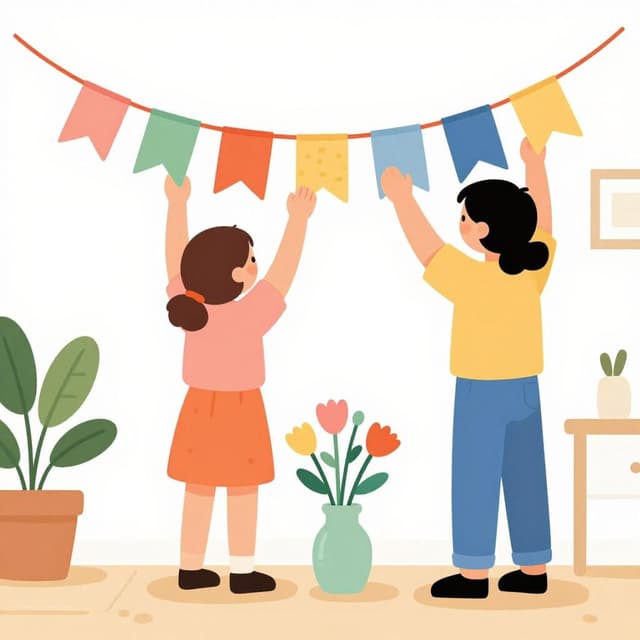
Koniugacja decorar Czas przyszły
decorar — to decorate
Use 'decoraré' (yo) and 'decorarán' (ellos/ellas/ustedes) for actions that will happen in the future.
Formy decorar Czas przyszły
Kiedy używać Czas przyszły
This tense is for talking about decorating that is certain to happen later. For example, 'I will decorate the living room next week' or 'They will decorate the venue for the party.' It can also express probability ('He will probably decorate it himself').
Uwagi dotyczące decorar w czasie Czas przyszły
Decorar is regular in the future tense. The stem is the entire infinitive ('decorar-') and you add the standard future endings.
Przykładowe zdania
Yo decoraré la casa para Navidad.
I will decorate the house for Christmas.
yo
¿Tú decorarás el jardín?
Will you decorate the garden?
tú
Ella decorará su oficina con plantas.
She will decorate her office with plants.
él/ella/usted
Nosotros decoraremos el salón de eventos.
We will decorate the event hall.
nosotros
Ellos decorarán la entrada.
They will decorate the entrance.
ellos/ellas/ustedes
Częste błędy
Błąd: Using the present tense instead of the future.
Poprawnie: Use 'decoraré' for a future action, not 'decoro'.
Dlaczego: The present tense is for current or habitual actions, while the future tense is specifically for events that will occur later.
Błąd: Forgetting the infinitive stem.
Poprawnie: The future stem for 'decorar' is 'decorar-', so it's 'decoraré', not something like 'decoreré'.
Dlaczego: Future tense endings are added to the infinitive for regular verbs.
Opanuj hiszpańskie czasowniki w kontekście
Zapamiętywanie tabel to dopiero początek. Przeczytaj ponad 200 ilustrowanych i udźwiękowionych hiszpańskich historii, aby zobaczyć czasowniki takie jak 'decorar' używane naturalnie — w czasach, których się uczysz.
Powiązane czasy
Czas teraźniejszy
yo: decoro
Use 'decoro' (yo) and 'decoran' (ellos/ellas/ustedes) for current, habitual, or general decorating actions.
Czas przeszły prosty
yo: decoré
Use 'decoré' (yo) and 'decoró' (él/ella/usted) for completed actions of decorating in the past.
Czas przeszły niedokonany
yo: decoraba
Use 'decoraba' (yo/él/ella/usted) and 'decoraban' (ellos/ellas/ustedes) for ongoing or habitual decorating in the past.
Tryb warunkowy
yo: decoraría
Use 'decoraría' (yo/él/ella/usted) and 'decorarían' (ellos/ellas/ustedes) for hypothetical situations ('would decorate').
Tryb Subj. teraźniejszy
yo: decore
Use 'decore' (yo/él/ella/usted) and 'decoren' (ellos/ellas/ustedes) after expressions of doubt, desire, or emotion.
Tryb Subj. przeszły niedokonany
yo: decorara
Use 'decorara' or 'decorase' for past hypothetical situations or wishes.
Tryb rozkazujący (twierdzący)
yo: decora
Use 'decora' (tú) and 'decoren' (ustedes) for direct commands to decorate.
Tryb rozkazujący (przeczący)
yo: no decores
Use 'no decores' (tú) and 'no decoren' (ustedes) for negative commands.