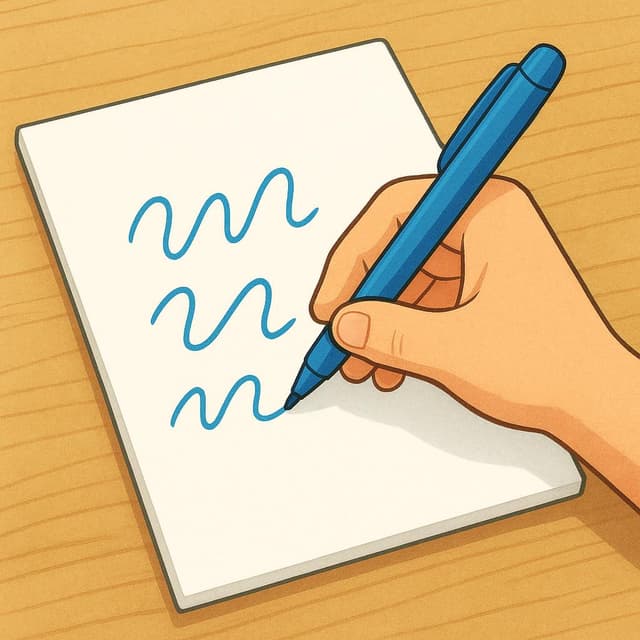
Koniugacja escribir Czas przyszły
escribir — to write
The future tense uses the full infinitive as the base: escribiré, escribirás, escribirá, escribiremos, escribiréis, escribirán.
Formy escribir Czas przyszły
Kiedy używać Czas przyszły
Use this to talk about things you plan to write later or to express a guess about what someone might be writing currently.
Uwagi dotyczące escribir w czasie Czas przyszły
Escribir is regular in the future. Simply add the future endings to the infinitive form 'escribir'.
Przykładowe zdania
Escribiré el informe mañana.
I will write the report tomorrow.
yo
¿Escribirás una postal desde Italia?
Will you write a postcard from Italy?
tú
Ellos escribirán un libro juntos.
They will write a book together.
ellos/ellas/ustedes
Częste błędy
Błąd: Removing the -ir before adding endings (e.g., 'escribiré' vs 'escribré').
Poprawnie: Keep the full 'escribir' and add the ending: escribiré.
Dlaczego: In the future tense, you do not drop the infinitive ending like you do in the present tense.
Opanuj hiszpańskie czasowniki w kontekście
Zapamiętywanie tabel to dopiero początek. Przeczytaj ponad 200 ilustrowanych i udźwiękowionych hiszpańskich historii, aby zobaczyć czasowniki takie jak 'escribir' używane naturalnie — w czasach, których się uczysz.
Powiązane czasy
Czas teraźniejszy
yo: escribo
The present tense of escribir is a regular -ir verb: escribo, escribes, escribe, escribimos, escribís, escriben.
Czas przeszły prosty
yo: escribí
The preterite of escribir is regular: escribí, escribiste, escribió, escribimos, escribisteis, escribieron.
Czas przeszły niedokonany
yo: escribía
The imperfect of escribir uses -ía endings: escribía, escribías, escribía, escribíamos, escribíais, escribían.
Tryb warunkowy
yo: escribiría
The conditional is formed by adding -ía to the infinitive: escribiría, escribirías, escribiría, escribiríamos, escribiríais, escribirían.
Tryb Subj. teraźniejszy
yo: escriba
The present subjunctive of escribir uses -a endings: escriba, escribas, escriba, escribamos, escribáis, escriban.
Tryb Subj. przeszły niedokonany
yo: escribiera
The imperfect subjunctive of escribir is built from the 'ellos' preterite: escribiera, escribieras, escribiera, escribiéramos, escribierais, escribieran.
Tryb rozkazujący (twierdzący)
yo: escribe
The affirmative imperative gives commands: escribe (tú), escribid (vosotros), escriba (usted), escriban (ustedes).
Tryb rozkazujący (przeczący)
yo: no escribas
The negative imperative uses 'no' + present subjunctive: no escribas, no escriba, no escribamos, no escribáis, no escriban.