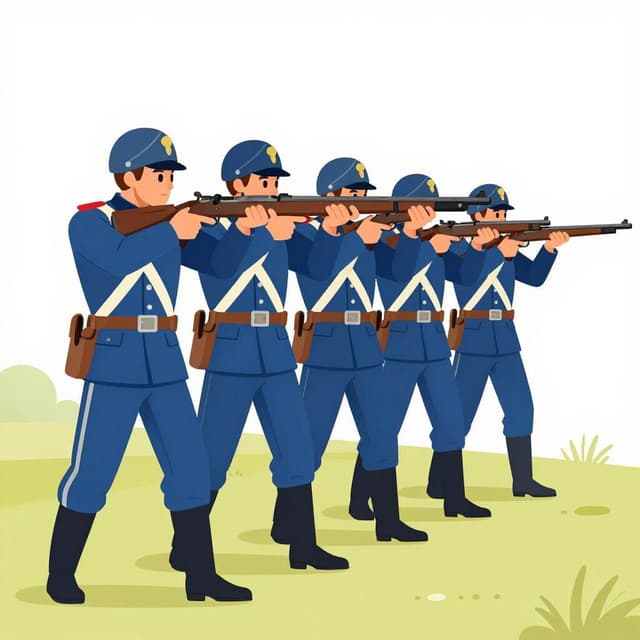
Koniugacja fusilar Czas przeszły niedokonany
fusilar — to execute by firing squad
The imperfect 'fusilaba' (yo) to 'fusilaban' (ellos) describes past ongoing or habitual executions.
Formy fusilar Czas przeszły niedokonany
Kiedy używać Czas przeszły niedokonany
Use the imperfect for descriptions in the past, ongoing actions, or repeated habits. For 'fusilar', it could describe a period when executions were common or a background detail in a story.
Uwagi dotyczące fusilar w czasie Czas przeszły niedokonany
Fusilar is regular in the imperfect tense. The conjugation follows the standard pattern for -ar verbs: -aba, -abas, -aba, -ábamos, -abais, -aban.
Przykładowe zdania
Cuando gobernaba el tirano, fusilaban a los disidentes cada semana.
When the tyrant ruled, they executed dissidents every week.
ellos/ellas/ustedes
Mi abuelo me contaba que fusilaban a los soldados rasos por cualquier cosa.
My grandfather told me they used to execute low-ranking soldiers for anything.
ellos/ellas/ustedes
Antes, el rey fusilaba a los traidores sin dudar.
Before, the king used to execute traitors without hesitation.
él/ella/usted
Yo fusilaba a los malos en mis historias de niño.
I used to execute the bad guys in my childhood stories.
yo
Częste błędy
Błąd: Using the imperfect 'fusilaba' for a single, completed past execution.
Poprawnie: For a specific completed action, use the preterite: 'El soldado fusiló al prisionero', not 'El soldado fusilaba al prisionero'.
Dlaczego: The imperfect describes ongoing or habitual actions, not punctual, completed events.
Błąd: Confusing the nosotros imperfect ('fusilábamos') with the nosotros present ('fusilamos').
Poprawnie: Ensure context clarifies whether it's 'we were executing' (imperfect) or 'we execute' (present).
Dlaczego: The '-ábamos' ending clearly marks the imperfect, but learners might sometimes drop it or mishear.
Opanuj hiszpańskie czasowniki w kontekście
Zapamiętywanie tabel to dopiero początek. Przeczytaj ponad 200 ilustrowanych i udźwiękowionych hiszpańskich historii, aby zobaczyć czasowniki takie jak 'fusilar' używane naturalnie — w czasach, których się uczysz.
Powiązane czasy
Czas teraźniejszy
yo: fusilo
The present indicative 'fusilo' (yo) to 'fusilan' (ellos) describes current or habitual executions.
Czas przeszły prosty
yo: fusilé
The preterite 'fusilé' (yo) to 'fusilaron' (ellos) marks completed past executions.
Czas przyszły
yo: fusilaré
The future 'fusilaré' (yo) to 'fusilarán' (ellos) predicts or states future executions.
Tryb warunkowy
yo: fusilaría
The conditional 'fusilaría' (yo) to 'fusilarían' (ellos) expresses hypotheticals ('would execute').
Tryb Subj. teraźniejszy
yo: fusile
Use present subjunctive 'fusile' (él/ella/usted) or 'fusilen' (ellos/ellas/ustedes) after verbs of doubt, emotion, or desire.
Tryb Subj. przeszły niedokonany
yo: fusilara
The imperfect subjunctive 'fusilara' or 'fusilase' is used for past hypotheticals, wishes, or doubts.
Tryb rozkazujący (twierdzący)
yo: fusila
Use imperative commands like 'fusila' (tú) or 'fusilen' (ustedes) for direct orders with 'fusilar'.
Tryb rozkazujący (przeczący)
yo: no fusiles
Negative commands like 'no fusiles' (tú) or 'no fusilen' (ustedes) use the present subjunctive with 'no'.