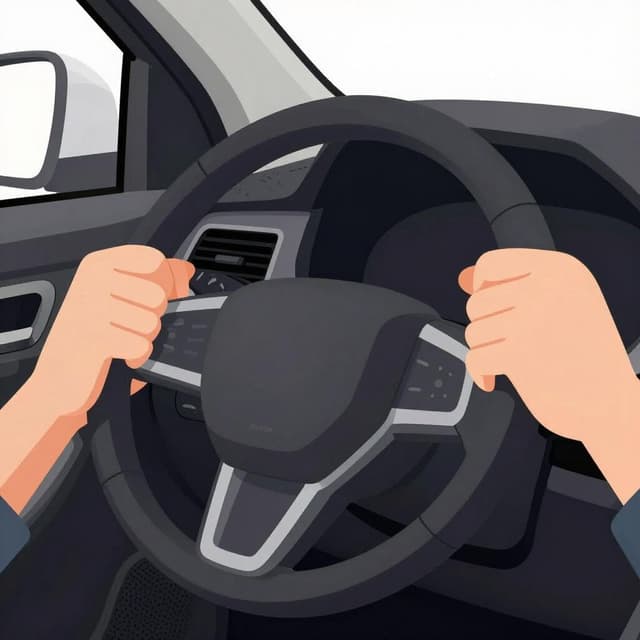
Koniugacja manejar Tryb warunkowy
manejar — to drive
Hypotheticals ('would drive'), polite requests, or future-in-the-past.
Formy manejar Tryb warunkowy
Kiedy używać Tryb warunkowy
Use the conditional tense for hypothetical situations ('I would drive if...'), polite requests ('Would you drive me?'), or to describe what someone would do in the past.
Uwagi dotyczące manejar w czasie Tryb warunkowy
Manejar is regular in the conditional tense. The stem is the infinitive ('manejar-'), and the conditional endings (-ía, -ías, -ía, -íamos, -íais, -ían) are added.
Przykładowe zdania
Yo manejaría hasta allí si tuviera tiempo.
I would drive there if I had time.
yo
¿Manejarías tú mi coche?
Would you drive my car?
tú
Él dijo que manejaría al aeropuerto.
He said he would drive to the airport.
él/ella/usted
Nosotros manejaríamos si no lloviera.
We would drive if it weren't raining.
nosotros
Ellos manejarían más rápido si tuvieran prisa.
They would drive faster if they were in a hurry.
ellos/ellas/ustedes
Częste błędy
Błąd: Using the future tense instead of the conditional for hypotheticals: 'Yo manejaré si tuviera tiempo'.
Poprawnie: For hypothetical 'would' statements, use the conditional: 'Yo manejaría si tuviera tiempo'.
Dlaczego: The future tense talks about what *will* happen, while the conditional talks about what *would* happen under certain conditions.
Błąd: Confusing the conditional ending with the imperfect: 'Yo manejaba si tuviera tiempo'.
Poprawnie: The correct conditional form is 'Yo manejaría si tuviera tiempo'.
Dlaczego: The conditional endings (-ía, -ías, etc.) are distinct from the imperfect endings (-aba, -abas, etc.).
Opanuj hiszpańskie czasowniki w kontekście
Zapamiętywanie tabel to dopiero początek. Przeczytaj ponad 200 ilustrowanych i udźwiękowionych hiszpańskich historii, aby zobaczyć czasowniki takie jak 'manejar' używane naturalnie — w czasach, których się uczysz.
Powiązane czasy
Czas teraźniejszy
yo: manejo
Habits, actions happening now, or general truths about driving.
Czas przeszły prosty
yo: manejé
Completed past actions: 'I drove', 'you drove' at a specific time.
Czas przeszły niedokonany
yo: manejaba
Ongoing or habitual past actions: 'I used to drive', 'was driving'.
Czas przyszły
yo: manejaré
Actions that will happen: 'I will drive', 'you will drive'.
Tryb Subj. teraźniejszy
yo: maneje
Expressing wishes, doubts, or emotions about driving: 'I want you to drive...'.
Tryb Subj. przeszły niedokonany
yo: manejara
Past hypotheticals or wishes, like 'if I drove...' or 'I wish you would drive...'.
Tryb rozkazujący (twierdzący)
yo: maneja
Direct commands like 'drive!' or 'let's drive!' for manejar.
Tryb rozkazujący (przeczący)
yo: no manejes
Negative commands like 'don't drive!' for manejar, using the present subjunctive.