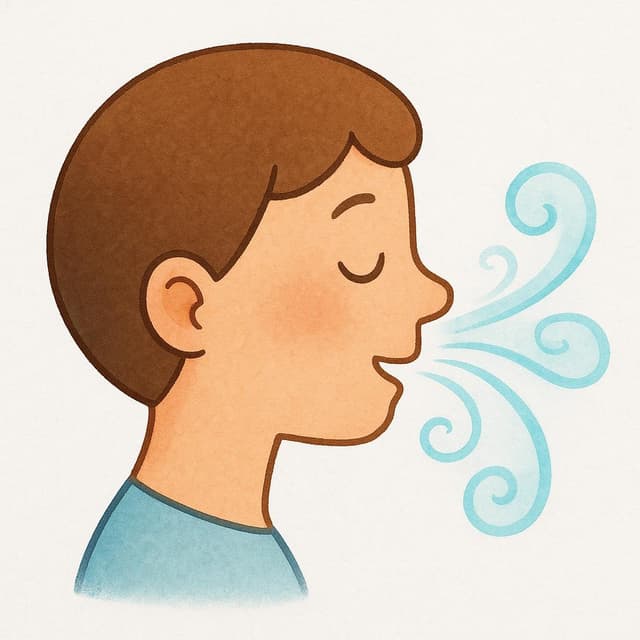
Koniugacja respirar Czas przeszły niedokonany
respirar — to breathe
The imperfect tense of respirar (respiraba) describes ongoing or habitual past actions and sets the scene.
Formy respirar Czas przeszły niedokonany
Kiedy używać Czas przeszły niedokonany
Use the imperfect to describe background actions in the past, habitual activities, or states of being. It paints a picture of what was happening.
Uwagi dotyczące respirar w czasie Czas przeszły niedokonany
Respirar is regular in the imperfect indicative. All endings follow the standard -ar pattern.
Przykładowe zdania
Cuando era niño, respiraba aire puro todo el tiempo.
When I was a child, I used to breathe pure air all the time.
yo
¿Tú respirabas con normalidad?
Were you breathing normally?
tú
Ella respiraba muy suavemente mientras dormía.
She was breathing very softly while she slept.
él/ella/usted
Nosotros respirábamos agitados después de correr.
We were breathing heavily after running.
nosotros
Ellos respiraban con dificultad en la altitud.
They were breathing with difficulty at the altitude.
ellos/ellas/ustedes
Częste błędy
Błąd: Using the preterite for ongoing past actions.
Poprawnie: For 'She was breathing softly', use 'Ella respiraba suavemente', not 'Ella respiró suavemente'.
Dlaczego: The imperfect describes continuous or habitual past actions, while the preterite describes completed ones.
Błąd: Incorrect endings for 'vosotros'.
Poprawnie: The correct form is 'respirabais', not 'respiraban'.
Dlaczego: The vosotros form always ends in -ais for regular -ar verbs in the imperfect.
Opanuj hiszpańskie czasowniki w kontekście
Zapamiętywanie tabel to dopiero początek. Przeczytaj ponad 200 ilustrowanych i udźwiękowionych hiszpańskich historii, aby zobaczyć czasowniki takie jak 'respirar' używane naturalnie — w czasach, których się uczysz.
Powiązane czasy
Czas teraźniejszy
yo: respiro
The present tense of respirar (respiro) describes habitual actions, things happening now, and general truths.
Czas przeszły prosty
yo: respiré
The preterite of respirar (respiré) indicates completed past actions.
Czas przyszły
yo: respiraré
The future tense of respirar (respiraré) indicates actions that will happen or expresses probability.
Tryb warunkowy
yo: respiraría
The conditional of respirar (respiraría) expresses hypotheticals ('would breathe'), polite requests, or future-in-the-past.
Tryb Subj. teraźniejszy
yo: respire
The present subjunctive of respirar (respire) is used for wishes, doubts, emotions, and after certain conjunctions.
Tryb Subj. przeszły niedokonany
yo: respirara
The imperfect subjunctive of respirar (respirara/respirase) expresses past hypotheticals, wishes, or doubts.
Tryb rozkazujący (twierdzący)
yo: respira
Use the imperative of respirar for direct commands: respira (tú), respire (usted), respiremos (nosotros), respiren (ustedes), respirad (vosotros).
Tryb rozkazujący (przeczący)
yo: no respires
Negative commands for respirar use the present subjunctive: no respires (tú), no respire (usted), no respiremos (nosotros), no respiren (ustedes), no respiréis (vosotros).