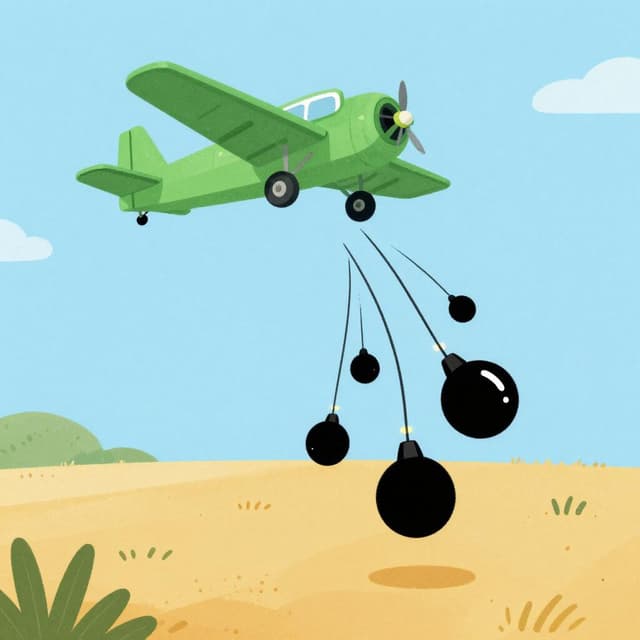
Koniugacja bombardear Czas przeszły prosty
bombardear — to bomb
Use preterite like 'bombardeé' for completed actions, e.g., 'bombardeamos la fortaleza'.
Formy bombardear Czas przeszły prosty
Kiedy używać Czas przeszły prosty
The preterite is for actions that started and finished at a specific point in the past. Think of a single event: 'Ayer bombardearon la ciudad' (Yesterday they bombed the city). It's about actions with a clear beginning and end.
Uwagi dotyczące bombardear w czasie Czas przeszły prosty
Bombardear is a regular -ar verb in the preterite. All the forms follow the standard conjugation pattern.
Przykładowe zdania
Ayer bombardearon el puesto de avanzada.
Yesterday they bombed the outpost.
ellos/ellas/ustedes
Yo bombardeé el objetivo desde lejos.
I bombed the target from afar.
yo
¿Tú bombardeaste el puente?
Did you bomb the bridge?
tú
Él bombardeó la zona con propaganda.
He bombed the area with propaganda.
él/ella/usted
Częste błędy
Błąd: Using the imperfect instead of the preterite for a single, completed action.
Poprawnie: For a specific past event like 'they bombed yesterday', use the preterite 'bombardearon'.
Dlaczego: The imperfect describes ongoing or habitual past actions, not single completed ones.
Błąd: Forgetting the accent on 'yo' and 'él/ella/usted' forms.
Poprawnie: Remember the accents: 'bombardeé' and 'bombardeó'.
Dlaczego: The accents are crucial for pronunciation and distinguishing forms.
Opanuj hiszpańskie czasowniki w kontekście
Zapamiętywanie tabel to dopiero początek. Przeczytaj ponad 200 ilustrowanych i udźwiękowionych hiszpańskich historii, aby zobaczyć czasowniki takie jak 'bombardear' używane naturalnie — w czasach, których się uczysz.
Powiązane czasy
Czas teraźniejszy
yo: bombardeo
Use present like 'bombardeo' for actions happening now or habitual actions.
Czas przeszły niedokonany
yo: bombardeaba
Use imperfect like 'bombardeaba' for ongoing or habitual past actions.
Czas przyszły
yo: bombardearé
Use future like 'bombardearé' for actions that will happen or to express probability.
Tryb warunkowy
yo: bombardearía
Use conditional like 'bombardearía' for hypotheticals ('would bomb') or polite requests.
Tryb Subj. teraźniejszy
yo: bombardee
Use present subjunctive like 'bombardee' after expressions of doubt, desire, or emotion.
Tryb Subj. przeszły niedokonany
yo: bombardeara
Use imperfect subjunctive like 'bombeara' or 'bombearase' for past hypotheticals or wishes.
Tryb rozkazujący (twierdzący)
yo: bombardea
Use imperative forms like 'bombardea' (tú) for direct commands, remembering 'bombardead' for vosotros.
Tryb rozkazujący (przeczący)
yo: no bombardees
Form negative commands using 'no' plus the present subjunctive, like 'no bombees' (tú).