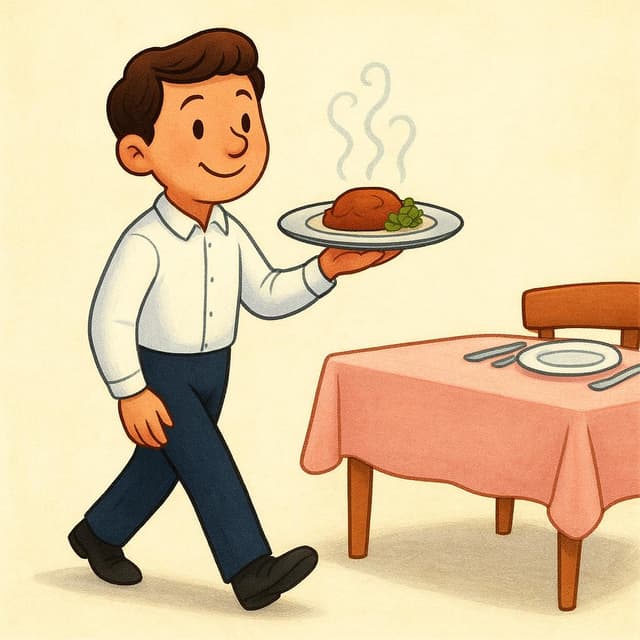
Koniugacja servir Tryb rozkazujący (twierdzący)
servir — to serve
Use 'sirve' (tú) or 'sirva' (usted) to tell someone to serve or function.
Formy servir Tryb rozkazujący (twierdzący)
Kiedy używać Tryb rozkazujący (twierdzący)
Use commands to tell a waiter what to do or to tell a friend to serve the drinks at a party.
Uwagi dotyczące servir w czasie Tryb rozkazujący (twierdzący)
The 'tú' form uses the present indicative 'sirve'. The 'usted' and 'ustedes' forms use the subjunctive 'sirva/sirvan'.
Przykładowe zdania
Sirve el vino ahora, por favor.
Serve the wine now, please.
tú
Sirva la sopa mientras está caliente.
Serve the soup while it's hot.
usted
Częste błędy
Błąd: serve
Poprawnie: sirve
Dlaczego: The informal command (tú) still requires the e > i stem change.
Opanuj hiszpańskie czasowniki w kontekście
Zapamiętywanie tabel to dopiero początek. Przeczytaj ponad 200 ilustrowanych i udźwiękowionych hiszpańskich historii, aby zobaczyć czasowniki takie jak 'servir' używane naturalnie — w czasach, których się uczysz.
Powiązane czasy
Czas teraźniejszy
yo: sirvo
Servir is a stem-changer (e > i) in all forms except nosotros and vosotros.
Czas przeszły prosty
yo: serví
Servir has a 'slipper' stem change (e > i) in the third-person forms: sirvió and sirvieron.
Czas przeszły niedokonany
yo: servía
Servir is regular in the imperfect: servía, servías, servía, servíamos, servíais, servían.
Czas przyszły
yo: serviré
Servir is completely regular in the future tense; just add the endings to the infinitive.
Tryb warunkowy
yo: serviría
The conditional of servir is regular: serviría, servirías, serviría, serviríamos, serviríais, servirían.
Tryb Subj. teraźniejszy
yo: sirva
Servir changes e > i in all forms of the present subjunctive, including nosotros.
Tryb Subj. przeszły niedokonany
yo: sirviera
The imperfect subjunctive is based on the 'sirvieron' stem: sirviera, sirvieras, sirviera...
Tryb rozkazujący (przeczący)
yo: no sirvas
Negative commands use 'no' + the present subjunctive: no sirvas, no sirva.