Koniugacja batir Czas przeszły niedokonany
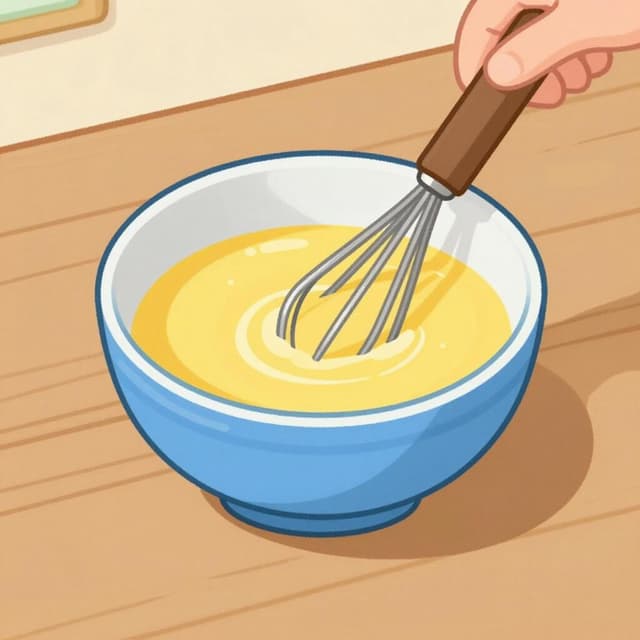
batir — to whisk
The imperfect 'batía' describes ongoing or habitual past whisking actions.
Formy batir Czas przeszły niedokonany
Kiedy używać Czas przeszły niedokonany
Use the imperfect of 'batir' to describe actions that were happening repeatedly or continuously in the past, or to set the scene. For instance, 'My mom always whisked the sauce while cooking' or 'He was whisking eggs when the phone rang'.
Uwagi dotyczące batir w czasie Czas przeszły niedokonany
'Batir' is regular in the imperfect indicative tense. The conjugations are formed by taking the stem 'bati-' and adding the standard imperfect endings for -ir verbs.
Przykładowe zdania
Cuando era niño, mi abuelo batía el chocolate cada mañana.
When I was a child, my grandfather whisked chocolate every morning.
él/ella/usted
Yo batía la crema cuando sonó el teléfono.
I was whisking the cream when the phone rang.
yo
¿Tú batías mucho las claras para los pasteles?
Did you often whisk the egg whites for the cakes?
tú
Ellos batían la mezcla lentamente.
They were whisking the mixture slowly.
ellos/ellas/ustedes
Częste błędy
Błąd: Using the preterite 'batió' for a habitual past action.
Poprawnie: For habits like 'He always whisked...', use 'Él batía...', not 'Él batió...'.
Dlaczego: The imperfect describes ongoing or repeated actions in the past, while the preterite describes single, completed events.
Błąd: Confusing the imperfect 'batía' (yo/él/ella/usted) with 'batías' (tú).
Poprawnie: Ensure you use the correct ending for the subject: 'batía' for yo/él/ella/usted and 'batías' for tú.
Dlaczego: These are distinct forms and must match the subject of the sentence.
Opanuj hiszpańskie czasowniki w kontekście
Zapamiętywanie tabel to dopiero początek. Przeczytaj ponad 200 ilustrowanych i udźwiękowionych hiszpańskich historii, aby zobaczyć czasowniki takie jak 'batir' używane naturalnie — w czasach, których się uczysz.
Powiązane czasy
Czas teraźniejszy
yo: bato
The present tense 'bato', 'bates', 'bate' describes current actions or habits.
Czas przeszły prosty
yo: batí
The preterite of 'batir' is regular: batí, batiste, batió, batimos, batisteis, batieron.
Czas przyszły
yo: batiré
The future tense 'batiré', 'batirás', 'batirá' indicates actions that will happen.
Tryb warunkowy
yo: batiría
The conditional 'batiría' suggests hypothetical actions ('would whisk').
Tryb Subj. teraźniejszy
yo: bata
Use 'bata' (yo/él/ella/usted) or 'batan' (ellos/ellas/ustedes) for wishes, doubts, and emotions.
Tryb Subj. przeszły niedokonany
yo: batiera
The imperfect subjunctive 'batiera' or 'batiese' is used for past hypotheticals or wishes.
Tryb rozkazujący (twierdzący)
yo: bate
Use the imperative 'batir' forms for direct commands like 'bate' (tú) or 'batan' (ustedes).
Tryb rozkazujący (przeczący)
yo: no batas
Negative commands like 'no batas' (tú) use the present subjunctive with 'no'.