Koniugacja enfriar Tryb rozkazujący (twierdzący)
enfriar — to cool
Use 'enfriar' imperative for direct commands like 'enfría' (you, informal) or 'enfríe' (you, formal).
Formy enfriar Tryb rozkazujący (twierdzący)
Kiedy używać Tryb rozkazujący (twierdzący)
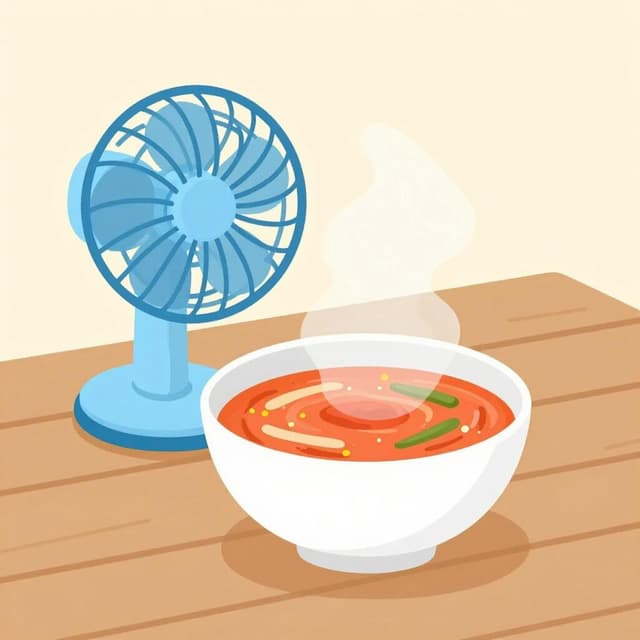
The imperative mood is for giving direct commands or making requests. For 'enfriar', you might tell someone to cool something down, like 'Enfría el café' (Cool the coffee down) or 'Enfríen la sopa' (Cool the soup down).
Uwagi dotyczące enfriar w czasie Tryb rozkazujący (twierdzący)
The verb 'enfriar' is regular in the affirmative imperative, except for the tú form which drops the 'i' from the stem: 'enfría'. The vosotros form is regular: 'enfriad'.
Przykładowe zdania
Enfría la bebida, por favor.
Cool the drink down, please.
tú
Enfriemos la habitación antes de que lleguen.
Let's cool the room down before they arrive.
nosotros
Ustedes, enfríen el pastel antes de decorarlo.
You all, cool the cake down before decorating it.
ustedes
Enfriad bien la cerveza.
Cool the beer down well.
vosotros
Częste błędy
Błąd: Using the subjunctive instead of the imperative for tú: 'No enfríes' instead of 'Enfría'.
Poprawnie: For affirmative commands, use the imperative form 'Enfría'. For negative commands, use the subjunctive 'no enfríes'.
Dlaczego: Learners sometimes confuse affirmative and negative command structures, especially with tú.
Błąd: Forgetting the accent on 'enfría' (tú form).
Poprawnie: The tú command form is 'enfría' with an accent on the 'i'.
Dlaczego: The accent is necessary to indicate stress on the final syllable.
Opanuj hiszpańskie czasowniki w kontekście
Zapamiętywanie tabel to dopiero początek. Przeczytaj ponad 200 ilustrowanych i udźwiękowionych hiszpańskich historii, aby zobaczyć czasowniki takie jak 'enfriar' używane naturalnie — w czasach, których się uczysz.
Powiązane czasy
Czas teraźniejszy
yo: enfrío
The present tense of 'enfriar' ('enfrío', 'enfrías', 'enfría') describes actions happening now or habitual cooling.
Czas przeszły prosty
yo: enfrié
The preterite of 'enfriar' is regular: 'enfrié', 'enfriaste', 'enfrió', 'enfriamos', 'enfriasteis', 'enfriaron'.
Czas przeszły niedokonany
yo: enfriaba
The imperfect of 'enfriar' ('enfriaba', 'enfriabas', 'enfriaba') describes ongoing or habitual cooling in the past.
Czas przyszły
yo: enfriaré
The future tense of 'enfriar' ('enfriaré', 'enfriarás', 'enfriará') indicates actions that will happen.
Tryb warunkowy
yo: enfriaría
The conditional of 'enfriar' ('enfriaría', 'enfriarías', 'enfriaría') is used for hypotheticals ('would cool') and polite requests.
Tryb Subj. teraźniejszy
yo: enfríe
The present subjunctive of 'enfriar' (like 'enfríe' or 'enfríen') is used after expressions of doubt, desire, or emotion.
Tryb Subj. przeszły niedokonany
yo: enfriara
Use the imperfect subjunctive of 'enfriar' (like 'enfriara' or 'enfriase') for past hypotheticals or wishes.
Tryb rozkazujący (przeczący)
yo: no enfríes
Negative commands with 'enfriar' use 'no' plus the present subjunctive, like 'no enfríes' (you, informal).