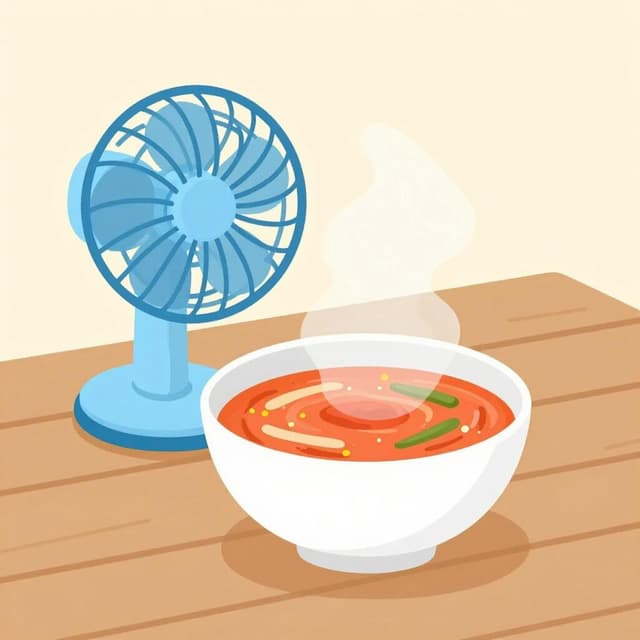
Koniugacja enfriar Tryb Subj. teraźniejszy
enfriar — to cool
The present subjunctive of 'enfriar' (like 'enfríe' or 'enfríen') is used after expressions of doubt, desire, or emotion.
Formy enfriar Tryb Subj. teraźniejszy
Kiedy używać Tryb Subj. teraźniejszy
You'll use the present subjunctive of 'enfriar' after phrases that express wishes, doubts, emotions, or uncertainty. For instance, 'Espero que el clima se enfríe pronto' (I hope the weather cools down soon) or 'Dudo que se enfríe a tiempo' (I doubt it will cool down in time).
Uwagi dotyczące enfriar w czasie Tryb Subj. teraźniejszy
The verb 'enfriar' is regular in the present subjunctive. It follows the standard pattern for -ar verbs, where the stem vowel changes in the present indicative but not in the subjunctive, except for the nosotros form which is the same as the indicative.
Przykładowe zdania
Espero que la sopa se enfríe rápido.
I hope the soup cools down quickly.
él/ella/usted
No creo que el ambiente se enfríe hoy.
I don't think the atmosphere will cool down today.
él/ella/usted
Queremos que ustedes se enfríen un poco.
We want you all to cool down a bit.
Ojalá enfriemos la casa antes de que lleguen.
Hopefully, we cool the house down before they arrive.
nosotros
Częste błędy
Błąd: Using the indicative instead of the subjunctive after expressions of doubt or desire.
Poprawnie: After verbs like 'esperar', 'dudar', 'querer', use the subjunctive: 'Espero que se enfríe', not 'Espero que se enfría'.
Dlaczego: These trigger phrases require the subjunctive mood to express uncertainty or desire.
Błąd: Forgetting the accent on 'enfríe' (yo/él/ella/usted form).
Poprawnie: The accent on the 'i' is necessary: 'enfríe'.
Dlaczego: The accent indicates the correct pronunciation and differentiates it from other forms.
Opanuj hiszpańskie czasowniki w kontekście
Zapamiętywanie tabel to dopiero początek. Przeczytaj ponad 200 ilustrowanych i udźwiękowionych hiszpańskich historii, aby zobaczyć czasowniki takie jak 'enfriar' używane naturalnie — w czasach, których się uczysz.
Powiązane czasy
Czas teraźniejszy
yo: enfrío
The present tense of 'enfriar' ('enfrío', 'enfrías', 'enfría') describes actions happening now or habitual cooling.
Czas przeszły prosty
yo: enfrié
The preterite of 'enfriar' is regular: 'enfrié', 'enfriaste', 'enfrió', 'enfriamos', 'enfriasteis', 'enfriaron'.
Czas przeszły niedokonany
yo: enfriaba
The imperfect of 'enfriar' ('enfriaba', 'enfriabas', 'enfriaba') describes ongoing or habitual cooling in the past.
Czas przyszły
yo: enfriaré
The future tense of 'enfriar' ('enfriaré', 'enfriarás', 'enfriará') indicates actions that will happen.
Tryb warunkowy
yo: enfriaría
The conditional of 'enfriar' ('enfriaría', 'enfriarías', 'enfriaría') is used for hypotheticals ('would cool') and polite requests.
Tryb Subj. przeszły niedokonany
yo: enfriara
Use the imperfect subjunctive of 'enfriar' (like 'enfriara' or 'enfriase') for past hypotheticals or wishes.
Tryb rozkazujący (twierdzący)
yo: enfría
Use 'enfriar' imperative for direct commands like 'enfría' (you, informal) or 'enfríe' (you, formal).
Tryb rozkazujący (przeczący)
yo: no enfríes
Negative commands with 'enfriar' use 'no' plus the present subjunctive, like 'no enfríes' (you, informal).