Koniugacja enfriar Czas teraźniejszy
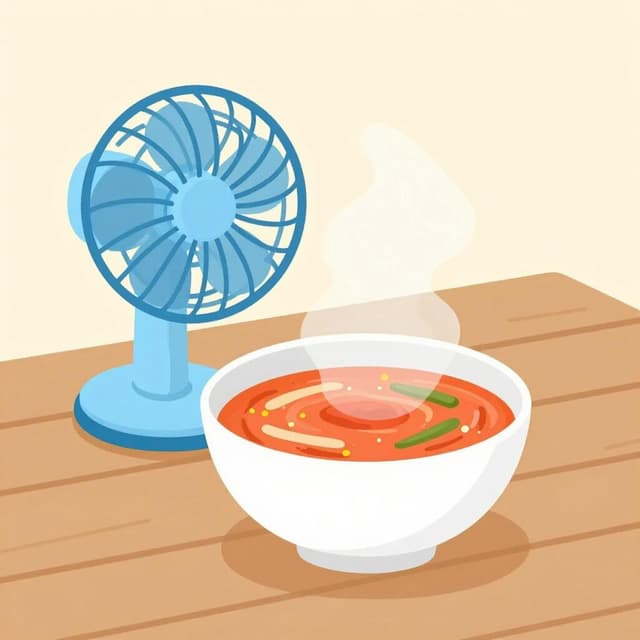
enfriar — to cool
The present tense of 'enfriar' ('enfrío', 'enfrías', 'enfría') describes actions happening now or habitual cooling.
Formy enfriar Czas teraźniejszy
Kiedy używać Czas teraźniejszy
Use the present tense of 'enfriar' for actions happening right now, habitual actions, or general truths related to cooling. For example, 'El sol enfría la calle' (The sun cools the street - maybe a bit counterintuitive, but possible in specific contexts like evaporative cooling) or 'Me enfrío fácilmente' (I get cold easily - reflexive use).
Uwagi dotyczące enfriar w czasie Czas teraźniejszy
The verb 'enfriar' is regular in the present indicative. All forms follow the standard -ar conjugation pattern.
Przykładowe zdania
El aire acondicionado enfría la habitación.
The air conditioning cools the room.
él/ella/usted
Me enfrío si no me pongo un suéter.
I get cold if I don't put on a sweater.
yo
Enfriamos la comida antes de guardarla.
We cool the food down before storing it.
nosotros
¿Ustedes enfrían la cerveza en el sótano?
Do you all cool the beer down in the basement?
ellos/ellas/ustedes
Częste błędy
Błąd: Using the present tense for a completed past action.
Poprawnie: For completed past actions, use the preterite: 'Enfrié la sopa' (I cooled the soup), not 'Enfrío la sopa'.
Dlaczego: The present tense describes current or habitual actions, not finished ones.
Błąd: Forgetting the accent on 'enfrías' (tú form) and 'enfría' (él/ella/usted form).
Poprawnie: The correct forms are 'enfrías' and 'enfría', both with accents on the 'i'.
Dlaczego: The accent indicates the stressed syllable, which is crucial for correct pronunciation and spelling.
Opanuj hiszpańskie czasowniki w kontekście
Zapamiętywanie tabel to dopiero początek. Przeczytaj ponad 200 ilustrowanych i udźwiękowionych hiszpańskich historii, aby zobaczyć czasowniki takie jak 'enfriar' używane naturalnie — w czasach, których się uczysz.
Powiązane czasy
Czas przeszły prosty
yo: enfrié
The preterite of 'enfriar' is regular: 'enfrié', 'enfriaste', 'enfrió', 'enfriamos', 'enfriasteis', 'enfriaron'.
Czas przeszły niedokonany
yo: enfriaba
The imperfect of 'enfriar' ('enfriaba', 'enfriabas', 'enfriaba') describes ongoing or habitual cooling in the past.
Czas przyszły
yo: enfriaré
The future tense of 'enfriar' ('enfriaré', 'enfriarás', 'enfriará') indicates actions that will happen.
Tryb warunkowy
yo: enfriaría
The conditional of 'enfriar' ('enfriaría', 'enfriarías', 'enfriaría') is used for hypotheticals ('would cool') and polite requests.
Tryb Subj. teraźniejszy
yo: enfríe
The present subjunctive of 'enfriar' (like 'enfríe' or 'enfríen') is used after expressions of doubt, desire, or emotion.
Tryb Subj. przeszły niedokonany
yo: enfriara
Use the imperfect subjunctive of 'enfriar' (like 'enfriara' or 'enfriase') for past hypotheticals or wishes.
Tryb rozkazujący (twierdzący)
yo: enfría
Use 'enfriar' imperative for direct commands like 'enfría' (you, informal) or 'enfríe' (you, formal).
Tryb rozkazujący (przeczący)
yo: no enfríes
Negative commands with 'enfriar' use 'no' plus the present subjunctive, like 'no enfríes' (you, informal).