corazones
“corazones” means “hearts” in Spanish. It has 2 different meanings depending on context:

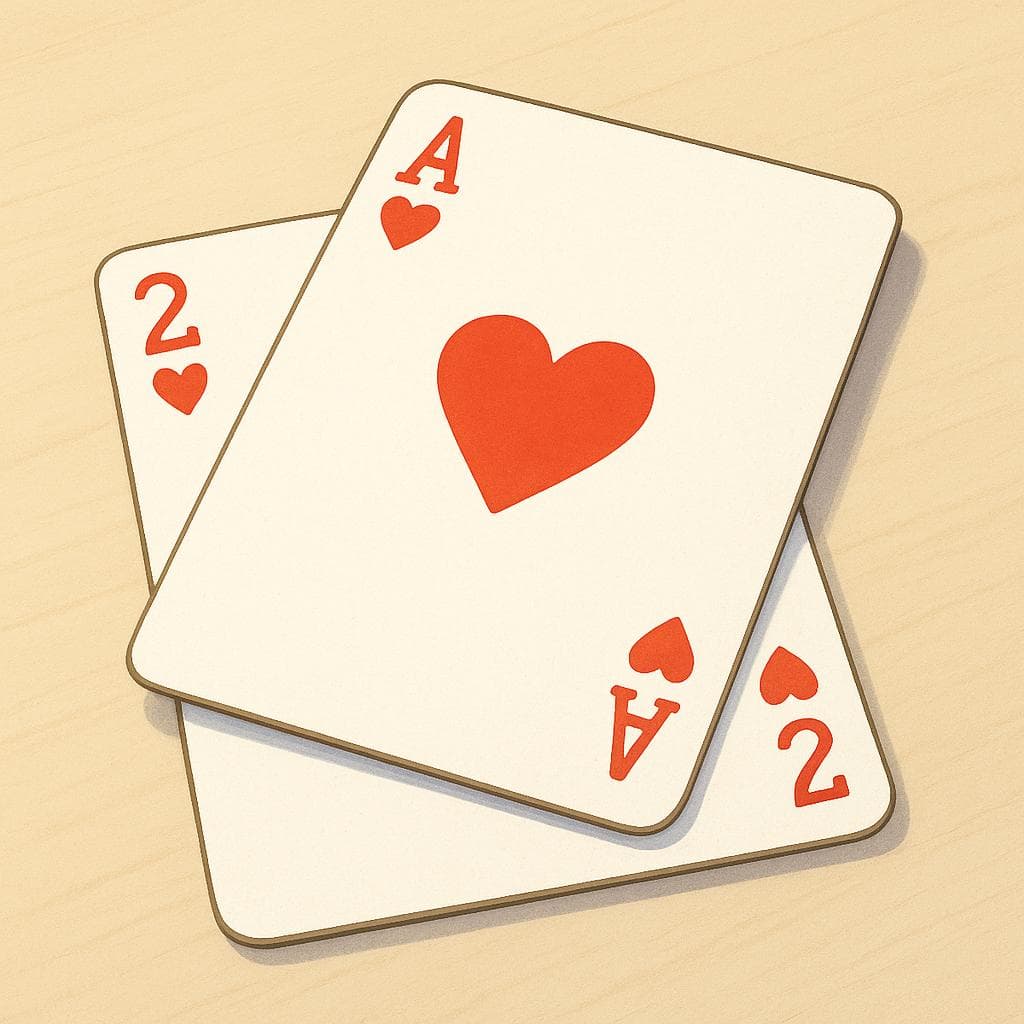
hearts
Also: feelings
📝 In Action
Los corazones de los niños latían con emoción.
A1The children's hearts were beating with excitement.
Debemos escuchar a nuestros corazones cuando tomamos decisiones importantes.
A2We must listen to our hearts when making important decisions.
hearts

📝 In Action
Me faltan tres cartas de corazones para completar la escalera.
B1I'm missing three hearts cards to complete the straight.
La reina de corazones es una carta muy valiosa en este juego.
B1The Queen of Hearts is a very valuable card in this game.
✏️ Quick Practice
Quick Quiz: corazones
Question 1 of 1
Which sentence uses 'corazones' to refer to a card game?
📚 More Resources
👥 Word Family▼
📚 Etymology▼
The word comes from the Latin word *cor*, which means 'heart.' It passed through Old Spanish, where it gained the ending that gives us 'corazón' and, eventually, the plural 'corazones.'
First recorded: Before 10th century
Cognates (Related words)
💡 Master Spanish
Take your Spanish to the next level. Read 200+ illustrated and narrated Spanish stories tailored to your level with the Inklingo app!
Frequently Asked Questions
Why is 'corazones' masculine if it ends in '-es'?
The gender is determined by the singular form, 'corazón.' Most Spanish nouns ending in '-ón' are masculine (like 'camión' or 'limón'). This pattern is kept even when making it plural ('los corazones').
¿Es 'corazones' un sustantivo contable o incontable?
It is generally a countable noun. You can count physical hearts (dos corazones) or symbolic hearts (mil corazones). You can use it in the plural easily.