Inklingo

entienda

/en-tyén-da/

(that) I understand

A person standing alone, looking thoughtful, with a bright, glowing lightbulb appearing directly above their head, representing a moment of sudden understanding.

Visualizing the sense of 'that I understand' (entienda) with a character experiencing a sudden realization symbolized by a lightbulb illuminating above them.

entienda(Verb)

B1irregular (e > ie stem change in present forms) er

(that) I understand

?

First person singular present subjunctive

,

(that) he/she/it understands

?

Third person singular present subjunctive

,

(that) you understand (formal)

?

Usted present subjunctive

Also:

(that) I/he/she gets it

?

Informal comprehension

📝 In Action

Dudo que ella entienda la lección tan rápido.

B1

I doubt that she understands the lesson so quickly.

Espero que usted entienda la importancia de este proyecto.

B2

I hope that you (formal) understand the importance of this project.

Aunque yo no entienda el chiste, me reiré por cortesía.

B1

Even if I don't understand the joke, I will laugh out of politeness.

Word Connections

Synonyms

  • comprenda ((that he/she) comprehends)

Antonyms

  • confunda ((that he/she) confuses)

Common Collocations

  • No creo que entiendaI don't think he/she understands

💡 Grammar Points

Using 'Entienda' for Feelings

'Entienda' is the special form (subjunctive) you must use after words that express feelings, wishes, or doubt, like 'espero que' (I hope that) or 'dudo que' (I doubt that).

The Stem Change

The verb 'entender' is irregular. The 'e' in the middle changes to 'ie' in most present forms, including 'entienda', but not in the 'we' (nosotros) form: 'entendamos'.

❌ Common Pitfalls

Mixing up moods

Mistake: "Espero que usted entiende la regla."

Correction: Espero que usted entienda la regla. (When expressing hope or desire, the second verb must change form.)

⭐ Usage Tips

The 'WEIRDO' Rule

Use 'entienda' when the sentence involves Wishes, Emotions, Impersonal expressions, Requests, Doubt, or Ojalá (WEIRDO). These trigger the special verb form.

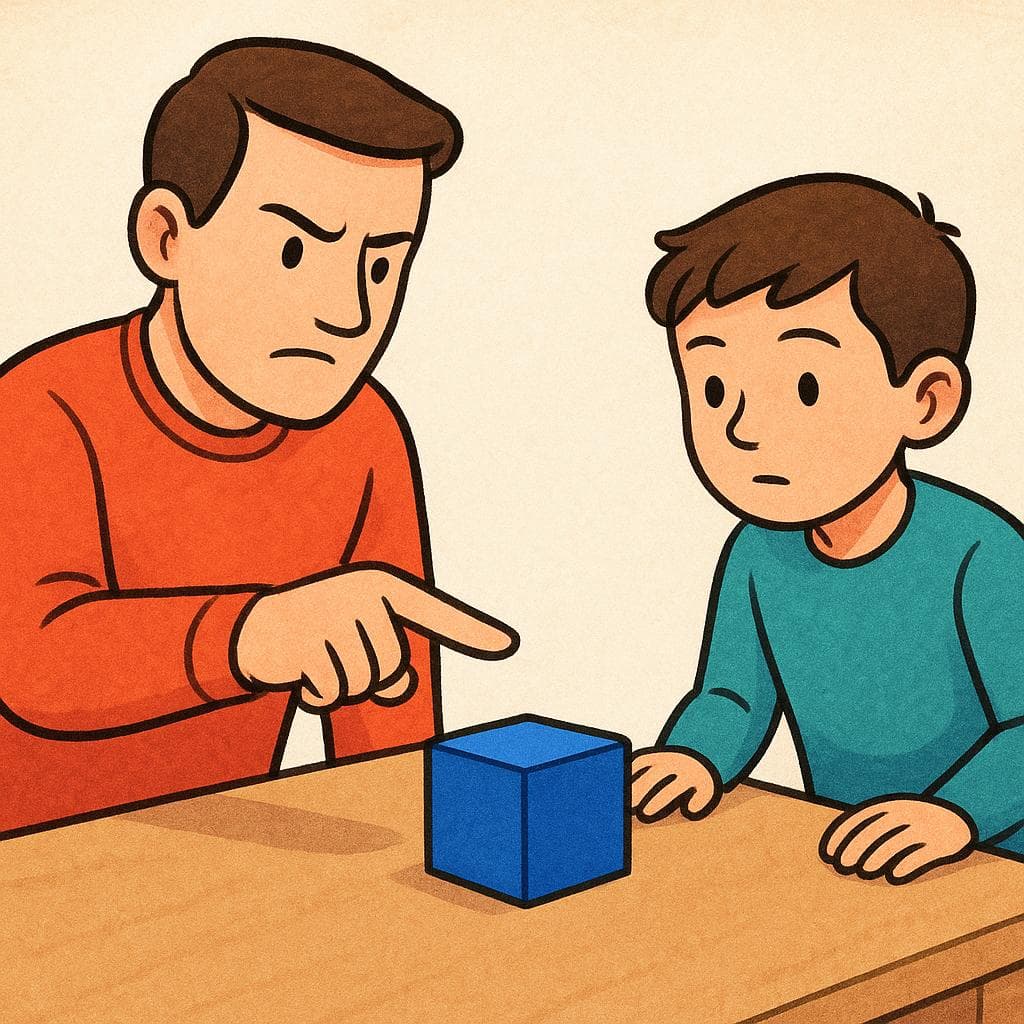
An adult figure giving a firm instruction by pointing clearly at a simple colored block on a table, while another figure leans in attentively to receive the command.

This image captures the formal command 'Understand!' (¡Entienda!), showing one person instructing another decisively and demanding attention.

entienda(Verb)

A2irregular (e > ie stem change) er

Understand!

?

Formal command (Usted)

Also:

Please grasp this

?

Polite request

📝 In Action

Señora, entienda que no podemos hacer una excepción.

A2

Madam, understand that we cannot make an exception.

Entienda bien esta parte antes de continuar.

B1

Understand this part well before continuing.

No entienda mal mis palabras; solo estoy siendo honesto.

B2

Don't misunderstand my words; I am just being honest.

Word Connections

Common Collocations

  • Entienda mi situaciónUnderstand my situation

💡 Grammar Points

Formal Commands

To give a polite command to someone you call 'Usted' (formal 'you'), you use the same form as the present subjunctive: 'entienda'. If you were speaking informally ('tú'), you would say 'entiende'.

Negative Commands

To tell someone formally not to do something, you also use 'entienda': 'No entienda eso' (Don't understand that).

❌ Common Pitfalls

Using the wrong 'you'

Mistake: "Señor, entiende la regla."

Correction: Señor, entienda la regla. (Since 'Señor' requires the formal Usted, use 'entienda', not the informal 'entiende'.)

⭐ Usage Tips

Politeness Key

Whenever you need to be professional or polite (using Usted), remember that 'entienda' is the correct way to issue a direct command or instruction.

🔄 Conjugations

indicative

present

él/ella/ustedentiende
yoentiendo
entiendes
ellos/ellas/ustedesentienden
nosotrosentendemos
vosotrosentendéis

imperfect

él/ella/ustedentendía
yoentendía
entendías
ellos/ellas/ustedesentendían
nosotrosentendíamos
vosotrosentendíais

preterite

él/ella/ustedentendió
yoentendí
entendiste
ellos/ellas/ustedesentendieron
nosotrosentendimos
vosotrosentendisteis

subjunctive

present

él/ella/ustedentienda
yoentienda
entiendas
ellos/ellas/ustedesentiendan
nosotrosentendamos
vosotrosentendáis

imperfect

él/ella/ustedentendiera
yoentendiera
entendieras
ellos/ellas/ustedesentendieran
nosotrosentendiéramos
vosotrosentendierais

✏️ Quick Practice

💡 Quick Quiz: entienda

Question 1 of 2

Which sentence correctly uses 'entienda' as a formal command?

📚 More Resources

Word Family

entender(to understand (infinitive)) - verb

Frequently Asked Questions

Why is 'entienda' used for both 'I understand' and 'he/she understands'?

This is common in the Spanish special verb form (the present subjunctive). In this mood, the verb ending for 'yo' (I) and 'él/ella/usted' (he/she/formal you) is often the same. The context or the subject pronoun clarifies who is performing the action.

How do I know if 'entienda' is a command or a statement of doubt?

If 'entienda' is the very first word of the sentence, or is preceded only by the person being addressed (like 'Señor, entienda...'), it is almost always a formal command. If it follows a trigger phrase like 'Espero que...' (I hope that...) or 'Dudo que...' (I doubt that...), it is the special verb form expressing uncertainty.