
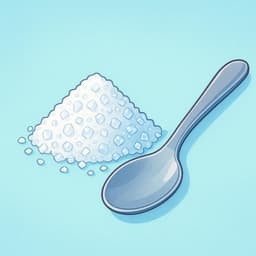
Using 'Libre de'
Mistake: “Saying 'libre de azúcar'.”
Correction: Use 'sin azúcar'.
seen ah-SOO-kar
This is the standard, most versatile way to express 'without sugar' in any Spanish-speaking country, whether you are reading a label or ordering a drink.

Always remember to say 'sin azúcar' when ordering fresh juice at a Latin American market!
seen NAH-dah deh ah-SOO-kar
Literally 'without any sugar,' this emphasizes that you want absolutely no sugar added.
ah-MAHR-go
This means 'bitter.' In the context of coffee or mate, it implies 'without sugar.'
no leh POHN-gahs ah-SOO-kar
This is a direct instruction meaning 'don't put sugar in it.'
SEH-roh ah-SOO-kar
Literally 'zero sugar.' It is very common in branding and marketing.
seen ah-SOO-kar ah-nyah-DEE-dah
This means 'no added sugar,' meaning the product contains only natural sugars.
Different ways to ask for sugar-free options depending on what you are consuming.
| Phrase | Formality | Best For | Avoid When |
|---|---|---|---|
| Sin azúcar | Neutral | General use, restaurants, and labels. | Never; it's always safe. |
| Amargo | Casual | Coffee, tea, and mate. | Ordering food or sodas. |
| Sin azúcar añadida | Formal | Reading labels or health stores. | Casual conversation with friends. |
The 'z' and 'u' accent are the only tricky parts, but it's very phonetic.
A simple prepositional phrase; no complex verbs required.
Important because of how common pre-sweetening is in Latin America.
Un café negro, sin azúcar, por favor.
A black coffee, without sugar, please.
¿Tienen algún postre que sea sin azúcar?
Do you have any dessert that is sugar-free?
Prefiero el mate amargo.
I prefer my mate unsweetened (bitter).
Este jugo es natural, sin azúcar añadida.
This juice is natural, with no added sugar.
In many Latin American countries, fresh fruit juices (jugos naturales) are often blended with a significant amount of sugar by default. If you want the pure fruit taste, you must say 'sin azúcar' as you order, or they will likely sweeten it for you.
In the Southern Cone (Argentina, Uruguay, Paraguay), 'mate' is a social ritual. Drinking it 'amargo' (bitter) is seen as the traditional way. If you prefer it 'dulce' (sweet), you might get some playful teasing from purists!
When you order coffee in Spain, it's usually served with a small packet of sugar on the side. You don't always need to specify 'sin azúcar' when ordering unless the coffee is pre-made (like a café con leche from a machine).
Mistake: “Saying 'libre de azúcar'.”
Correction: Use 'sin azúcar'.
Mistake: “Saying 'no quiero dulce'.”
Correction: Say 'sin azúcar'.
Remember that in Latin America, the 'z' in azúcar sounds like an 's' (ah-SOO-kar), but in most of Spain, it sounds like a 'th' (ah-THOO-kar).
If you don't want sugar but want a sweetener, ask for 'edulcorante' (e-duhl-koh-RAHN-teh) or specific brands like 'Stevia'.
Uses the 'distinción' (lisp-like sound for Z). Coffee is usually served with sugar packets, so specifying 'sin azúcar' is less urgent than in Latin America.
Vital for ordering 'aguas frescas' if you want to avoid the heavy syrup they often add.
The word 'amargo' is a badge of honor for mate drinkers. 'Cimarrón' is a very traditional/rural word for unsweetened mate.
¿Desea algún edulcorante?
Would you like some sweetener?
No, gracias, así está bien.
No thanks, it's fine like this.
Remember 'Sin' = 'Subtracting'. S-I-N starts with 'S' just like 'Subtracting'. You are subtracting the sugar!
Commonly used with coffee alongside 'sin azúcar'.
The next step if you want a sugar substitute.
Useful for specific coffee orders.
Question 1 of 2
You are in Argentina and want to drink mate the traditional way, without any sugar. What do you say?
Knowing a phrase is one thing — using it at the right moment is another. Read 200+ illustrated and narrated Spanish stories to see phrases in the contexts where they actually belong.
Both are actually accepted! 'El azúcar' is more common in masculine form, but you will hear 'la azúcar' in many regions, especially in poetry or song lyrics.
You can ask for them by name, or use the general word 'edulcorante' (sweetener). For example: '¿Tiene edulcorante?'
Usually, you just say the name of the soda + 'Zero' or 'Light'. For example, 'Coca Light' or 'Coca Zero'.
Strengthen the grammar behind this phrase:
Dive deeper into related topics:
Find similar phrases to expand your Spanish vocabulary:
Browse our complete collection of Spanish phrases organized by situation, from basic greetings to advanced conversations. Perfect for travelers, students, and anyone learning Spanish.
View All Spanish Phrases →