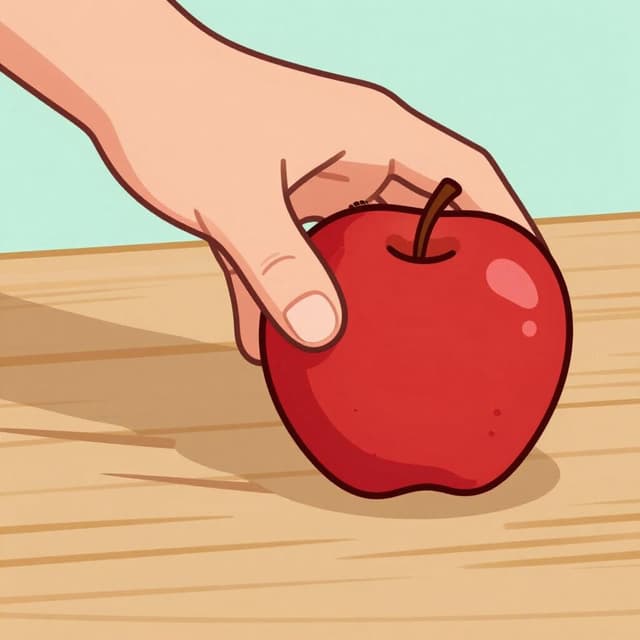
Koniugacja arrebatar Czas teraźniejszy
arrebatar — to snatch
Use present forms like 'arrebato' and 'arrebatan' for habitual actions or things happening now.
Formy arrebatar Czas teraźniejszy
Kiedy używać Czas teraźniejszy
This tense covers actions happening right now, general truths, or habits. For example, 'El viento arrebata las hojas' (The wind snatches the leaves) describes a current or habitual action.
Uwagi dotyczące arrebatar w czasie Czas teraźniejszy
Arrebatar is a regular -ar verb in the present indicative. All forms follow the standard conjugation pattern.
Przykładowe zdania
Yo arrebato el balón en cada partido.
I snatch the ball in every game.
yo
Ella arrebata la atención del público.
She snatches the audience's attention.
él/ella/usted
Los niños arrebatan los juguetes.
The children snatch the toys.
ellos/ellas/ustedes
¿Tú arrebatas las oportunidades?
Do you snatch opportunities?
tú
Częste błędy
Błąd: Using the present subjunctive when the indicative is needed.
Poprawnie: For factual statements or habits, use the present indicative forms like 'arrebato', 'arrebatas', 'arrebata'.
Dlaczego: The subjunctive is used for uncertainty, desire, etc., not for describing what actually happens.
Błąd: Incorrect endings for vosotros.
Poprawnie: The correct vosotros form is 'arrebatáis', ending in -áis.
Dlaczego: This is a common area of confusion for learners of -ar verbs.
Opanuj hiszpańskie czasowniki w kontekście
Zapamiętywanie tabel to dopiero początek. Przeczytaj ponad 200 ilustrowanych i udźwiękowionych hiszpańskich historii, aby zobaczyć czasowniki takie jak 'arrebatar' używane naturalnie — w czasach, których się uczysz.
Powiązane czasy
Czas przeszły prosty
yo: arrebaté
Use preterite forms like 'arrebaté' and 'arrebataron' for completed actions in the past.
Czas przeszły niedokonany
yo: arrebataba
Use imperfect forms like 'arrebataba' and 'arrebataban' for ongoing or habitual past actions.
Czas przyszły
yo: arrebataré
Use future forms like 'arrebataré' and 'arrebatarán' for actions that will happen.
Tryb warunkowy
yo: arrebataría
Use conditional forms like 'arrebataría' and 'arrebatarían' for hypothetical situations ('would').
Tryb Subj. teraźniejszy
yo: arrebate
Use present subjunctive forms like 'arrebate' and 'arrebaten' after expressions of doubt, desire, or emotion.
Tryb Subj. przeszły niedokonany
yo: arrebatara
Use imperfect subjunctive forms like 'arrebatara' or 'arrebatase' for past hypotheticals or wishes.
Tryb rozkazujący (twierdzący)
yo: arrebata
Use imperative forms like 'arrebata' and 'arrebatad' for direct commands.
Tryb rozkazujący (przeczący)
yo: no arrebates
Use negative commands like 'no arrebates' and 'no arrebaten' with the present subjunctive.