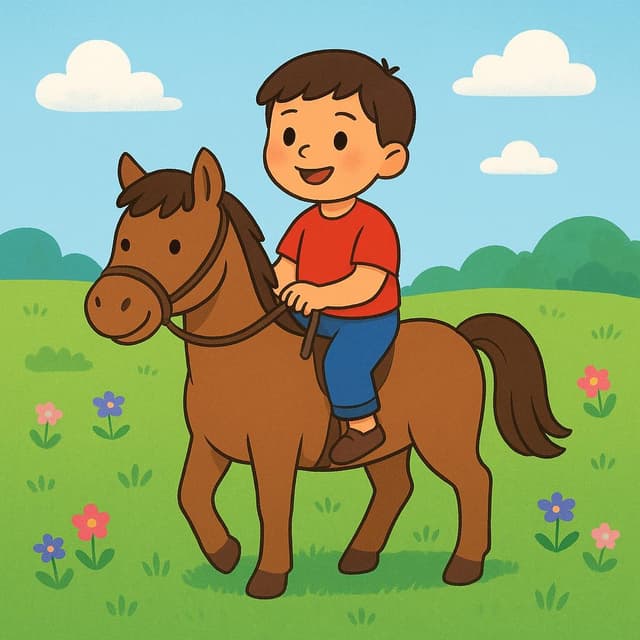
Koniugacja montar Czas przeszły prosty
montar — to ride
The preterite of montar describes completed actions like riding or assembling in the past.
Formy montar Czas przeszły prosty
Kiedy używać Czas przeszły prosty
Use the preterite tense of 'montar' to talk about a specific, completed action in the past. Think of it as a snapshot: you rode, you assembled, it happened and finished.
Uwagi dotyczące montar w czasie Czas przeszły prosty
Montar is regular in the preterite tense. The forms are 'monté', 'montaste', 'montó', 'montamos', 'montasteis', 'montaron'. Note that the 'nosotros' form is identical to the present tense, so context is key.
Przykładowe zdania
Ayer monté en bicicleta hasta el parque.
Yesterday I rode my bike to the park.
yo
¿Montaste a caballo cuando fuiste de vacaciones?
Did you ride horses when you went on vacation?
tú
Mi padre montó una tienda de campaña.
My father set up a tent.
él/ella/usted
Ellos montaron el escenario para el concierto.
They assembled the stage for the concert.
ellos/ellas/ustedes
Częste błędy
Błąd: Using the imperfect instead of the preterite for a single, completed action.
Poprawnie: For a specific event that finished, use the preterite: 'Monté la bicicleta' (I rode the bike) not 'Montaba la bicicleta' (I was riding/used to ride).
Dlaczego: The preterite marks completion, the imperfect describes ongoing or habitual past actions.
Błąd: Forgetting the accent on the 'yo' and 'él/ella/usted' forms.
Poprawnie: The accents are crucial: 'monté' and 'montó'.
Dlaczego: The accent distinguishes these preterite forms and indicates the stressed syllable.
Opanuj hiszpańskie czasowniki w kontekście
Zapamiętywanie tabel to dopiero początek. Przeczytaj ponad 200 ilustrowanych i udźwiękowionych hiszpańskich historii, aby zobaczyć czasowniki takie jak 'montar' używane naturalnie — w czasach, których się uczysz.
Powiązane czasy
Czas teraźniejszy
yo: monto
The present tense of montar describes habitual actions, things happening now, or general truths.
Czas przeszły niedokonany
yo: montaba
The imperfect tense of montar describes ongoing or habitual past actions.
Czas przyszły
yo: montaré
The future tense of montar expresses actions that will happen or probabilities.
Tryb warunkowy
yo: montaría
The conditional of montar expresses 'would' actions, polite requests, or future-in-the-past.
Tryb Subj. teraźniejszy
yo: monte
The present subjunctive of montar is used for wishes, doubts, and suggestions.
Tryb Subj. przeszły niedokonany
yo: montara
The imperfect subjunctive of montar expresses past doubts, wishes, or hypothetical situations.
Tryb rozkazujący (twierdzący)
yo: monta
Use the imperative of montar for direct commands like 'ride!' or 'let's ride!'.
Tryb rozkazujący (przeczący)
yo: no montes
Use 'no' + present subjunctive for negative commands with montar, like 'don't ride!'.