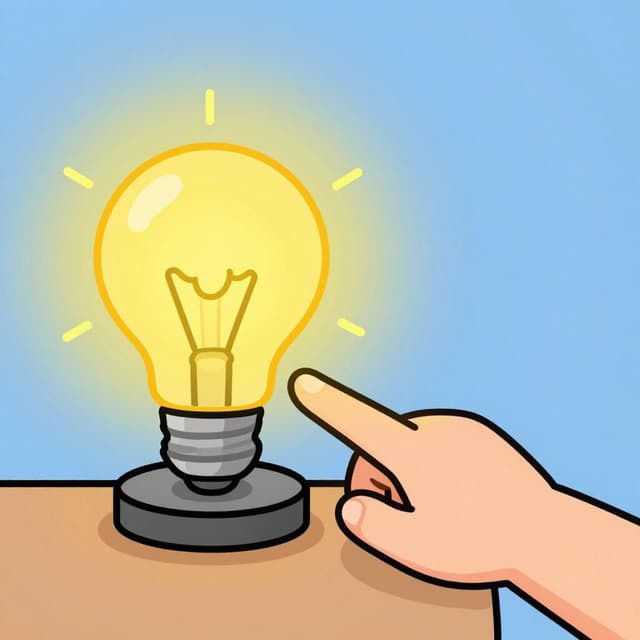
Koniugacja prender Czas teraźniejszy
prender — to turn on
Use 'prendo', 'prendes', 'prende' for actions happening now or habitually, like 'I turn on the TV'.
Formy prender Czas teraźniejszy
Kiedy używać Czas teraźniejszy
The present tense is your go-to for actions happening right now, habitual actions, or general truths. You'll use it to say 'I turn on my computer every morning,' 'He is turning on the fan,' or 'The light turns on automatically.'
Uwagi dotyczące prender w czasie Czas teraźniejszy
Prender is a regular -er verb in the present indicative. The only slight irregularity is that the stem doesn't change (e.g., like 'entender' becoming 'entiendo'). All forms follow the standard conjugation pattern.
Przykładowe zdania
Yo prendo la radio para escuchar las noticias.
I turn on the radio to listen to the news.
yo
¿Tú prendes el aire acondicionado cuando hace calor?
Do you turn on the air conditioning when it's hot?
tú
Ella prende el ordenador antes de empezar a trabajar.
She turns on the computer before starting to work.
él/ella/usted
Nosotros prendemos las luces al anochecer.
We turn on the lights at dusk.
nosotros
Częste błędy
Błąd: Using 'estar' + gerund for habitual actions: 'Yo estoy prendiendo la tele todos los días'.
Poprawnie: Use the simple present for habits: 'Yo prendo la tele todos los días'.
Dlaczego: The present progressive ('estar' + gerund) is for actions happening *right now*, not for routines.
Błąd: Confusing 'prende' (él/ella/usted) with 'prende' (tú imperative).
Poprawnie: The indicative is 'él/ella/usted prende', the command is 'tú prende'.
Dlaczego: They look the same but have different functions; context clarifies whether it's a statement or a command.
Opanuj hiszpańskie czasowniki w kontekście
Zapamiętywanie tabel to dopiero początek. Przeczytaj ponad 200 ilustrowanych i udźwiękowionych hiszpańskich historii, aby zobaczyć czasowniki takie jak 'prender' używane naturalnie — w czasach, których się uczysz.
Powiązane czasy
Czas przeszły prosty
yo: prendí
Use 'prendí', 'prendiste', 'prendió' for completed actions like 'I turned on the light'.
Czas przeszły niedokonany
yo: prendía
Use 'prendía' for ongoing or habitual past actions, like 'I used to turn on'.
Czas przyszły
yo: prenderé
Use 'prenderé', 'prenderás' for actions that will happen, like 'I will turn on'.
Tryb warunkowy
yo: prendería
Use 'prendería' for hypothetical situations, like 'I would turn on'.
Tryb Subj. teraźniejszy
yo: prenda
Use 'prenda' for wishes, doubts, or emotions, like 'I hope you turn on'.
Tryb Subj. przeszły niedokonany
yo: prendiera
Use 'prendiera' or 'prendiera' for past hypotheticals or wishes, like 'if I turned on'.
Tryb rozkazujący (twierdzący)
yo: prende
Use 'prende' for tú, 'prendan' for ustedes to command someone to turn something on.
Tryb rozkazujący (przeczący)
yo: no prendas
Use 'no prendas' for tú, 'no prendan' for ustedes to forbid someone from turning something on.