
Historical Present vs Preterite
Use the historical present to make a story feel like it's happening NOW. Use the preterite to report a past event that's finished.
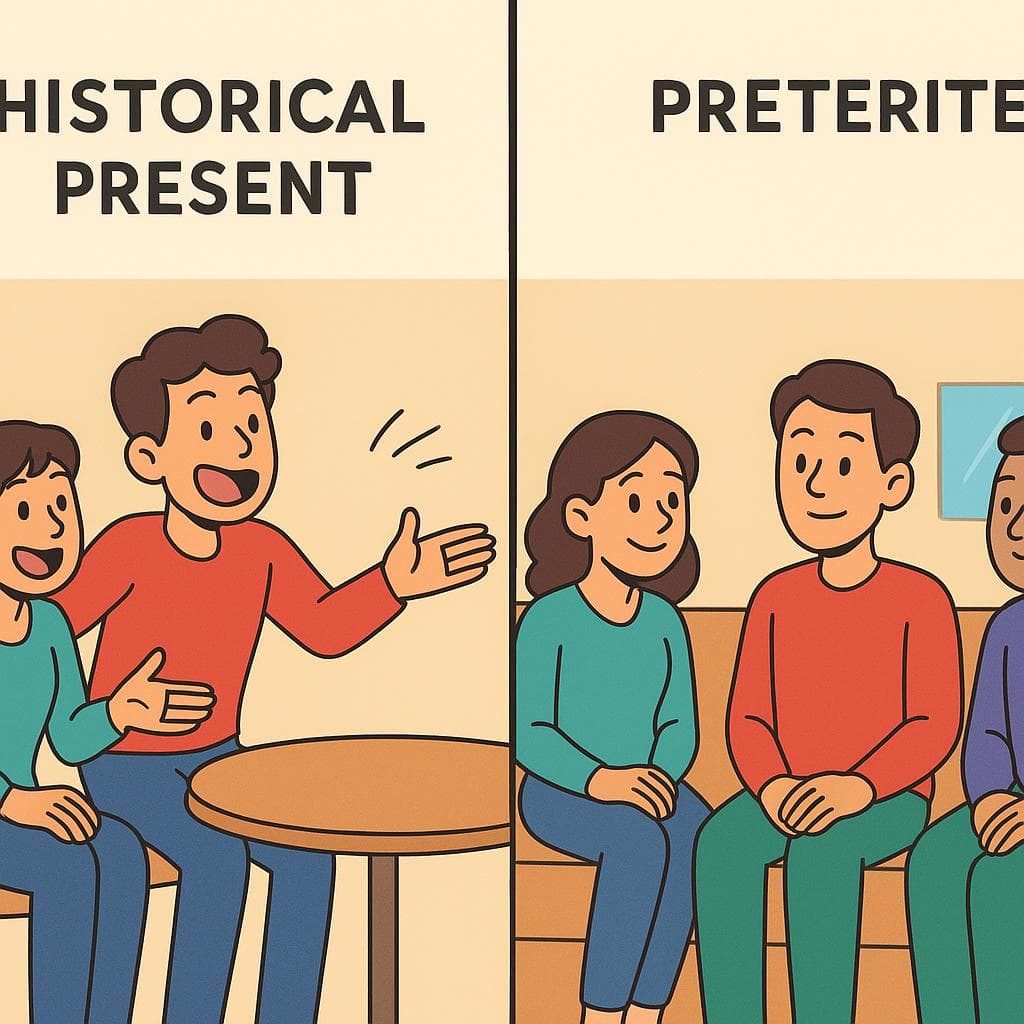
historical present
Using the present tense to talk about past events to make them feel more vivid and immediate.
preh-SEHN-teh ees-TOH-ree-kohpreterite
The standard past tense used for actions that were completed at a specific point in the past.
preh-TEH-ree-tohQuick Rule
Use the historical present to make a story feel like it's happening NOW. Use the preterite to report a past event that's finished.
Think: Historical Present = 'Live TV'. Preterite = 'History Book'.
- Only works in narrative contexts (storytelling, history, summaries). You can't use it to answer a simple question like 'What did you do yesterday?'
Comparison Table
| Context | historical present | preterite | Why? |
|---|---|---|---|
| Storytelling Style | Y entonces, el rey dice... | Y entonces, el rey dijo... | Historical present makes you feel like you're there. Preterite reports what happened. |
| Historical Fact | En 1808, Napoleón invade España. | En 1808, Napoleón invadió España. | Historical present is common in textbooks to make history feel dynamic. Preterite is a standard statement of fact. |
| Recounting a Personal Anecdote | Voy a la cocina y veo que el gato está en la mesa. | Fui a la cocina y vi que el gato estaba en la mesa. | Historical present adds drama and immediacy to your story. Preterite is the default, neutral way to tell it. |
When to Use "historical present / preterite"
historical present
Using the present tense to talk about past events to make them feel more vivid and immediate.
preh-SEHN-teh ees-TOH-ree-koh
Vivid storytelling
Estaba caminando y de repente, ¡un perro sale de la nada!
I was walking and suddenly, a dog comes out of nowhere!
Narrating historical events
En 1492, Colón llega a América.
In 1492, Columbus arrives in the Americas.
Summarizing plots (books/movies)
Al final, el detective descubre la verdad.
In the end, the detective discovers the truth.
Newspaper headlines
El equipo local gana el campeonato.
Local Team Wins Championship.
preterite
The standard past tense used for actions that were completed at a specific point in the past.
preh-TEH-ree-toh
Reporting completed actions
Ayer un perro salió de la nada.
Yesterday a dog came out of nowhere.
Stating historical facts
En 1492, Colón llegó a América.
In 1492, Columbus arrived in the Americas.
Narrating a sequence of events
El detective investigó el caso y descubrió la verdad.
The detective investigated the case and discovered the truth.
Answering direct questions about the past
El equipo local ganó el campeonato el sábado.
The local team won the championship on Saturday.
Contrast Examples
With "historical present":
Llego a la oficina, abro mi email, y ¿qué veo? ¡Un mensaje de mi jefe! Me pide un informe para ya.
I get to the office, I open my email, and what do I see? A message from my boss! He asks me for a report immediately.
With "preterite":
Llegué a la oficina, abrí mi email y vi un mensaje de mi jefe. Me pidió un informe urgentemente.
I got to the office, opened my email, and saw a message from my boss. He asked me for a report urgently.
The Difference: The historical present (A) makes the story sound dramatic and stressful, like it's happening live. The preterite (B) is a standard, neutral report of what happened.
With "historical present":
El 20 de julio de 1969, el hombre pisa la luna por primera vez.
On July 20, 1969, man steps on the moon for the first time.
With "preterite":
El 20 de julio de 1969, el hombre pisó la luna por primera vez.
On July 20, 1969, man stepped on the moon for the first time.
The Difference: The historical present (A) is often used in documentaries or textbooks to make the event feel momentous and present. The preterite (B) is a simple statement of a historical fact.
Common Mistakes
Ayer como una pizza deliciosa.
Ayer comí una pizza deliciosa.
For a simple, one-off statement about the past, you must use the preterite. The historical present only works within a larger story or narrative.
Cuando era niño, juego en el parque.
Cuando era niño, jugaba en el parque.
Don't confuse the historical present with describing repeated past actions. For habits or ongoing situations in the past, use the imperfect tense ('jugaba'), not the present.
Quick Practice
Quick Quiz: Historical Present vs Preterite
Question 1 of 2
You are telling your friend a dramatic story about seeing a famous person yesterday. Which is the best choice to make it sound exciting?
Related Grammar
Want to understand the grammar behind this pair? Explore these lessons for a deep dive:
Preterite Tense (Regular Verbs)
Master the standard preterite before learning stylistic alternatives.
Preterite vs Imperfect Overview
The most fundamental past tense distinction to learn first.
Present Tense (Regular Verbs)
The historical present uses the simple present tense forms.
Key Words



Tags
Build the instinct, not just the rule
Rules help you get it right; context makes it automatic. Read 200+ illustrated and narrated Spanish stories to see confusing pairs chosen correctly — over and over — until you stop thinking about it.
Frequently Asked Questions
Can I mix the historical present and preterite in the same story?
Absolutely! It's very common. Writers often use the preterite and imperfect to set the scene, and then switch to the historical present for the peak action to make it more exciting. Then they might switch back to the preterite to conclude the story.
Is this used in formal writing or just casual speaking?
Both! It's a key feature of casual, engaging storytelling with friends. But it's also a respected literary device used in novels, and a standard convention in history books and news headlines to add a sense of immediacy.