
Imperative vs Subjunctive Commands
Use Imperative for positive 'tú' commands. Use Subjunctive for ALL negative and ALL formal commands.
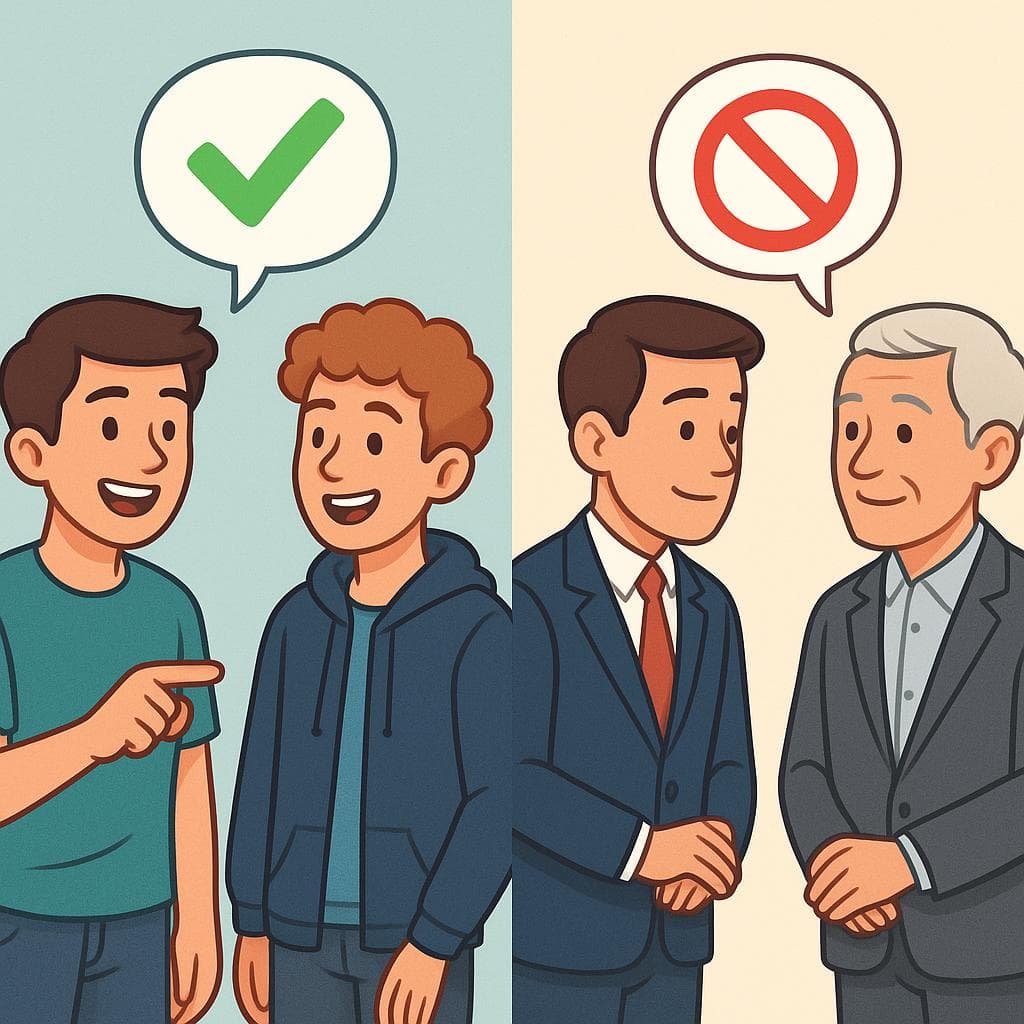
imperative
The 'true' imperative mood is used for giving direct, positive commands to someone you address as 'tú' (your friend, a family member).
Imperativosubjunctive
The subjunctive mood's forms are 'borrowed' to create all other commands: negative, formal (usted/ustedes), and 'we' commands.
SubjuntivoQuick Rule
Use Imperative for positive 'tú' commands. Use Subjunctive for ALL negative and ALL formal commands.
Positive Tú stands alone. All others (No, Formal, We) use the Subjunctive zone.
- The positive 'vosotros' command has its own unique form (e.g., ¡Hablad!), but it's mainly used in Spain.
- The positive 'nosotros' command (Let's...) also uses the subjunctive form (e.g., ¡Hablemos!).
Comparison Table
| Context | imperative | subjunctive | Why? |
|---|---|---|---|
| Informal 'Tú' Command | ¡Come la verdura! | ¡No comas la verdura! | Positive 'tú' uses the imperative. Negative 'tú' switches to the subjunctive. |
| Formal 'Usted' Command | ¡Coma la verdura! | ¡No coma la verdura! | Both positive and negative formal commands use the subjunctive form. |
| Plural 'Ustedes' Command | ¡Coman la verdura! | ¡No coman la verdura! | Like singular 'usted', plural commands use the subjunctive for both positive and negative. |
| Handling Pronouns | ¡Dímelo! | ¡No me lo digas! | Pronouns attach to the end of positive commands but go before the verb in negative commands. |
When to Use "imperative / subjunctive"
imperative
The 'true' imperative mood is used for giving direct, positive commands to someone you address as 'tú' (your friend, a family member).
im-peh-rah-TEE-voh
Positive, informal 'tú' commands
¡Habla más despacio!
Speak more slowly!
Irregular positive 'tú' forms
¡Haz tu cama! ¡Ven aquí!
Make your bed! Come here!
Attaching pronouns to the end
¡Dámelo!
Give it to me!
subjunctive
The subjunctive mood's forms are 'borrowed' to create all other commands: negative, formal (usted/ustedes), and 'we' commands.
soob-hoon-TEE-voh
ALL negative commands
¡No hables tan rápido!
Don't speak so fast!
Formal commands (usted/ustedes)
Hable más despacio, por favor.
Speak more slowly, please.
'We' commands (Let's...)
¡Hablemos en español!
Let's speak in Spanish!
Pronouns before the verb (in negative commands)
¡No me lo des!
Don't give it to me!
Contrast Examples
With "imperative":
¡Escribe el correo ahora!
Write the email now!
With "subjunctive":
¡No escribas el correo ahora!
Don't write the email now!
The Difference: This is the classic split. The positive command to a friend uses the special imperative form. As soon as you add 'No', the verb form must switch to the subjunctive.
With "imperative":
Firme aquí, por favor.
Sign here, please.
With "subjunctive":
No firme aquí, por favor.
Don't sign here, please.
The Difference: When you're being formal, there's no debate. Both the positive and negative commands use the verb forms from the present subjunctive. The 'true' imperative is never used with 'usted'.
With "imperative":
¡Empecemos la reunión!
Let's start the meeting!
With "subjunctive":
¡No empecemos sin Juan!
Let's not start without Juan!
The Difference: Like formal commands, 'nosotros' (Let's...) commands also use the subjunctive for both positive and negative suggestions.
Common Mistakes
¡No habla en la biblioteca!
¡No hables en la biblioteca!
ALL negative commands must use the subjunctive. 'No habla' is a statement ('He/she doesn't speak'), not a command.
Señor, ¡abre la puerta!
Señor, ¡abra la puerta!
When addressing someone formally ('Señor', 'usted'), you must use the subjunctive form for the command, not the informal 'tú' imperative.
¡No abres la ventana!
¡No abras la ventana!
This is a common error. Even though you're talking to 'tú', the command is negative, so it must switch from the indicative-looking 'abres' to the subjunctive 'abras'.
Quick Practice
Quick Quiz: Imperative vs Subjunctive Commands
Question 1 of 3
You want to tell your friend, 'Don't worry!' Which is correct?
Related Grammar
Want to understand the grammar behind this pair? Explore these lessons for a deep dive:
Affirmative Informal (Tú) Commands
Covers the unique imperative forms in detail.
Formal (Usted/Ustedes) Commands
Explains how to form commands using the subjunctive for formal situations.
Negative Commands
Details how all negative commands, regardless of formality, use the subjunctive.
Present Subjunctive
The subjunctive is the foundation for most command forms, so understanding it is key.
Key Words


Tags
Build the instinct, not just the rule
Rules help you get it right; context makes it automatic. Read 200+ illustrated and narrated Spanish stories to see confusing pairs chosen correctly — over and over — until you stop thinking about it.
Frequently Asked Questions
So are formal commands (usted/ustedes) imperative or subjunctive?
That's the million-dollar question! Functionally, they are commands, so you can call them 'formal imperatives'. But grammatically, they use the exact same verb forms as the present subjunctive. Our 'Quick Rule' helps you bypass the confusing terminology: if it's formal, use the subjunctive form.
What about 'vosotros' commands in Spain?
Great question! 'Vosotros' (the informal plural used in Spain) has its own special positive imperative form. You create it by taking the infinitive and changing the final '-r' to a '-d'. For example, 'hablar' becomes '¡hablad!'. However, its negative command follows the rule and uses the subjunctive: '¡no habléis!'.
Why do negative commands use a different mood? It seems so complicated.
It does feel complicated, but there's a certain logic to it. You can think of positive commands as direct and certain ('Do this!'), which fits the directness of the imperative. Negative commands, prohibitions, and formal requests are a bit less direct—you're talking about something that *shouldn't* happen or that you *wish* would happen. This aligns better with the general 'unreality' or 'desire' feeling of the subjunctive mood.