
Preterite vs Present Perfect (Spain vs LatAm)
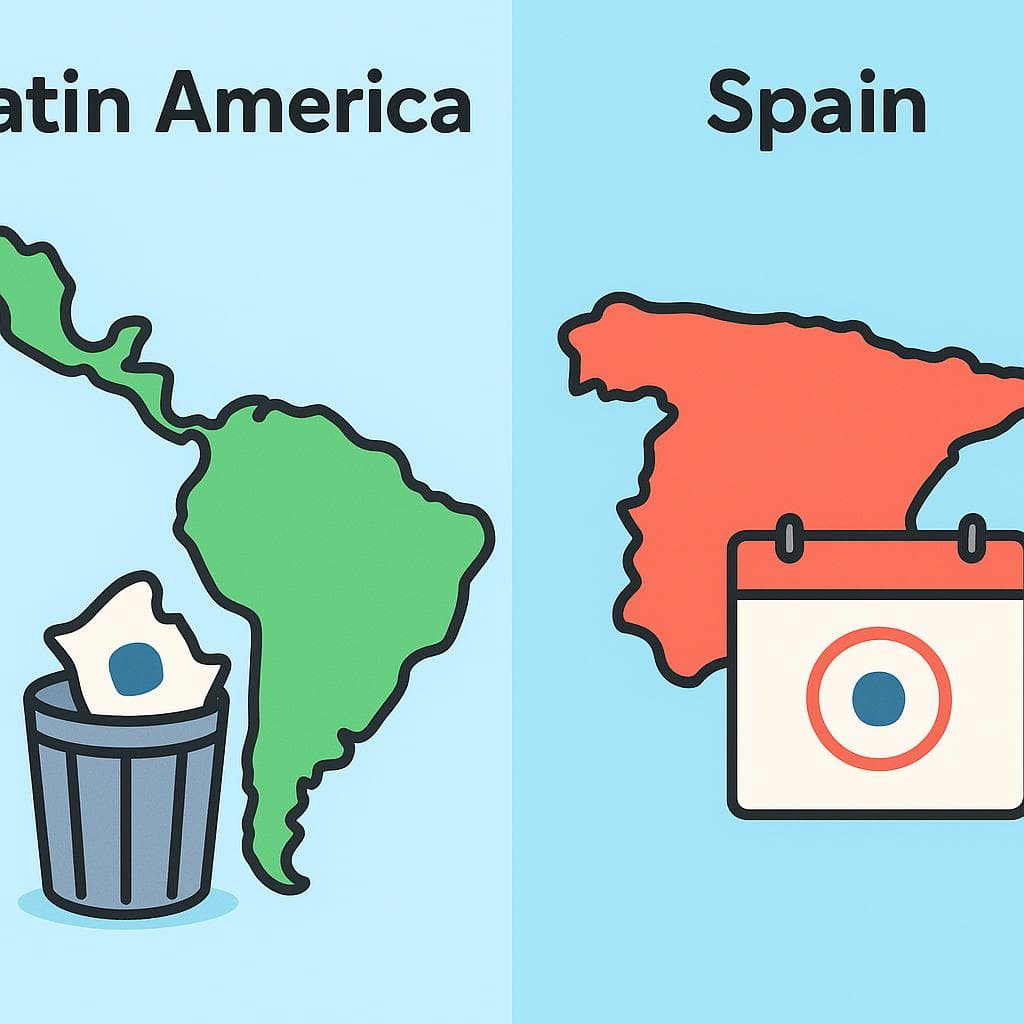
Spain: Use Present Perfect for 'today's' finished actions. Latin America: Use Preterite for ALL finished actions.
preterite
The Preterite (pretérito indefinido) is for completed actions in the past. Think of it as a snapshot of a finished event.
Pretéritopresent perfect
The Present Perfect (pretérito perfecto) is for past actions connected to the present. Think of actions within a still-open time frame.
Presente PerfectoQuick Rule
Spain: Use Present Perfect for 'today's' finished actions. Latin America: Use Preterite for ALL finished actions.
Think: Spain keeps today's past 'present'. LatAm calls all finished actions the 'past'.
- Both regions use Preterite for specific, finished actions in a narrative past (e.g., 'Ayer comí paella').
- Both regions use Present Perfect for life experiences without a specific date (e.g., 'He viajado a Asia').
Comparison Table
| Context | preterite | present perfect | Why? |
|---|---|---|---|
| Action finished today | Hoy vi a tu hermano. (LatAm) | Hoy he visto a tu hermano. (Spain) | LatAm uses Preterite for any finished past. Spain uses Present Perfect for actions within 'today'. |
| Action finished this morning | Esta mañana no desayuné. (LatAm) | Esta mañana no he desayunado. (Spain) | For speakers in Spain, 'this morning' is part of the current, unfinished day, requiring Present Perfect. |
| Action finished yesterday | Ayer terminé el proyecto. | Ayer terminé el proyecto. | Both regions use Preterite for actions in a clearly finished time period like 'yesterday'. |
| Life experience | Fui a Perú en 2010. | He ido a Perú dos veces. | Preterite for a specific past trip. Present Perfect for the general life experience of having gone (no specific date). |
When to Use "preterite / present perfect"
preterite
The Preterite (pretérito indefinido) is for completed actions in the past. Think of it as a snapshot of a finished event.
preh-TEH-ree-toh
Finished actions at a specific time (everywhere)
Ayer compré un libro.
Yesterday I bought a book.
Main verb for any finished past action (Latin America)
Hoy trabajé mucho. (Common in LatAm)
I worked a lot today.
A sequence of past events
Me levanté, me duché y salí.
I got up, showered, and left.
Interrupting an ongoing action
Yo leía cuando sonó el teléfono.
I was reading when the phone rang.
present perfect
The Present Perfect (pretérito perfecto) is for past actions connected to the present. Think of actions within a still-open time frame.
preh-SEN-teh per-FEK-toh
Actions in an unfinished time period (especially in Spain)
Hoy he trabajado mucho. (Common in Spain)
I have worked a lot today.
Life experiences (both regions)
He viajado a México.
I have traveled to Mexico.
Recent past with present results
He perdido mis llaves.
I've lost my keys (and I still can't find them).
Things you have 'ever' or 'never' done
¿Alguna vez has visto esa película?
Have you ever seen that movie?
Contrast Examples
With "preterite":
Esta mañana fui al gimnasio. (LatAm style)
This morning I went to the gym.
With "present perfect":
Esta mañana he ido al gimnasio. (Spain style)
This morning I've gone to the gym.
The Difference: Both are correct, but your choice signals where you learned Spanish. The first is standard in Latin America, while the second is standard in Spain because 'this morning' is part of the unfinished day.
With "preterite":
¿Qué hiciste hoy? (LatAm style)
What did you do today?
With "present perfect":
¿Qué has hecho hoy? (Spain style)
What have you done today?
The Difference: A Latin American speaker will almost always ask this with the Preterite. A speaker from Spain will almost always use the Present Perfect. Both are understood everywhere.
Common Mistakes
Estoy en Madrid y digo: 'Hoy trabajé mucho.'
Hoy he trabajado mucho.
In Spain, this would sound a bit strange. For actions that happened on the same day ('hoy'), the Present Perfect is the standard choice.
Estoy en México y digo: 'He hablado con ella esta mañana.'
Hablé con ella esta mañana.
While not technically wrong, this sounds very formal or like a speaker from Spain. The Preterite is much more natural and common in Latin America for this situation.
Quick Practice
Quick Quiz: Preterite vs Present Perfect (Spain vs LatAm)
Question 1 of 3
You're in Madrid and you just finished your coffee. How would you say 'I drank a coffee this morning'?
Related Grammar
Want to understand the grammar behind this pair? Explore these lessons for a deep dive:
Key Words


Tags
Build the instinct, not just the rule
Rules help you get it right; context makes it automatic. Read 200+ illustrated and narrated Spanish stories to see confusing pairs chosen correctly — over and over — until you stop thinking about it.
Frequently Asked Questions
Will people understand me if I use the 'wrong' one?
Absolutely! Everyone will understand you perfectly. Using the Preterite in Spain or the Present Perfect in Latin America for 'today's' actions might just make you sound like a foreigner or someone from the other region, but it won't cause any confusion.
Is there a 'better' one to learn first?
It's best to learn the one that's most common where you plan to speak Spanish. If you're focusing on Spain, get comfortable with the Present Perfect for recent events. If you're focusing on Latin America, mastering the Preterite is your priority. But ultimately, you'll need to recognize both.
Are there any parts of Latin America that use the Present Perfect like Spain?
Yes, but it's less common. You might hear it more in some Andean regions or among certain speakers in cities like Bogotá or Lima, but as a general rule, the Preterite is dominant throughout Latin America for all completed past actions.