
También vs Tampoco
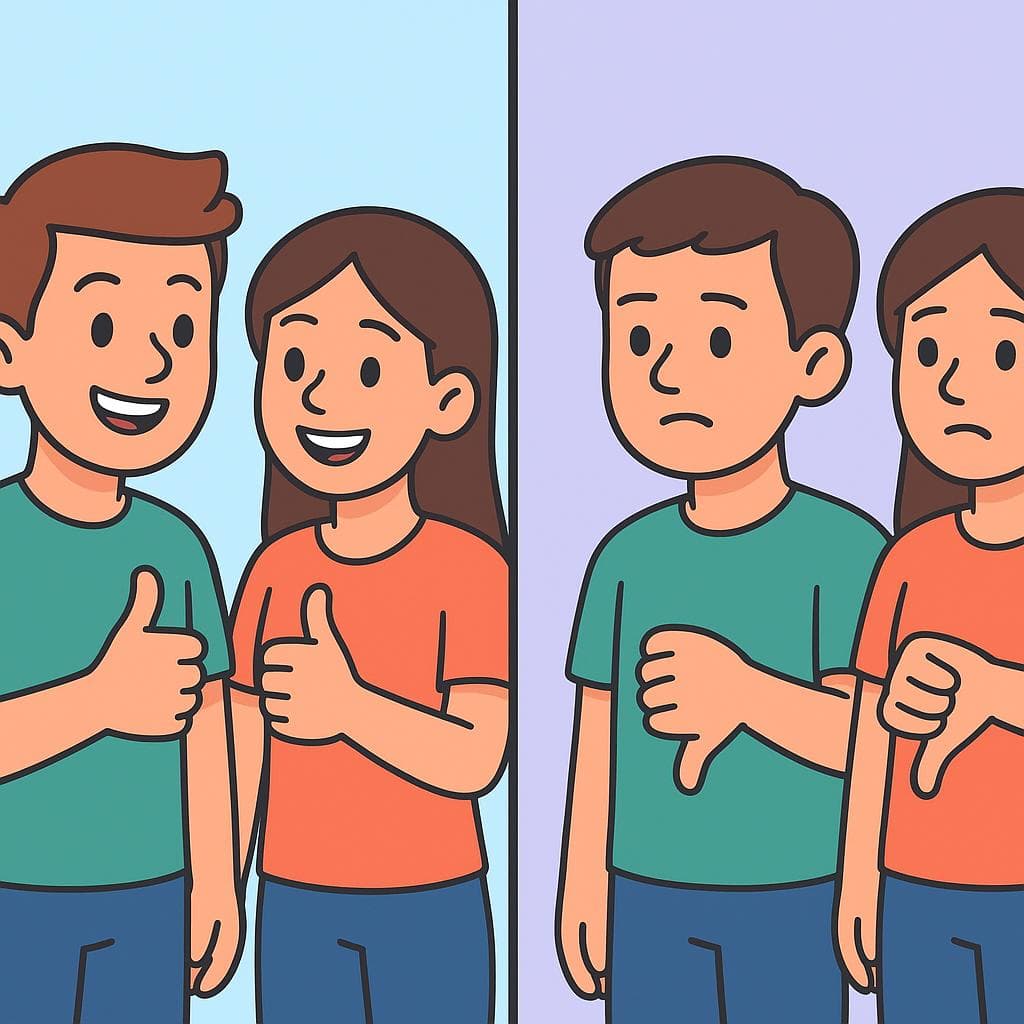
Use también for 'me too' (positive). Use tampoco for 'me neither' (negative).
también
Also, too. Use it to agree with a positive statement or add more positive information.
tahm-BYEHNtampoco
Neither, not either. Use it to agree with a negative statement or add more negative information.
tahm-PO-koQuick Rule
Use también for 'me too' (positive). Use tampoco for 'me neither' (negative).
También has 'bien' (good), so it's for positive agreement. Tampoco sounds like 'no poco' - it's for negative agreement.
- You can't say 'no tampoco' because 'tampoco' already includes the 'no'. It's either 'Yo tampoco voy' or 'Yo no voy tampoco'.
Comparison Table
| Context | también | tampoco | Why? |
|---|---|---|---|
| Simple Agreement | A: ¡Tengo hambre! B: Yo también. | A: No tengo dinero. B: Yo tampoco. | Use también to agree with a positive statement ('I am hungry') and tampoco to agree with a negative one ('I don't have money'). |
| Listing Preferences | Me gusta el rock y el jazz también. | No me gusta la cumbia ni el reguetón tampoco. | También adds another positive item to a list of likes. Tampoco adds another negative item to a list of dislikes. |
| Talking About Actions | Mi hermana fue a la fiesta y yo también fui. | Mi hermana no fue a la fiesta y yo tampoco fui. | Your choice of word depends entirely on whether the original action happened or didn't happen. |
When to Use "también / tampoco"
también
Also, too. Use it to agree with a positive statement or add more positive information.
tahm-BYEHN
Agreeing with something positive
A: Me gusta el verano. B: A mí también.
A: I like summer. B: Me too.
Adding a similar positive fact
Hablo español y también entiendo portugués.
I speak Spanish and I also understand Portuguese.
Confirming you'll do the same
Voy a pedir tacos. ¿Y tú? — Yo también.
I'm going to order tacos. And you? — Me too.
tampoco
Neither, not either. Use it to agree with a negative statement or add more negative information.
tahm-PO-ko
Agreeing with something negative
A: No quiero salir hoy. B: Yo tampoco.
A: I don't want to go out today. B: Me neither.
Adding a similar negative fact
No come carne y tampoco bebe alcohol.
He doesn't eat meat and he doesn't drink alcohol either.
Confirming you won't do the same
No vi la película. ¿Y tú? — Yo tampoco.
I didn't see the movie. And you? — Me neither.
Contrast Examples
With "también":
A: Me encanta la pizza. B: ¡A mí también!
A: I love pizza. B: Me too!
With "tampoco":
A: No me gusta la piña en la pizza. B: A mí tampoco.
A: I don't like pineapple on pizza. B: Me neither.
The Difference: Your response depends on the first person's statement. Use también to agree with a positive ('I love') and tampoco to agree with a negative ('I don't like').
With "también":
Fui al cine y también visité a mi abuela.
I went to the movies and I also visited my grandma.
With "tampoco":
No fui al cine y tampoco visité a mi abuela.
I didn't go to the movies and I didn't visit my grandma either.
The Difference: También links two things you DID. Tampoco links two things you DID NOT do.
Common Mistakes
A: No me gustan las espinacas. B: A mí también.
A mí tampoco.
This is the most common mistake. If you are agreeing with a negative sentence ('I don't like...'), you must use 'tampoco' (me neither), not 'también' (me too).
Yo no tampoco quiero ir.
Yo tampoco quiero ir. / Yo no quiero ir tampoco.
'Tampoco' already has the 'no' built into it. Saying 'no tampoco' is like saying 'I don't not want to go either' in English—it's redundant and incorrect.
Quick Practice
Quick Quiz: También vs Tampoco
Question 1 of 3
A: No me gusta levantarme temprano. B: A mí ___.
Related Grammar
Want to understand the grammar behind this pair? Explore these lessons for a deep dive:
Key Words



Tags
Build the instinct, not just the rule
Rules help you get it right; context makes it automatic. Read 200+ illustrated and narrated Spanish stories to see confusing pairs chosen correctly — over and over — until you stop thinking about it.
Frequently Asked Questions
Can I put 'tampoco' at the end of a sentence?
Yes, you can! Both 'Yo tampoco voy' (I'm not going either) and 'Yo no voy tampoco' are correct and mean the same thing. The second version with 'tampoco' at the end is very common in conversation.
Is 'tampoco' related to 'poco' (a little)?
While they look similar, they aren't directly related in modern usage. 'Tampoco' evolved from the Latin phrase 'tam paucu', but its function today is purely as a negative adverb for agreement, not to mean 'a little'.
What's the difference between 'yo tampoco' and 'a mí tampoco'?
Great question! You use 'a mí tampoco' to agree with sentences that use verbs like 'gustar' (e.g., 'No me gusta...'). You use 'yo tampoco' for most other verbs (e.g., 'No quiero...', 'No voy...'). It mirrors the structure of the original statement.