
Uno vs Se (impersonal)
Use 'se' for general rules or observations. Use 'uno' for personal experiences that could apply to anyone.
uno
Means 'one' or 'you' in a general sense, typically to generalize from a personal feeling or experience.
OO-nohse (impersonal)
Creates an impersonal statement where the person doing the action is unknown or unimportant. Focuses on the action itself.
sehQuick Rule
Use 'se' for general rules or observations. Use 'uno' for personal experiences that could apply to anyone.
Think: Se = Sign (like a public sign stating a rule). Uno = One person's experience (that could be yours).
- In very formal writing, 'uno' is often avoided in favor of 'se' or other passive constructions.
- Regional preferences can make 'uno' more or less common in everyday speech.
Comparison Table
| Context | uno | se (impersonal) | Why? |
|---|---|---|---|
| Giving Instructions | Uno tiene que leer el manual. | Se lee el manual primero. | 'Uno' sounds like personal advice. 'Se' sounds like a formal, required step. |
| Making Observations | Desde aquí, uno ve toda la ciudad. | Desde aquí, se ve toda la ciudad. | Both are correct. 'Uno' emphasizes the personal experience of seeing. 'Se' is a more detached, objective statement that the view exists. |
| Social Norms | Uno no debería hablar así. | No se habla así. | 'Uno' expresses a personal moral judgment. 'Se' states a general social rule. |
| Common Knowledge | Uno aprende de sus errores. | Se dice que va a llover. | 'Uno' generalizes a personal learning process. 'Se' reports what 'they say' or what is generally known. |
When to Use "uno / se (impersonal)"
uno
Means 'one' or 'you' in a general sense, typically to generalize from a personal feeling or experience.
OO-noh
Generalizing from personal experience
Uno no sabe qué hacer en esa situación.
One doesn't know what to do in that situation.
Expressing a common feeling or opinion
A veces, uno se siente un poco perdido.
Sometimes, you feel a little lost.
Describing a process from a personal viewpoint
Cuando uno aprende un idioma, comete errores.
When you learn a language, you make mistakes.
se (impersonal)
Creates an impersonal statement where the person doing the action is unknown or unimportant. Focuses on the action itself.
seh
Stating rules, laws, or general norms
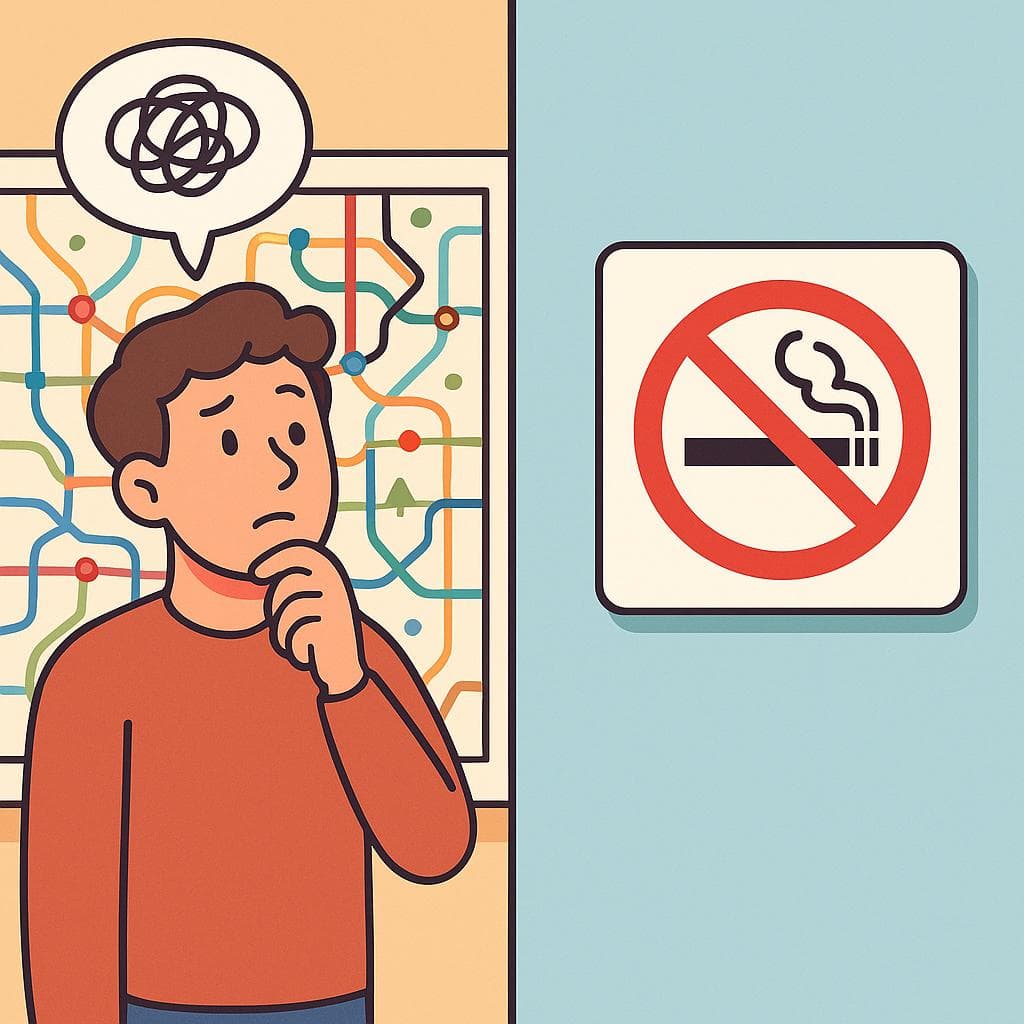
No se puede fumar aquí.
You can't smoke here. / Smoking is not allowed.
Making objective observations or statements
En España se come tarde.
In Spain, people eat late.
On signs and in public notices
Se habla español.
Spanish is spoken here.
Contrast Examples
With "uno":
En esta ciudad, uno se siente seguro.
In this city, one feels safe. (A personal, subjective feeling.)
With "se (impersonal)":
En esta ciudad, se vive muy bien.
In this city, people live very well. (An objective, general statement.)
The Difference: 'Uno' generalizes a personal, internal feeling. 'Se' makes a broad, factual statement about the quality of life.
With "uno":
Al principio, uno comete muchos errores.
At the beginning, one makes many mistakes. (Focus on the personal experience of the learner.)
With "se (impersonal)":
Se aprende mucho viajando.
One learns a lot by traveling. (A general truth about how learning happens.)
The Difference: 'Uno' puts you in the shoes of the person having the experience. 'Se' states a universal principle or observation.
With "uno":
Cuando uno está enfermo, debe descansar.
When one is sick, they should rest. (Empathetic, experience-based advice.)
With "se (impersonal)":
Se recomienda descansar cuando se está enfermo.
It is recommended to rest when one is sick. (Formal, clinical advice.)
The Difference: 'Uno' sounds like friendly advice from someone who understands. 'Se' sounds like a doctor's official recommendation.
Common Mistakes
Se no sabe qué pensar.
Uno no sabe qué pensar.
For subjective feelings like confusion or indecision, 'uno' is used to generalize that personal state. 'Se' is for more objective facts.
Uno se vende pan en la panadería.
Se vende pan en la panadería.
To state what is done or available at a place of business, always use the impersonal 'se'. 'Uno' would be incorrect here.
Quick Practice
Quick Quiz: Uno vs Se (impersonal)
Question 1 of 3
Which word best completes the sentence? 'En esta biblioteca, no ___ permite hablar en voz alta.'
Related Grammar
Want to understand the grammar behind this pair? Explore these lessons for a deep dive:
Key Words


Tags
Build the instinct, not just the rule
Rules help you get it right; context makes it automatic. Read 200+ illustrated and narrated Spanish stories to see confusing pairs chosen correctly — over and over — until you stop thinking about it.
Frequently Asked Questions
Can I always use 'se' instead of 'uno' to sound more formal?
Not always. While 'se' is often more formal, they aren't interchangeable. 'Se' is for objective facts and rules ('Se habla español'), while 'uno' is for subjective, personal experiences ('Uno se siente feliz aquí'). Using 'se' for a personal feeling would sound strange.
Why do I hear native speakers use 'tú' or 'usted' in these general situations?
Great question! In informal conversation, it's very common to use the second person ('tú' or 'usted') to mean 'you' in a general sense, just like in English. For example, 'Cuando viajas, aprendes mucho' (When you travel, you learn a lot). This is a conversational alternative to both 'uno' and 'se'.