archivar Preterite Conjugation
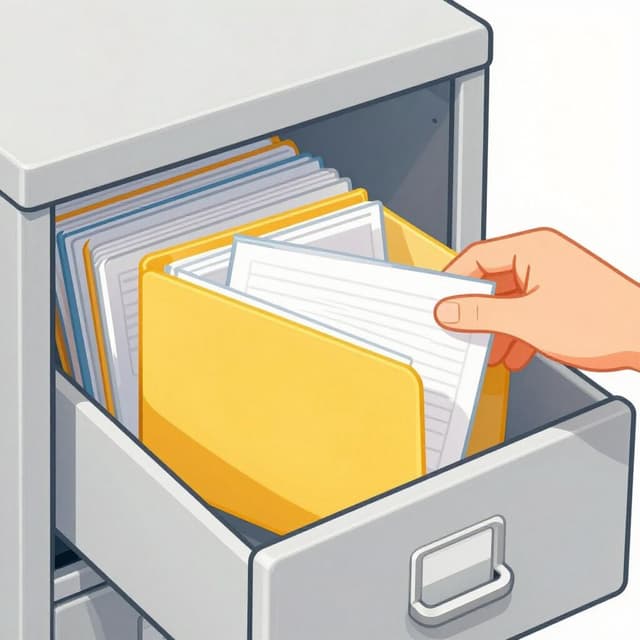
archivar — to file
The preterite of 'archivar' is regular: archivé, archivaste, archivó, archivamos, archivasteis, archivaron.
archivar Preterite Forms
When to Use the Preterite
Use the preterite for completed actions in the past related to filing. For example, 'I filed the documents yesterday' or 'She filed the case last week.'
Notes on archivar in the Preterite
'Archivar' is a regular -ar verb, so all its preterite conjugations are predictable and follow the standard pattern.
Example Sentences
Archivé todos los papeles importantes ayer.
I filed all the important papers yesterday.
yo
¿Archivaste la factura del mes pasado?
Did you file last month's invoice?
tú
Él archivó la solicitud en la carpeta correcta.
He filed the application in the correct folder.
él/ella/usted
Archivamos las fotos de las vacaciones.
We filed the vacation photos.
nosotros
Ellos archivaron el proyecto a tiempo.
They filed the project on time.
ellos/ellas/ustedes
Common Mistakes
Mistake: Using 'archivamos' (preterite) when meaning 'we file' (present).
Correct: Use 'archivamos' for a completed past action and 'archivamos' (present) for a habitual action.
Why: The form is the same for both 'nosotros' preterite and 'nosotros' present indicative, so context is key.
Mistake: Forgetting the accent on 'archivó'.
Correct: The él/ella/usted form needs an accent: 'archivó'.
Why: The accent indicates the stress falls on the final syllable, distinguishing it from other forms.
Master Spanish verbs in context
Memorizing tables only gets you so far. Read 200+ illustrated and narrated Spanish stories to see verbs like 'archivar' used naturally — in the tenses you're learning.
Related Tenses
Present
yo: archivo
The present tense of 'archivar' is 'archivo' (I file), 'archivas' (you file), 'archiva' (he/she/you files), 'archivamos' (we file), 'archiváis' (you all file), 'archivan' (they file).
Imperfect
yo: archivaba
The imperfect of 'archivar' is 'archivaba' (I/he/she/you filed/used to file), 'archivabas' (you filed/used to file), 'archivábamos' (we filed/used to file), 'archivabais' (you all filed/used to file), 'archivaban' (they filed/used to file).
Future
yo: archivaré
The future tense of 'archivar' adds endings to the infinitive: archivaré (I will file), archivarás (you will file), archivará (he/she/you will file), etc.
Conditional
yo: archivaría
The conditional of 'archivar' uses the infinitive + endings: archivaría (I would file), archivarías (you would file), archivaría (he/she/you would file), etc.
Present Subjunctive
yo: archive
The present subjunctive of 'archivar' is archive (yo, él/ella/usted), archives (tú), archivemos (nosotros), archivéis (vosotros), archiven (ellos/ellas/ustedes).
Imperfect Subjunctive
yo: archivara
The imperfect subjunctive of 'archivar' has two forms for each pronoun, like archivara/archivase (yo, él, ella, usted).
Affirmative Imperative
yo: archiva
Archiva (tú), archive (usted), archived (vosotros), archivemos (nosotros), archiven (ustedes) are the imperative forms for 'archivar'.
Negative Imperative
yo: no archives
Negative commands for 'archivar' use 'no' plus the present subjunctive: no archives (tú), no archive (usted), no archivéis (vosotros), no archivemos (nosotros), no archiven (ustedes).