Inklingo

dejarle

/deh-HAR-leh/

to leave him/her/you (formal) something

A person gently placing a small, wrapped blue gift and a folded note on a wooden table. The person is turning to walk away, indicating the item is left for someone else.

Leaving a thoughtful item for someone else is one way to use dejarle.

dejarle(verb)

A2regular ar

to leave him/her/you (formal) something

?

as in leaving a message, object, or inheritance for someone

Also:

to hand over to him/her/you (formal)

?

giving possession

📝 In Action

Fui al banco a dejarle dinero a mi hermano.

A2

I went to the bank to leave money for my brother (him).

Si no estás, voy a dejarle la llave a tu vecina.

A2

If you aren't here, I am going to leave the key for your neighbor (her).

Word Connections

Synonyms

  • entregarle (to hand over to him/her)

Common Collocations

  • dejarle una propinato leave him/her a tip

💡 Grammar Points

Infinitive + Pronoun

When using an infinitive form like 'dejar,' the pronoun 'le' (meaning 'to him' or 'to her') attaches directly to the end, forming one word: 'dejarle'.

The Function of 'le'

'Le' tells you who the recipient of the action is. The key is that the recipient is a single person ('him,' 'her,' or 'you formal').

❌ Common Pitfalls

Using 'lo' for people

Mistake: "Voy a dejarlo un mensaje. (If referring to a male recipient)"

Correction: Voy a dejarle un mensaje. 'Le' is used for the person who benefits from or receives the action (indirect object), even if they are masculine.

⭐ Usage Tips

Placement Flexibility

In compound verb phrases, you can often put 'le' before the conjugated verb (e.g., 'Le quiero dejar') or attach it to the infinitive ('Quiero dejarle').

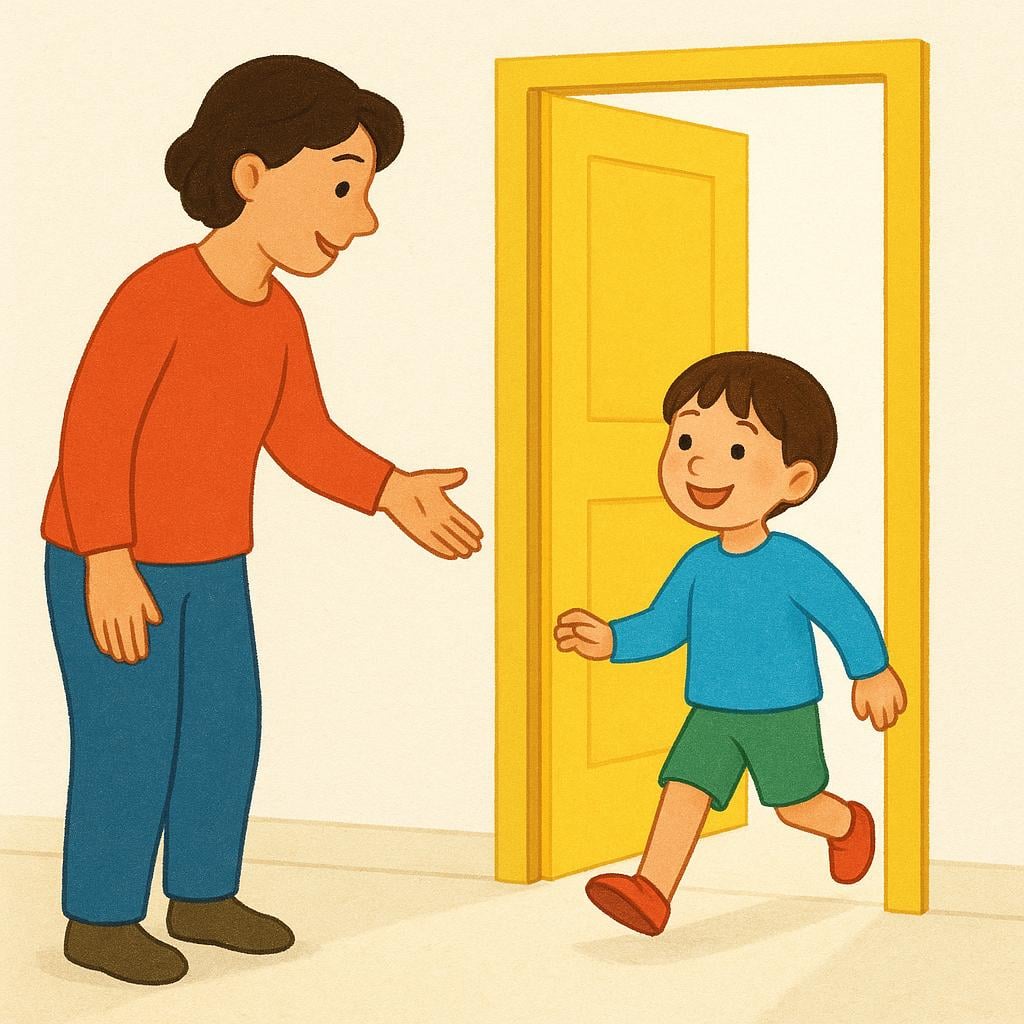
A smiling adult standing next to an open doorway, extending an arm in an inviting gesture to a child, allowing the child to pass through.

When you allow someone to do something, you use the verb form dejarle.

dejarle(verb)

B1regular ar

to let him/her/you (formal)

?

to allow or permit someone to do something

Also:

to permit him/her/you (formal)

?

formal permission

📝 In Action

No puedes dejarle ir a la fiesta si no ha terminado sus tareas.

B1

You cannot let him go to the party if he hasn't finished his chores.

El guardia no quería dejarle pasar sin identificación.

B1

The guard didn't want to let her pass without identification.

Word Connections

Synonyms

  • permitirle (to permit him/her)

Antonyms

  • prohibirle (to forbid him/her)

Common Collocations

  • dejarle entrarto let him/her in

💡 Grammar Points

Chain of Verbs

When 'dejarle' is used in the sense of 'to allow,' it is usually followed immediately by another verb in the infinitive: 'dejarle + [action]'. (E.g., dejarle comer, dejarle hablar).

⭐ Usage Tips

Implied Action

Sometimes the action is implied and omitted, such as when you tell someone to stop annoying a person: '¡Déjale ya!' (Just leave him/her alone already!)

🔄 Conjugations

indicative

present

él/ella/usteddeja
yodejo
dejas
ellos/ellas/ustedesdejan
nosotrosdejamos
vosotrosdejáis

imperfect

él/ella/usteddejaba
yodejaba
dejabas
ellos/ellas/ustedesdejaban
nosotrosdejábamos
vosotrosdejabais

preterite

él/ella/usteddejó
yodejé
dejaste
ellos/ellas/ustedesdejaron
nosotrosdejamos
vosotrosdejasteis

subjunctive

present

él/ella/usteddeje
yodeje
dejes
ellos/ellas/ustedesdejen
nosotrosdejemos
vosotrosdejéis

imperfect

él/ella/usteddejara/dejase
yodejara/dejase
dejaras/dejases
ellos/ellas/ustedesdejaran/dejasen
nosotrosdejáramos/dejásemos
vosotrosdejarais/dejaseis

✏️ Quick Practice

💡 Quick Quiz: dejarle

Question 1 of 1

Which sentence correctly uses 'dejarle' to mean 'to allow him'?

📚 More Resources

Word Family

dejar(to leave, to allow) - verb

Frequently Asked Questions

Why is 'dejarle' sometimes written as two words ('le voy a dejar') and sometimes as one word ('voy a dejarle')?

When the verb is conjugated (like 'voy'), the pronoun 'le' usually goes before it ('le voy a dejar'). But when the verb is in the infinitive ('dejar') or the gerund ('dejando'), you have the choice to attach the pronoun to the end, forming one word ('voy a dejarle' or 'estoy dejándole').