Inklingo

detuvo

/deh-TOO-voh/

stopped

A large hand firmly stops a brightly colored, rolling red ball on a green grassy field.

The hand stopped (detuvo) the ball.

detuvo(Verb)

A2irregular er

stopped

?

He/She/It/You (formal) stopped something

,

halted

?

Brought movement to a stop

Also:

delayed

?

Caused a delay or interruption

📝 In Action

El conductor detuvo el autobús de repente.

A2

The driver stopped the bus suddenly.

Ella detuvo la grabación para hablar por teléfono.

B1

She paused the recording to talk on the phone.

La policía detuvo el tráfico por el accidente.

B1

The police halted traffic because of the accident.

Word Connections

Synonyms

  • paró (stopped)
  • frenó (braked)

Antonyms

  • continuó (continued)

Common Collocations

  • detuvo el cochehe/she stopped the car
  • detuvo el progresohe/she halted the progress

💡 Grammar Points

Tense Identification

'Detuvo' is the simple past tense (preterite) used when talking about a single, completed action in the past by a third person (he, she, or formal you).

Irregularity Pattern

The verb 'detener' is irregular, following the pattern of 'tener' (to have). Notice the 'u' (detUvo, tUve) in the simple past.

❌ Common Pitfalls

Confusing Past Tenses

Mistake: "Using 'detenía' when referring to a single, quick action: 'Ella detenía el carro.'"

Correction: Use 'detuvo' for single completed actions: 'Ella detuvo el carro.' 'Detenía' describes continuous or habitual past actions.

⭐ Usage Tips

Focus on the Result

Use 'detuvo' when the stopping action is the main point and the result is known (e.g., the car is now still).

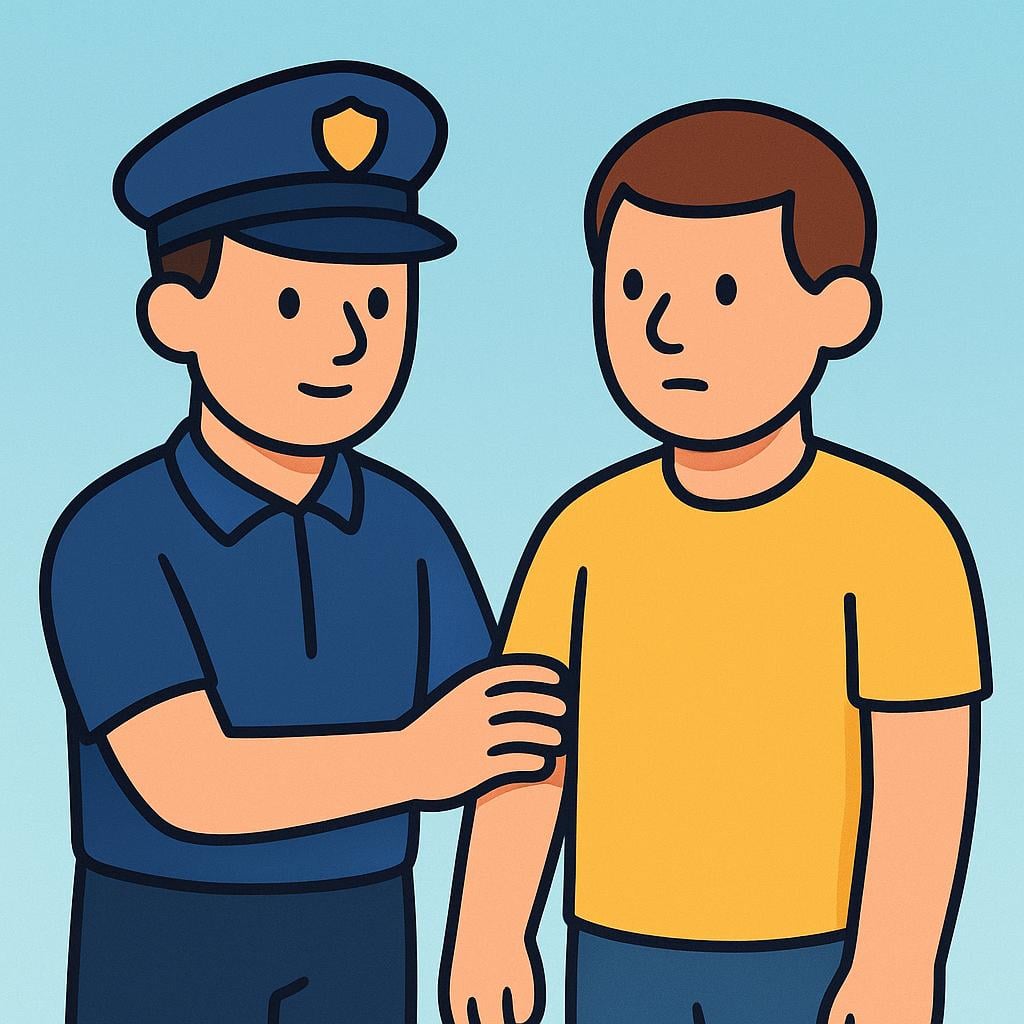
A simplified figure wearing a police cap and blue shirt gently holds the upper arm of another civilian figure wearing a yellow shirt, signifying detention.

The officer detained (detuvo) the person.

detuvo(Verb)

B1irregular er

detained

?

He/She/It/You (formal) held someone in custody

,

arrested

?

Taken into legal custody

📝 In Action

La policía detuvo al sospechoso inmediatamente después del robo.

B1

The police detained the suspect immediately after the robbery.

El oficial lo detuvo para interrogarlo.

B2

The officer arrested him for questioning.

Word Connections

Synonyms

  • arrestó (arrested)
  • apresó (apprehended)

Common Collocations

  • detuvo al ladrónhe/she detained the thief

💡 Grammar Points

Formal Context

In this meaning, 'detuvo' often implies an official or legal action, usually carried out by law enforcement or border patrol.

⭐ Usage Tips

Avoiding Ambiguity

If you mean 'arrested,' you can use 'arrestó' for clarity, but 'detuvo' is often the preferred, more neutral term in Spanish news.

A cartoon figure running quickly on a path suddenly stands completely motionless, signifying a pause.

The runner paused (detuvo) mid-race.

detuvo(Verb)

A2irregular (reflexive) er

paused

?

He/She/It/You (formal) stopped moving or talking

,

stopped oneself

?

Halted their own action (requires 'se')

📝 In Action

Se detuvo en la puerta a mirar la lluvia.

A2

He paused at the door to look at the rain. (Requires the 'se')

Ella se detuvo antes de cruzar la calle.

A2

She stopped herself before crossing the street. (Requires the 'se')

Word Connections

Synonyms

  • se paró (stopped oneself)
  • cesó (ceased)

💡 Grammar Points

The 'Se' Difference

When the subject stops themselves (He stopped), you must use the reflexive pronoun 'se' (Se detuvo). Without 'se', it means He stopped something else (Él detuvo el coche).

❌ Common Pitfalls

Missing the Reflexive Pronoun

Mistake: "Saying: 'Él detuvo y miró.' (This means 'He stopped something and looked.')"

Correction: Say: 'Él se detuvo y miró.' (This correctly means 'He stopped himself/paused and looked.')

🔄 Conjugations

indicative

present

él/ella/usteddetiene
yodetengo
detienes
ellos/ellas/ustedesdetienen
nosotrosdetenemos
vosotrosdetenéis

imperfect

él/ella/usteddetenía
yodetenía
detenías
ellos/ellas/ustedesdetenían
nosotrosdeteníamos
vosotrosdeteníais

preterite

él/ella/usteddetuvo
yodetuve
detuviste
ellos/ellas/ustedesdetuvieron
nosotrosdetuvimos
vosotrosdetuvisteis

subjunctive

present

él/ella/usteddetenga
yodetenga
detengas
ellos/ellas/ustedesdetengan
nosotrosdetengamos
vosotrosdetengáis

imperfect

él/ella/usteddetuviera
yodetuviera
detuvieras
ellos/ellas/ustedesdetuvieran
nosotrosdetuviéramos
vosotrosdetuvierais

✏️ Quick Practice

💡 Quick Quiz: detuvo

Question 1 of 2

Which sentence correctly uses 'detuvo' to mean someone stopped their own action?

📚 More Resources

Word Family

detenido(detainee, arrested person (noun/adjective)) - noun

Frequently Asked Questions

Why does 'detuvo' have a 'u' but the infinitive 'detener' has an 'e'?

'Detener' is an irregular verb that follows the pattern of 'tener' (to have). In the simple past tense (preterite), verbs like this change their vowel sound to a 'u' (tenEr → tUve; detEnEr → detUvo). This is a common irregularity pattern you must memorize.

Is 'detuvo' the same as 'paró'?

They are very similar, both meaning 'stopped.' However, 'detuvo' (detener) can also mean 'to detain/arrest' and is often used for stopping machines or processes. 'Paró' (parar) is more general and common for simple physical stopping.