Inklingo
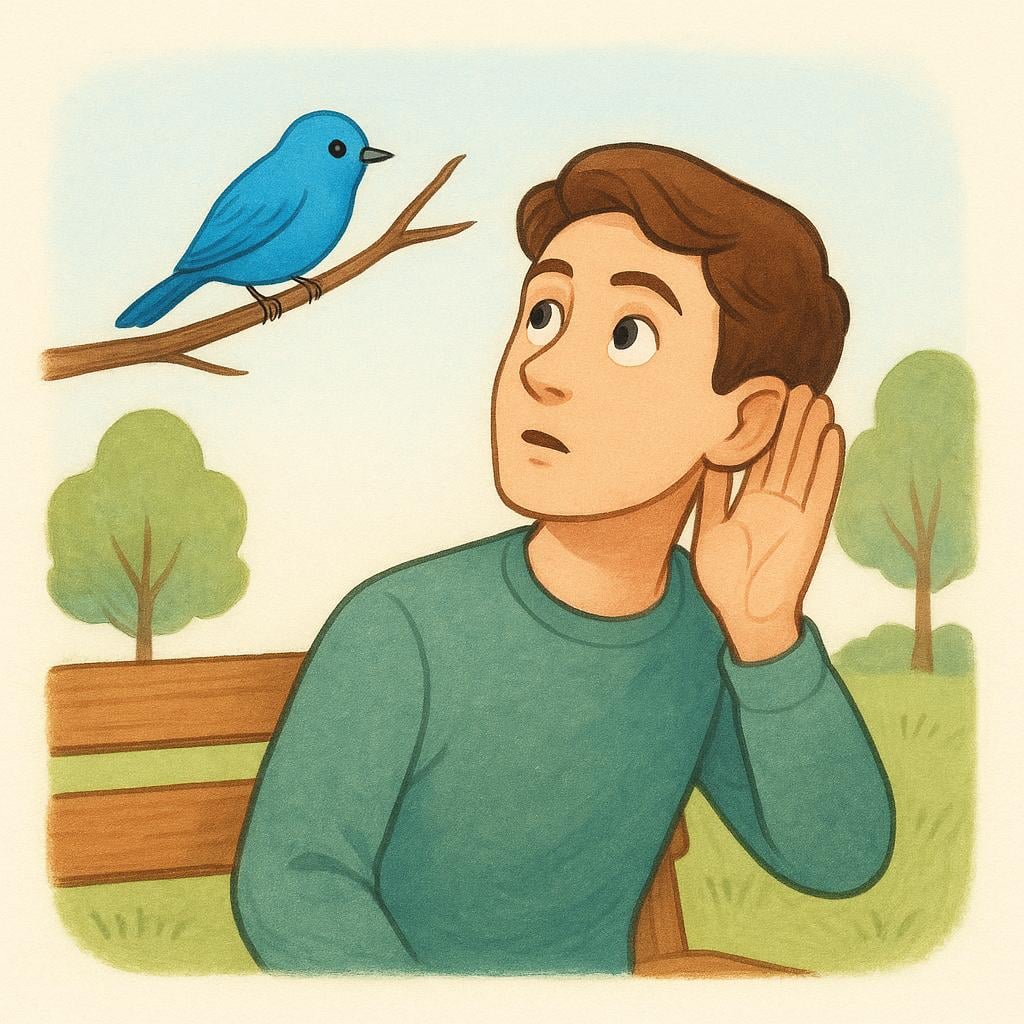
A young man sitting on a park bench, leaning forward and cupping his ear, listening intently to a blue songbird singing on a nearby branch.

escuchó

es-koo-CHOH

VerbA1regular ar
he listened?completed past action,she heard?completed past action,you listened (formal singular)?completed past action
Also:he paid attention?focus on intent

Quick Reference

infinitiveescuchar
gerundescuchando
past Participleescuchado

📝 In Action

Ella escuchó atentamente el discurso del presidente.

A1

She listened carefully to the president's speech.

¿Usted escuchó lo que dijo el jefe ayer?

A2

Did you (formal) hear what the boss said yesterday?

Él no escuchó la alarma y llegó tarde.

A2

He didn't hear the alarm and arrived late.

Word Connections

Synonyms

  • oyó (he/she heard (from oír))
  • atendió (he/she paid attention)

Antonyms

  • ignoró (he/she ignored)
  • desatendió (he/she disregarded)

Common Collocations

  • escuchó la radiohe/she listened to the radio
  • escuchó un ruidohe/she heard a noise

Idioms & Expressions

  • no escuchó razoneshe/she wouldn't listen to reason

💡 Grammar Points

The Simple Past (Preterite)

This form, 'escuchó,' tells you that the action of listening started and finished at a specific point in the past. It's a single, completed event.

Who Did It?

'Escuchó' always refers to a singular person: 'él' (he), 'ella' (she), or 'usted' (formal you). You often don't need the pronoun because the ending tells you who performed the action.

❌ Common Pitfalls

Preterite vs. Imperfect

Mistake: "Using 'escuchaba' when referring to a single, quick event: 'Él escuchaba la noticia.' (Incorrect if it was a one-time event)"

Correction: Use 'escuchó' for the single event: 'Él escuchó la noticia.' ('He heard the news.') Use 'escuchaba' only for continuous or habitual actions in the past.

⭐ Usage Tips

Listening vs. Hearing

'Escuchar' usually implies active listening (paying attention), whereas 'oír' (oyó) often means passively hearing a sound. However, 'escuchó' is commonly used for both in casual speech.

🔄 Conjugations

indicative

present

él/ella/ustedescucha
yoescucho
escuchas
ellos/ellas/ustedesescuchan
nosotrosescuchamos
vosotrosescucháis

imperfect

él/ella/ustedescuchaba
yoescuchaba
escuchabas
ellos/ellas/ustedesescuchaban
nosotrosescuchábamos
vosotrosescuchabais

preterite

él/ella/ustedescuchó
yoescuché
escuchaste
ellos/ellas/ustedesescucharon
nosotrosescuchamos
vosotrosescuchasteis

subjunctive

present

él/ella/ustedescuche
yoescuche
escuches
ellos/ellas/ustedesescuchen
nosotrosescuchemos
vosotrosescuchéis

imperfect

él/ella/ustedescuchara/escuchase
yoescuchara/escuchase
escucharas/escuchases
ellos/ellas/ustedesescucharan/escuchasen
nosotrosescucháramos/escuchásemos
vosotrosescucharais/escuchaseis

✏️ Quick Practice

💡 Quick Quiz: escuchó

Question 1 of 1

Which sentence correctly uses 'escuchó' to describe a single, finished action?

📚 More Resources

Frequently Asked Questions

What is the difference between 'escuchó' and 'oyó'?

'Escuchó' (from escuchar) means 'he/she listened,' implying intent and attention. 'Oyó' (from oír) means 'he/she heard,' often referring to passively perceiving a sound, like hearing a sudden noise.

Why does 'escuchamos' mean two different things in the conjugation table?

The 'nosotros' (we) form is the same in both the present tense ('we listen') and the simple past (preterite) tense ('we listened'). You must rely on context or time markers (like 'ayer' or 'hoy') to know which tense is being used.