Inklingo

juzgado

/hooz-GAH-doh/

court

A grand, symmetrical stone building with tall columns and a wide set of stairs leading to the entrance, representing a courthouse.

A courthouse, illustrating 'juzgado' meaning 'court' (as a place or institution).

juzgado(noun)

mB1

court

?

as a place or institution

,

courthouse

?

the building where legal trials happen

Also:

tribunal

?

legal body

📝 In Action

Tuvimos que ir al juzgado para presentar la demanda.

B1

We had to go to the courthouse to file the lawsuit.

El juzgado emitió una orden de arresto contra el sospechoso.

B2

The court issued an arrest warrant against the suspect.

Word Connections

Synonyms

  • tribunal (tribunal)
  • corte (court)

Common Collocations

  • ir al juzgadoto go to court
  • el juzgado de guardiathe duty court/on-call court

💡 Grammar Points

Masculine Noun

Remember that 'juzgado' is always masculine, so you use 'el juzgado' or 'un juzgado'.

⭐ Usage Tips

Formal Context

This word is used specifically for the legal institution or building. Use 'corte' (court) or 'tribunal' interchangeably, especially in Latin America.

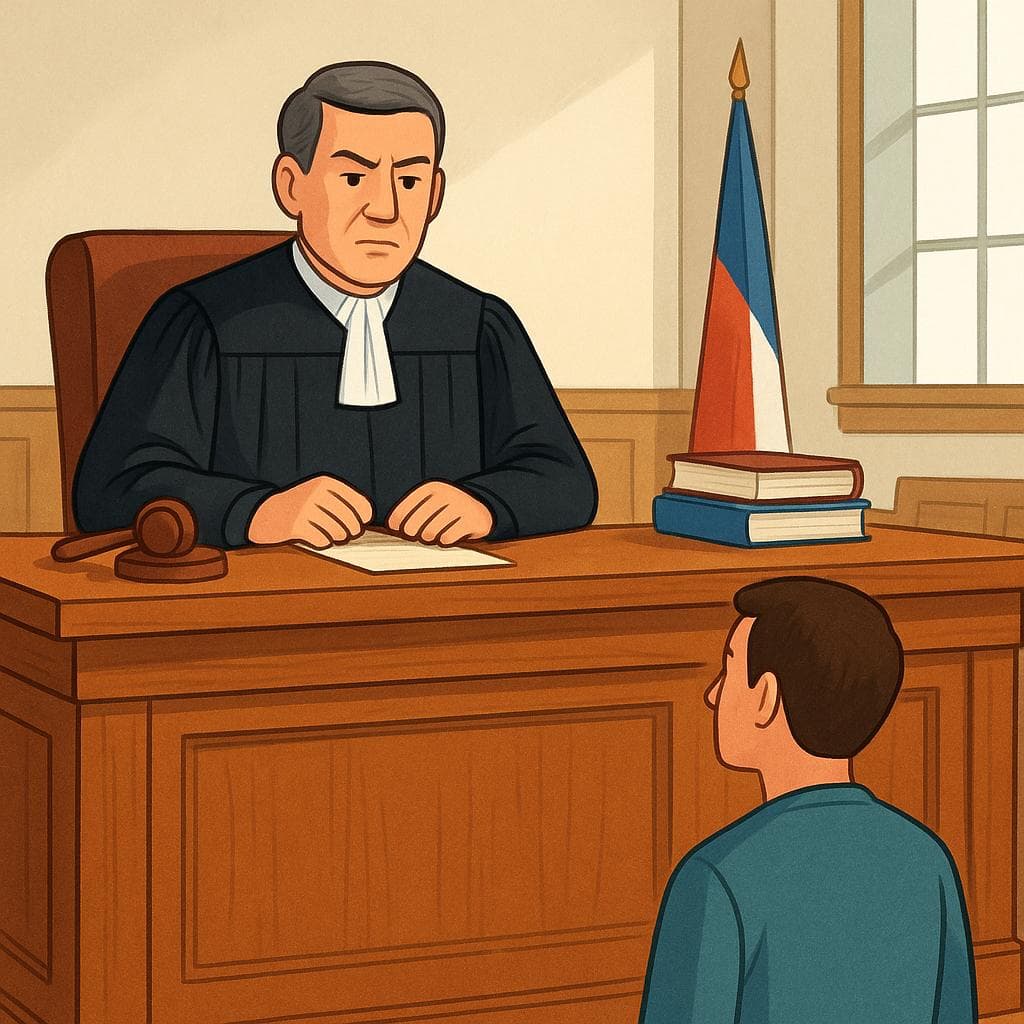
A solemn judge in black robes seated behind a large wooden bench, looking intently at an individual standing formally before them.

A person being tried, representing the adjective 'juzgado' meaning 'judged' (having been tried).

juzgado(adjective)

mB1

judged

?

having been tried

,

tried

?

in a legal sense

Also:

evaluated

?

assessed

📝 In Action

El acusado fue juzgado y declarado inocente.

B1

The defendant was judged and declared innocent.

Su conducta fue juzgada como inapropiada.

B2

His conduct was evaluated as inappropriate.

Word Connections

Synonyms

  • sentenciado (sentenced)
  • valorado (valued)

Common Collocations

  • ser juzgadoto be judged/tried

💡 Grammar Points

Must Agree in Gender and Number

As an adjective, 'juzgado' must match the word it describes. If you are talking about 'la causa' (the case, feminine), you must say 'la causa fue juzgada' (feminine ending -a).

❌ Common Pitfalls

Using the wrong ending

Mistake: "La persona fue juzgado."

Correction: La persona fue juzgada. (The person was judged.) Remember to change the -o to -a when describing a feminine noun.

A judge's hand firmly setting a large wooden gavel down on a desk next to a closed leather-bound book, indicating a final decision has been made.

The final action of judgment, illustrating 'juzgado' as the past participle 'judged' (used after 'haber').

juzgado(verb)

A2regular (with spelling change in certain forms) ar

judged

?

used after 'haber' (to have)

Also:

assessed

?

evaluated

📝 In Action

Ellos han juzgado mal la situación.

A2

They have judged the situation poorly.

¿Alguna vez has juzgado a alguien sin conocerlo?

B1

Have you ever judged someone without knowing them?

💡 Grammar Points

Spelling Change Alert!

The verb 'juzgar' needs a spelling change in the preterite 'yo' form and all present subjunctive forms (g → gu) to keep the hard 'g' sound. For example, 'yo juzgué' (I judged).

❌ Common Pitfalls

Confusing the Participle and the Adjective

Mistake: "El juez está juzgado la causa."

Correction: El juez ha juzgado la causa. (The judge has judged the case.) Remember, 'juzgado' with 'estar' means 'is judged' (adjective), while with 'haber' it forms the perfect tense (verb).

🔄 Conjugations

indicative

present

él/ella/ustedjuzga
yojuzgo
juzgas
ellos/ellas/ustedesjuzgan
nosotrosjuzgamos
vosotrosjuzgáis

imperfect

él/ella/ustedjuzgaba
yojuzgaba
juzgabas
ellos/ellas/ustedesjuzgaban
nosotrosjuzgábamos
vosotrosjuzgabais

preterite

él/ella/ustedjuzgó
yojuzgué
juzgaste
ellos/ellas/ustedesjuzgaron
nosotrosjuzgamos
vosotrosjuzgasteis

subjunctive

present

él/ella/ustedjuzgue
yojuzgue
juzgues
ellos/ellas/ustedesjuzguen
nosotrosjuzguemos
vosotrosjuzguéis

imperfect

él/ella/ustedjuzgara / juzgase
yojuzgara / juzgase
juzgaras / juzgases
ellos/ellas/ustedesjuzgaran / juzgasen
nosotrosjuzgáramos / juzgásemos
vosotrosjuzgarais / juzgaseis

✏️ Quick Practice

💡 Quick Quiz: juzgado

Question 1 of 2

Which sentence uses 'juzgado' as a place?

📚 More Resources

Frequently Asked Questions

What is the difference between 'juzgado' (noun) and 'juicio' (noun)?

'Juzgado' refers to the physical building or the institution (the court itself). 'Juicio' refers to the actual legal process, the trial, or the judgment/opinion reached.

Is 'juzgado' irregular?

Not really! It's generally a regular '-ar' verb, but it has a common spelling change (g to gu) in forms where the 'g' is followed by an 'e' (like in the preterite 'yo' form and the present subjunctive) to keep the hard 'g' sound you hear in 'juzgar'.