Inklingo

pegar

/peh-GAR/

to hit

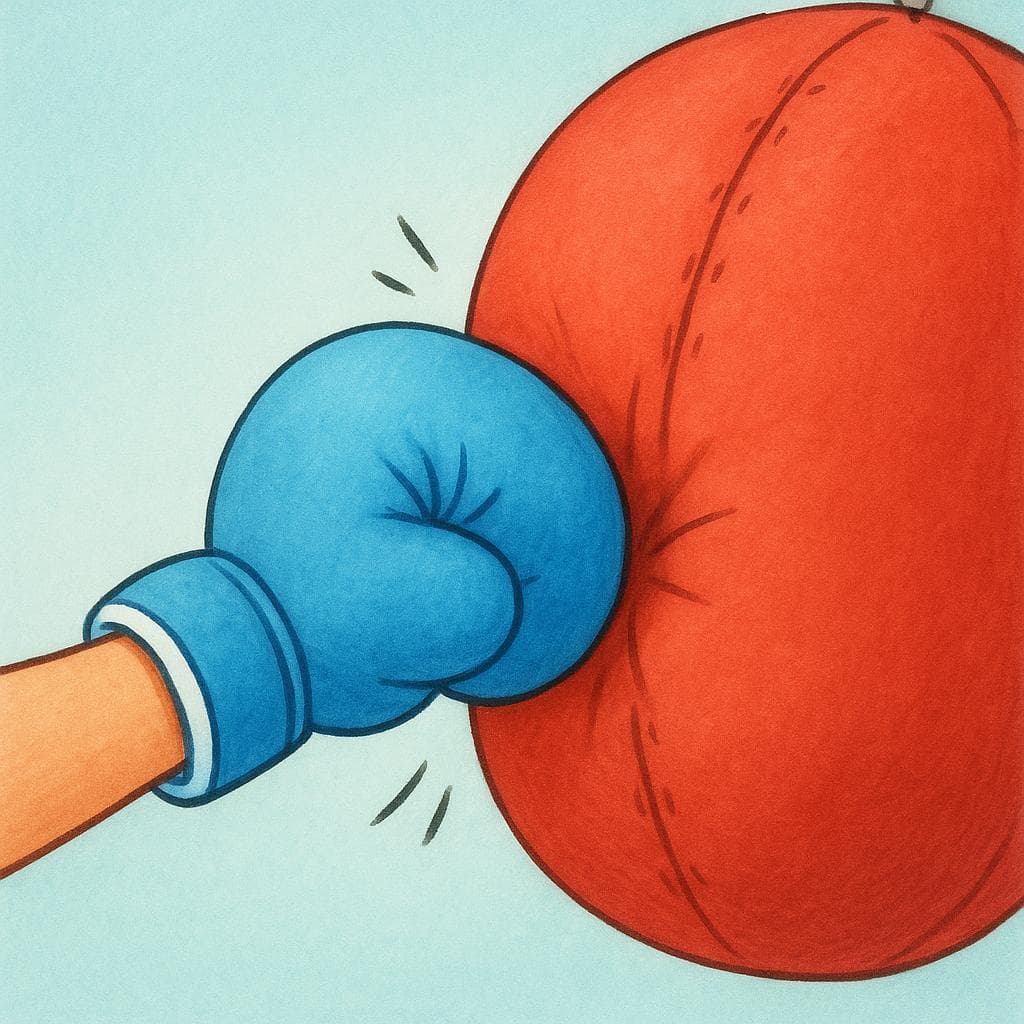
A cartoon child wearing boxing gloves lightly hitting a red punching bag.

Pegar (to hit) can refer to physical contact or striking.

pegar(verb)

A1regular (with minor spelling change) ar

to hit

?

physical contact, striking

,

to punch

?

with a fist

Also:

to strike

?

hitting something hard

📝 In Action

El niño no quería pegar a su hermano.

A1

The boy didn't want to hit his brother.

El boxeador pegó un golpe limpio al oponente.

A2

The boxer landed a clean punch on the opponent.

Si le pegas a la puerta, se va a romper.

A1

If you hit the door, it's going to break.

Word Connections

Synonyms

  • golpear (to hit)
  • dar un puñetazo (to punch)

Common Collocations

  • pegar fuerteto hit hard
  • pegar un gritoto yell/shout (literally: to strike a shout)

💡 Grammar Points

Spelling Tweak (G to GU)

When the 'g' sound needs to come before an 'e', 'pegar' changes to 'pegu-' (like in the past tense 'yo' form: 'yo pegué') so the sound stays strong, like in 'gato'.

⭐ Usage Tips

Indirect Meaning: Shouting

'Pegar un grito' is a common phrase meaning 'to shout' or 'to yell,' even though it literally translates to 'to hit a shout'.

A piece of bright yellow tape firmly sticking a small blue paper square onto a plain wall.

When translating as 'to stick', pegar describes something adhering to a surface.

pegar(verb)

A2regular (with minor spelling change) ar

to stick

?

to adhere to a surface

,

to glue

?

using adhesive

Also:

to paste

?

paper/crafts

,

to attach

?

firmly joining two things

📝 In Action

Necesitas pegamento para pegar las dos piezas de madera.

A2

You need glue to stick the two pieces of wood together.

La etiqueta no pega bien en esta superficie.

A2

The label doesn't stick well on this surface.

Pegué el póster en la pared de mi habitación.

A2

I stuck the poster on my bedroom wall.

Word Connections

Synonyms

  • adherir (to adhere)
  • encolar (to glue (specifically with 'cola'))

Common Collocations

  • pegar con cintato tape/stick with tape
  • pegar algoto glue something

❌ Common Pitfalls

Using 'stick' incorrectly

Mistake: "La goma pegó."

Correction: La goma se pegó. (When the action is happening to the object itself, use the reflexive 'se pegó'.)

⭐ Usage Tips

Related Noun

The related noun for 'glue' or 'adhesive' is often 'pegamento,' which comes directly from 'pegar'.

A small, round, green cartoon microbe floating between two friendly cartoon figures, symbolizing transmission.

Pegar also means 'to infect' or transmit a disease.

pegar(verb)

B1regular (with minor spelling change) ar

to infect

?

transmitting a disease

,

to transmit

?

spreading something

Also:

to catch (a habit)

?

acquiring a behavior from someone else

,

to be contagious

?

used impersonally

📝 In Action

No te acerques, no quiero pegarte la tos.

B1

Don't come near, I don't want to give you (infect you with) the cough.

Esa canción pegó muy fuerte el año pasado.

B2

That song became very popular (caught on) last year. (Informal)

Su mala suerte se me pegó.

B1

His bad luck rubbed off on me (stuck to me).

Word Connections

Synonyms

  • contagiar (to infect/contaminate)
  • transmitir (to transmit)

Common Collocations

  • pegar la gripeto transmit the flu
  • pegarse la risato catch the laughter (to start laughing because others are)

💡 Grammar Points

Using 'Se pegar'

When talking about catching a disease or a habit, you often use the verb reflexively ('pegarse') to show that the thing stuck to you: 'Se me pegó el resfriado' (The cold stuck to me / I caught the cold).

⭐ Usage Tips

Fashion and Trends

In informal Spanish, 'pegar' is used to talk about something becoming popular or successful, like a song or a style: 'Esa moda pegó mucho' (That trend really caught on).

🔄 Conjugations

indicative

present

él/ella/ustedpega
yopego
pegas
ellos/ellas/ustedespegan
nosotrospegamos
vosotrospegáis

imperfect

él/ella/ustedpegaba
yopegaba
pegabas
ellos/ellas/ustedespegaban
nosotrospegábamos
vosotrospegabais

preterite

él/ella/ustedpegó
yopegué
pegaste
ellos/ellas/ustedespegaron
nosotrospegamos
vosotrospegasteis

subjunctive

present

él/ella/ustedpegue
yopegue
pegues
ellos/ellas/ustedespeguen
nosotrospeguemos
vosotrospeguéis

imperfect

él/ella/ustedpegara
yopegara
pegaras
ellos/ellas/ustedespegaran
nosotrospegáramos
vosotrospegarais

✏️ Quick Practice

💡 Quick Quiz: pegar

Question 1 of 2

Which sentence uses 'pegar' in the sense of 'to stick or glue'?

📚 More Resources

Word Family

Frequently Asked Questions

Is 'pegar' rude when it means 'to hit'?

While it simply means 'to hit' or 'to strike,' the context often implies violence, so you should be mindful of the situation. For sports or non-violent actions (like hitting a ball), it is perfectly neutral.

How do I say 'to stick around' or 'to stay close' using 'pegar'?

You would use the reflexive form 'pegarse a alguien/algo' (to stick oneself to someone/something). For example, 'El niño se pegó a su madre' means 'The child stayed close to/clung to his mother.'