Inklingo

pintar

/peen-TAR/

to paint

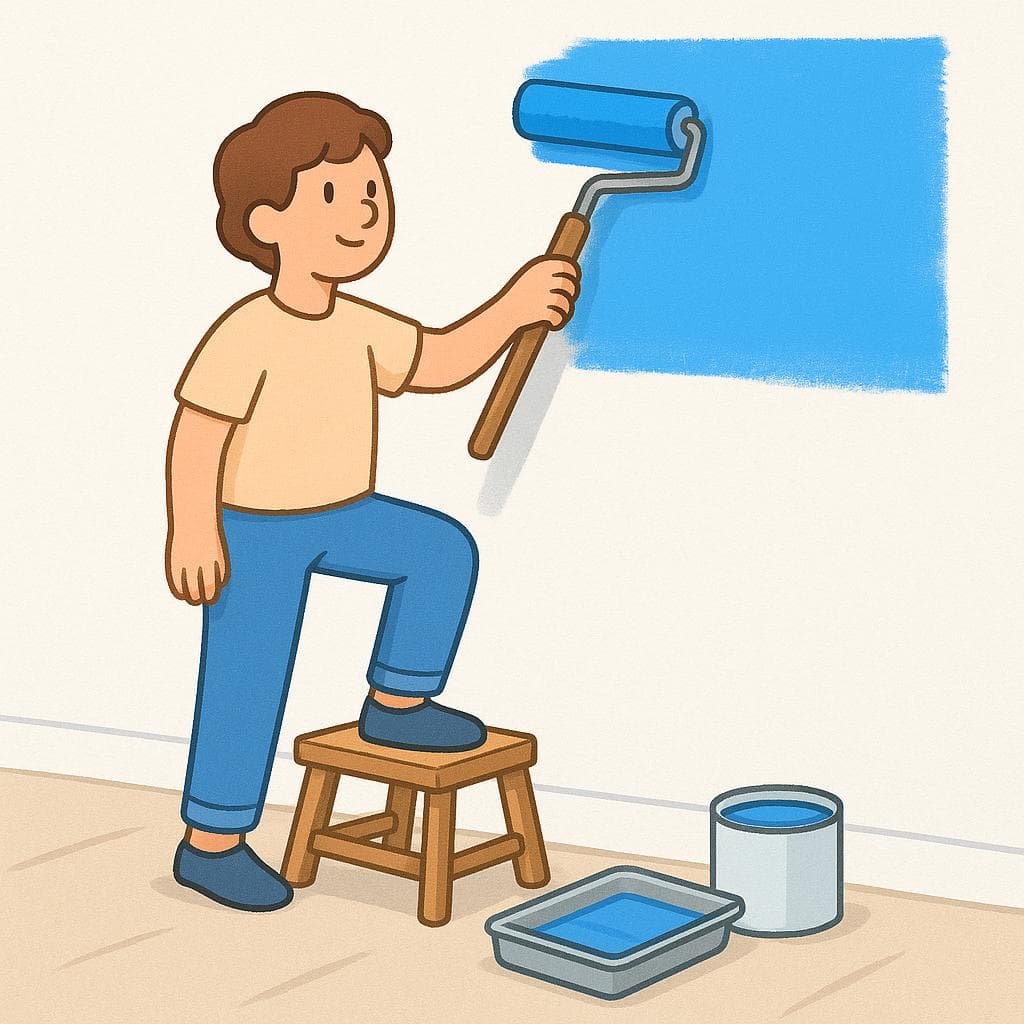
A person using a roller to apply bright blue paint to a plain white indoor wall.

When we use a roller to apply color to a wall, we are using the verb pintar.

pintar(verb)

A1regular ar

to paint

?

applying color to a wall/house

Also:

to color

?

coloring a drawing book

📝 In Action

Tenemos que pintar la cocina de azul.

A1

We have to paint the kitchen blue.

Mi padre pintó toda la casa el verano pasado.

A2

My father painted the whole house last summer.

Word Connections

Synonyms

  • colorear (to color in)
  • decorar (to decorate)

Common Collocations

  • pintar la paredto paint the wall
  • pintar con brochato paint with a brush

💡 Grammar Points

Regular AR Verb

Pintar follows the easiest conjugation pattern in Spanish. Just drop the -ar and add the standard endings for each tense.

⭐ Usage Tips

Use 'de' for Color

When saying what color you paint something, use 'de' (of): 'Pintamos la sala de verde' (We painted the living room green).

A close-up of a hand holding a paintbrush, adding yellow paint to a landscape painting on an easel.

Pintar also describes the act of creating artwork with paint.

pintar(verb)

A2regular ar

to paint

?

creating a picture/artwork

,

to draw

?

creating an image

Also:

to depict

?

representing something

📝 In Action

Picasso pintó obras muy famosas.

A2

Picasso painted very famous works.

¿Qué estás pintando? Parece un paisaje hermoso.

A2

What are you painting? It looks like a beautiful landscape.

Word Connections

Synonyms

  • dibujar (to draw (with lines))
  • retratar (to portray)

Common Collocations

  • pintar un cuadroto paint a painting
  • pintar al óleoto paint in oil

❌ Common Pitfalls

Drawing vs. Painting

Mistake: "Using 'dibujar' for applying paint/color."

Correction: 'Dibujar' (to draw) is for line work, pencil, or sketches. 'Pintar' is for applying paint or color, even if it's a sketch.

A hand holding a red lipstick tube applying the color directly onto a person's lips.

When someone uses makeup, they use the reflexive form of the verb, pintarse.

pintar(verb)

B1regular (reflexive) ar

to put on makeup

?

applying cosmetics to oneself (pintarse)

Also:

to put on nail polish

?

applying varnish to nails (pintarse las uñas)

,

to put on lipstick

?

applying lipstick (pintarse los labios)

📝 In Action

Ella se pinta muy rápido antes de salir.

B1

She puts on her makeup very quickly before leaving.

Me voy a pintar las uñas de rojo para la fiesta.

B1

I'm going to paint my nails red for the party.

Word Connections

Synonyms

  • maquillarse (to put on makeup (general))

Common Collocations

  • pintarse los labiosto put on lipstick
  • pintarse los ojosto put on eye makeup

💡 Grammar Points

Reflexive Use

When you use 'pintar' on yourself (like makeup or nails), you must use the reflexive form: 'pintarse'. This means you need a pronoun like 'me', 'te', 'se', etc.

❌ Common Pitfalls

Mixing up 'pintar' and 'pintarse'

Mistake: "Yo pinto la cara. (I paint the face [of someone else])."

Correction: Yo me pinto la cara. (I paint my own face/put on my own makeup). Remember the reflexive pronoun 'me' when the action comes back to you.

A tiny, dull grey geometric shape isolated on a plain surface, completely ignored by three large, brightly colored, interacting geometric shapes.

In Spanish, pintar can mean 'to be relevant,' often used negatively like no pinta nada (it's not relevant).

pintar(verb)

B2regular ar

to be relevant

?

usually negative: no pinta nada (it's not relevant)

,

to look like

?

to seem or appear

Also:

to play a role

?

figurative usage

📝 In Action

Este mueble aquí no pinta nada, deberíamos quitarlo.

B2

This piece of furniture doesn't belong here at all; we should remove it. (Literally: it doesn't paint anything)

El día pinta bien, creo que no lloverá.

C1

The day looks good, I think it won't rain.

Word Connections

Synonyms

Common Collocations

  • no pintar nadato not belong/to be irrelevant

Idioms & Expressions

  • Pintar bastosTo look bad; to indicate trouble or difficulty (from card games)

💡 Grammar Points

Idiomatic Use

This meaning is almost always used in the phrase 'no pintar nada' to mean something is out of place or irrelevant. It's a very common, informal way to express that something 'doesn't fit'.

⭐ Usage Tips

Figurative Meaning

Think of this meaning as: 'This item/person doesn't contribute color to the scene.' Use it when someone is standing around awkwardly or an object is unnecessary.

🔄 Conjugations

indicative

present

él/ella/ustedpinta
yopinto
pintas
ellos/ellas/ustedespintan
nosotrospintamos
vosotrospintáis

imperfect

él/ella/ustedpintaba
yopintaba
pintabas
ellos/ellas/ustedespintaban
nosotrospintábamos
vosotrospintabais

preterite

él/ella/ustedpintó
yopinté
pintaste
ellos/ellas/ustedespintaron
nosotrospintamos
vosotrospintasteis

subjunctive

present

él/ella/ustedpinte
yopinte
pintes
ellos/ellas/ustedespinten
nosotrospintemos
vosotrospintéis

imperfect

él/ella/ustedpintara
yopintara
pintaras
ellos/ellas/ustedespintaran
nosotrospintáramos
vosotrospintarais

✏️ Quick Practice

💡 Quick Quiz: pintar

Question 1 of 2

Which sentence uses 'pintar' in its figurative, informal meaning?

📚 More Resources

Word Family

pintura(paint; painting (artwork)) - noun

Frequently Asked Questions

What is the difference between 'pintar' and 'dibujar'?

'Pintar' means to apply color, usually using a wet medium like paint or makeup. 'Dibujar' means to draw, usually with lines or pencils, even if you fill in the lines afterward. If you are using oil or acrylic, always use 'pintar'.

Is 'pintar' always regular?

Yes, 'pintar' is a completely regular -AR verb in all tenses, making it one of the easiest verbs to learn and conjugate.