Inklingo

vacías

/vah-SEE-as/

empty

A transparent glass jar sitting on a simple wooden table. The jar is completely empty, showing only the background through the glass.

This empty jar shows the meaning of vacías (empty).

vacías(adjective)

fA1

empty

?

referring to containers or spaces

,

vacant

?

referring to rooms or seats

Also:

hollow

?

figurative or literal

📝 In Action

Las estanterías estaban completamente vacías después de la mudanza.

A2

The shelves were completely empty after the move.

Necesitamos más sillas porque todas estas están vacías.

A1

We need more chairs because all of these are vacant.

Me siento con las manos vacías sin mi teléfono.

B1

I feel like I have empty hands without my phone.

Word Connections

Synonyms

  • desocupadas (unoccupied)
  • libres (free)

Antonyms

Common Collocations

  • manos vacíasempty hands
  • neverías vacíasempty refrigerators

💡 Grammar Points

Matching the Noun

As an adjective, 'vacías' must be used only with feminine, plural nouns (like 'botellas' or 'sillas'). If the noun were masculine plural (like 'vasos'), you would use 'vacíos'.

❌ Common Pitfalls

Using the wrong number

Mistake: "Las caja está vacías."

Correction: La caja está vacía. (The box is singular, so the adjective must also be singular.)

⭐ Usage Tips

To Be or To Be

Use 'estar' (están vacías) to describe the temporary state of being empty, and 'ser' (son vacías) only for a permanent, defining characteristic, though this is rare.

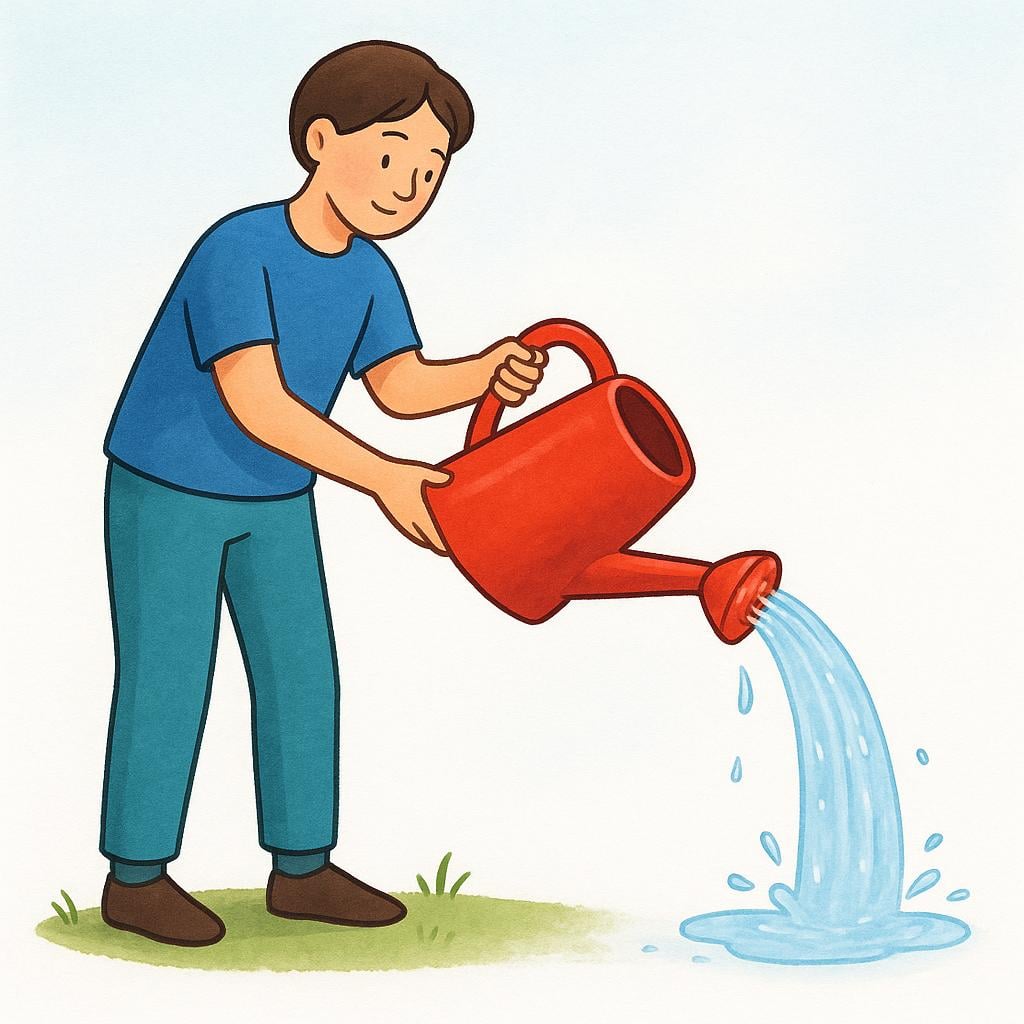
A person is actively tilting a full, red watering can upside down over a patch of green grass. The contents (water) are actively pouring out, illustrating the action of emptying.

The action of emptying a container is shown here, matching the meaning of vacías (you empty).

vacías(verb)

B1stem-changing ar

you empty

?

present action, informal singular 'tú'

,

you are emptying

?

present continuous, informal singular 'tú'

📝 In Action

Cada mañana vacías la cafetera antes de limpiarla.

B1

Every morning you empty the coffee maker before cleaning it.

¿Por qué vacías tu mochila en el suelo?

A2

Why are you emptying your backpack on the floor?

Word Connections

Synonyms

  • desocupas (you clear out)

Antonyms

💡 Grammar Points

Verb Stress Shift

The infinitive is 'vaciar,' but in most present tense forms (like 'vacías'), the stress moves to the 'i', which is why it gets an accent mark when written (vacío, vacías, vacía, vacían).

❌ Common Pitfalls

Confusing 'tú' and 'usted' forms

Mistake: "Usted vacías la basura."

Correction: Usted vacía la basura. (If you are speaking formally to one person, use the 'él/ella/usted' form, which is 'vacía'.)

⭐ Usage Tips

Action vs. State

Remember the difference: 'vacías' (verb) means 'you are performing the action of emptying,' while 'vacías' (adjective) means 'they are empty.'

🔄 Conjugations

indicative

present

nosotrosvaciamos
vacías
él/ella/ustedvacía
yovacío
vosotrosvaciáis
ellos/ellas/ustedesvacían

imperfect

nosotrosvaciábamos
vaciabas
él/ella/ustedvaciaba
yovaciaba
vosotrosvaciabais
ellos/ellas/ustedesvaciaban

preterite

nosotrosvaciamos
vaciaste
él/ella/ustedvació
yovacié
vosotrosvaciasteis
ellos/ellas/ustedesvaciaron

subjunctive

present

nosotrosvaciemos
vacíes
él/ella/ustedvacíe
yovacíe
vosotrosvaciéis
ellos/ellas/ustedesvacíen

imperfect

nosotrosvaciáramos/vaciásemos
vaciaras/vaciases
él/ella/ustedvaciara/vaciase
yovaciara/vaciase
vosotrosvaciarais/vaciaseis
ellos/ellas/ustedesvaciaran/vaciasen

✏️ Quick Practice

💡 Quick Quiz: vacías

Question 1 of 1

Which sentence uses 'vacías' as an action being performed?

📚 More Resources

Word Family

Frequently Asked Questions

How do I know if 'vacías' is the adjective or the verb?

If it follows 'están' or 'son' (forms of 'to be'), it's the adjective describing a feminine plural thing (the boxes are empty). If it follows the pronoun 'Tú' (you) or is the main action of the sentence, it's the verb 'to empty' (you empty the box).

Is 'vacías' used for people?

Yes, but usually in a figurative sense, meaning superficial or lacking substance (e.g., 'palabras vacías' means empty words). When describing a place where people *should* be, like a stadium, it means 'vacant' or 'unoccupied'.