


Mixing Formality
Mistake: “¿Usted tienes hijos?”
Correction: ¿Usted tiene hijos? (formal) or ¿Tú tienes hijos? (informal)
tee-EH-nehs EE-hohs
This is the most common and direct way to ask someone if they have children. It uses the informal 'you' (tú), making it perfect for casual conversations with friends, peers, or people your age.
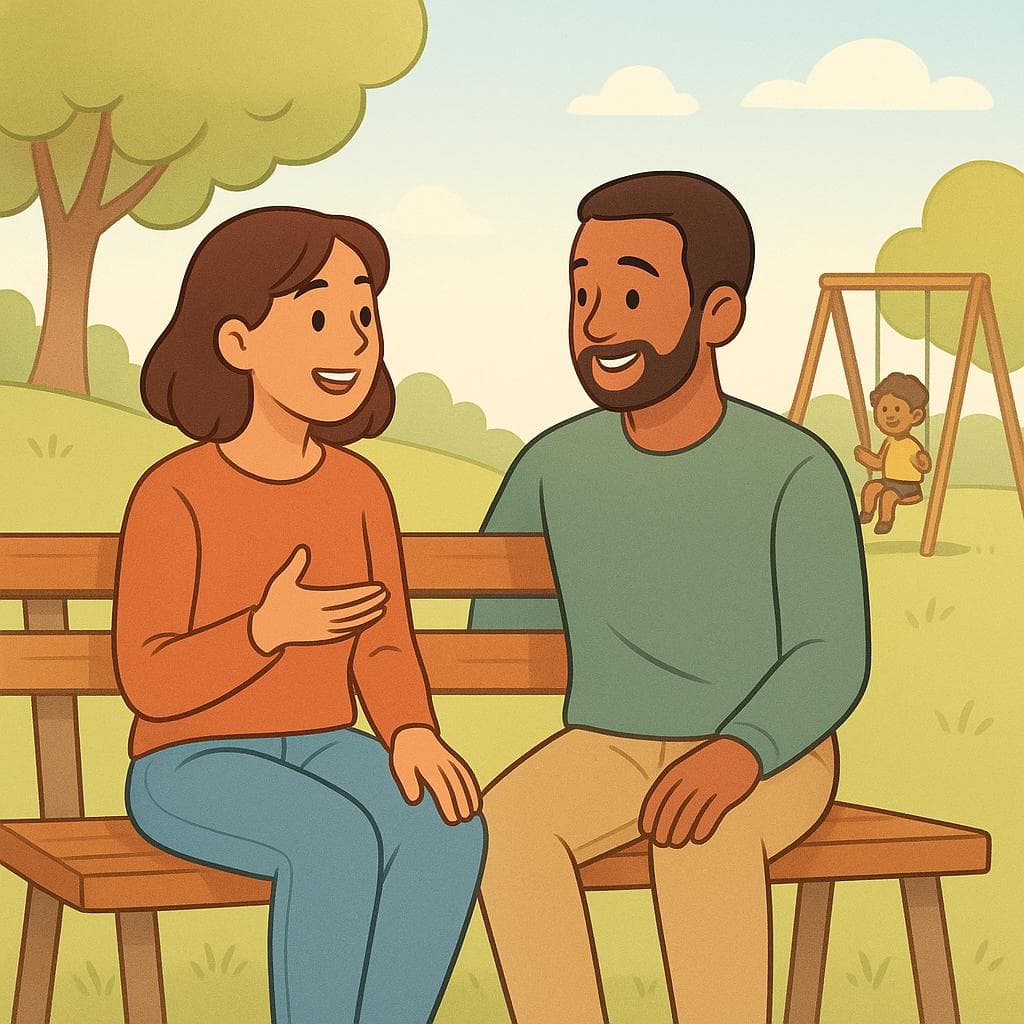
Asking about family, like '¿Tienes hijos?', is a great way to connect with people in Spanish-speaking cultures.
Do you have children? — in Spanish
tee-EH-neh EE-hohs
This is the formal version of the question, using 'usted' (the formal 'you'). It's the polite default when speaking to someone older, a superior, or a stranger you want to show respect to.
tee-EH-nen EE-hohs
This is how you ask a group of two or more people. In Latin America, 'ustedes' is used for all groups (formal and informal). In Spain, it's reserved for formal groups.
teh-NAYCE EE-hohs
This is the informal plural 'you' (vosotros), used almost exclusively in Spain. It's the equivalent of asking a group of friends, 'Do you guys have kids?'.
teh-NEHS EE-hohs
This version uses 'voseo', where 'vos' is used instead of 'tú'. 'Tenés' is the corresponding verb form. It's the standard informal way to ask this question in countries like Argentina.
tee-EH-nehs NEEN-yohs
A common variation using 'niños' instead of 'hijos'. 'Niños' often implies younger children or 'kids', whereas 'hijos' refers to one's offspring of any age. 'Hijos' is the more standard and versatile term.
teh-NAYCE KREE-ohs
A very informal and colloquial term used in Spain. 'Críos' is similar to the English 'kids' or 'little ones'. It has a very casual, friendly feel.
teh-NEHS PEE-behs
A highly regional and informal phrase from the Río de la Plata area. It combines the 'voseo' form ('tenés') with 'pibes', a very common slang word for 'kids' or 'guys/gals'.
Here's a quick guide to choosing the right way to ask about children based on who you're talking to and where you are.
| Phrase | Formality | Best For | Avoid When |
|---|---|---|---|
| ¿Tienes hijos? | Informal | Friends, peers, and people your age in any country. | Speaking to elders, bosses, or in very formal settings. |
| ¿Tiene hijos? | Formal | Strangers, older individuals, authority figures. The safe default. | Chatting with close friends, who might find it overly stiff. |
| ¿Tenéis hijos? | Informal (Plural) | Asking a group of friends or a couple you know well in Spain. | Outside of Spain (they use 'tienen') or in formal situations. |
| ¿Tenés pibes? | Colloquial | Casual, friendly chats with Argentinians or Uruguayans. | Any formal context, or with people from other Spanish-speaking regions. |
The 'h' in 'hijos' is silent, and the 'j' sound is a soft, throaty 'h' sound from the back of the throat, like the 'ch' in 'loch'. It can take a little practice for English speakers.
The main challenge is remembering to switch between the informal 'tienes' (for tú) and the formal 'tiene' (for usted). The concept is simple, but it requires conscious effort at first.
The question is very common, but knowing the right time to ask and which formality level to use is key. It's slightly more personal than in some English-speaking cultures.
Mucho gusto, señora García. Una pregunta, si no es indiscreción, ¿usted tiene hijos?
A pleasure to meet you, Mrs. Garcia. A question, if it's not too personal, do you have children?
¡Qué bonita tu familia! ¿Vosotros tenéis hijos o son sobrinos?
What a beautiful family! Do you guys have children, or are they nieces and nephews?
Che, veo que siempre estás ocupado los fines de semana. ¿Tenés pibes?
Hey man, I see you're always busy on the weekends. Do you have kids?
Hola Carlos, ¿qué tal? Oye, ¿tienes hijos? Quería organizar una parrillada con los niños.
Hi Carlos, how's it going? Hey, do you have children? I wanted to organize a barbecue with the kids.
In most Spanish-speaking cultures, family is a central part of life and a very common topic of conversation. Asking about children is generally seen as a friendly way to get to know someone, not as an intrusive question, especially after some initial small talk.
The word 'hijos' is gender-neutral when used in the plural. It means 'children'. If someone says, "Tengo dos hijos," it could mean two boys, or one boy and one girl. To specify daughters, they would say 'hijas'. 'Hijos' also refers to offspring of any age, from babies to grown adults.
While it's a common question, it's still personal. Avoid making it the very first thing you ask a stranger. It's best to ask after you've already chatted for a bit about other topics like work, hobbies, or where you're from. This makes the question feel more natural and less like an interrogation.
Choosing between the informal 'tú' ('tienes') and the formal 'usted' ('tiene') is crucial. As a learner, defaulting to the formal 'usted' with new acquaintances, especially if they are older, is always the safest and most respectful option. They will often invite you to use 'tú' if they feel comfortable.
Mistake: “¿Usted tienes hijos?”
Correction: ¿Usted tiene hijos? (formal) or ¿Tú tienes hijos? (informal)
Mistake: “¿Haces tienes hijos?”
Correction: ¿Tienes hijos?
Mistake: “Asking someone in their 60s, '¿Tiene niños?'”
Correction: Use '¿Tiene hijos?' instead.
Mistake: “Tienes hijos?”
Correction: ¿Tienes hijos?
For 95% of your conversations, you'll only need '¿Tienes hijos?' (informal) and '¿Tiene hijos?' (formal). Focus on getting comfortable with these two, and you'll be well-prepared for almost any situation.
Pay attention to how the other person addresses you. If they call you 'usted', you should use 'usted' back. If they use 'tú' with you, it's a green light to use 'tú' with them.
After you ask, they will likely ask you back with '¿Y tú?'. Be prepared with your own answer, such as 'Sí, tengo un hijo y una hija' (Yes, I have a son and a daughter) or 'No, no tengo hijos' (No, I don't have children).
If you feel the question might be too direct, you can soften it. Start with a phrase like 'Si no es mucha molestia...' (If it's not too much trouble...) or 'Una pregunta personal, si me permites...' (A personal question, if you'll allow me...).
The defining feature is the use of 'vosotros' ('tenéis') for the informal plural. This form is not used in Latin America. They also use colloquial terms like 'críos' more frequently among friends.
Mexicans use 'ustedes' ('tienen') for all plural groups, both formal and informal. Formality is important, so using '¿Tiene hijos?' (usted) with strangers or elders is standard practice.
The universal use of 'voseo' ('vos' instead of 'tú') is the most distinctive feature. You must use 'tenés' to sound natural in informal conversation. 'Pibes' is the go-to slang for 'kids'.
The pronunciation is the most unique aspect. The grammar is standard Latin American (no 'vosotros'). The rapid pace and dropped consonants can be challenging for learners to understand at first.
Sí, tengo dos.
Yes, I have two.
¿Cuántos años tienen?
How old are they?
No, por ahora no.
No, not for now.
Ah, entiendo.
Oh, I understand.
¿Y tú? / ¿Y usted?
And you?
Sí, tengo una hija de cinco años.
Yes, I have a five-year-old daughter.
This is the most natural follow-up question after someone tells you they have children.
You need to be able to answer the question yourself when they ask you back.
This is another common personal question that fits into conversations about family and relationships.
This broadens your small talk skills to another key topic for getting to know someone.
Question 1 of 4
You are meeting your new, 50-year-old boss in Mexico for the first time. How do you ask if she has children?
Knowing a phrase is one thing — using it at the right moment is another. Read 200+ illustrated and narrated Spanish stories to see phrases in the contexts where they actually belong.
Generally, no. It's a very common part of getting-to-know-you conversations. However, context is key. Ask it naturally during a friendly chat, not as the first question to a complete stranger. If the topic seems sensitive, it's always best to change the subject.
'Hijos' is the most standard and versatile word, referring to your offspring of any age. 'Niños' specifically means 'children' and usually implies they are young. You can't go wrong using 'hijos', but 'niños' is also very common in casual conversation when talking about little kids.
The simplest way is 'No, no tengo hijos.' You can also say 'No tengo' for short. If you want to add more context, you could say 'Todavía no' (Not yet) or 'No, pero me gustaría tenerlos' (No, but I'd like to have them).
This is called 'voseo', a grammatical feature common in Argentina, Uruguay, and parts of Central America. They use the pronoun 'vos' instead of 'tú' for informal address, and the verb changes form accordingly. So, 'tú tienes' becomes 'vos tenés'.
Yes, you still use '¿Tienes hijos?'. The plural 'hijos' is gender-inclusive and is the default way to ask about children in general. If they wanted to specify, they would respond, 'Sí, tengo dos hijas' (Yes, I have two daughters).
When in doubt, use 'usted' ('¿Tiene...?'). It is always polite and respectful. It's much safer to be a little too formal than too informal. Often, if the other person is comfortable with it, they will say 'Puedes tutearme,' which is an invitation to use the more casual 'tú' form.
Strengthen the grammar behind this phrase:
Dive deeper into related topics:
Find similar phrases to expand your Spanish vocabulary:
Browse our complete collection of Spanish phrases organized by situation, from basic greetings to advanced conversations. Perfect for travelers, students, and anyone learning Spanish.
View All Spanish Phrases →