
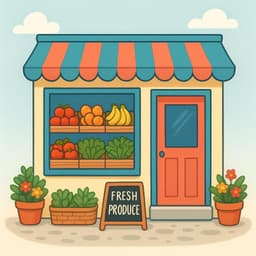


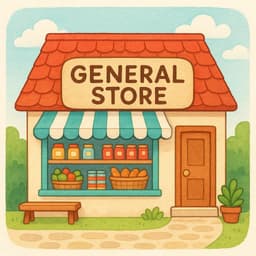
The 'Groserías' Gaffe
Mistake: “Saying 'tienda de groserías' as a literal translation of 'grocery store'.”
Correction: Use 'supermercado' or 'tienda de abarrotes'.
el soo-pehr-mehr-KAH-doh
This is the most common and universally understood word for a modern, self-service grocery store or supermarket, just like in English. If you only learn one word, this is the one to know.

Whether you call it a 'supermercado', 'tienda de abarrotes', or 'almacén', getting your groceries is a universal experience.
grocery store — in Spanish
el SOO-pehr
This is the casual, shortened version of 'supermercado,' similar to how we might say 'the supermarket' or 'the store'. It's extremely common in everyday conversation among friends and family.
la TYEN-dah deh ah-bah-RROH-tes
This specifically refers to a smaller grocery store or corner store that sells 'abarrotes' (dry goods, canned food, staples). In Mexico, this is the go-to term for a neighborhood grocery store that isn't a massive supermarket chain.
la boh-DEH-gah
While it can also mean 'wine cellar,' 'la bodega' commonly refers to a small, neighborhood corner store that sells groceries, drinks, and snacks. It's a key part of daily life in many Spanish-speaking neighborhoods.
el kohl-MAH-doh
Very similar to 'la bodega,' 'el colmado' is a small neighborhood store packed with groceries and essentials. In the Dominican Republic, it's a central social hub, often with music and outdoor seating.
el ahl-mah-SEN
In the Southern Cone, particularly Argentina and Uruguay, 'el almacén' is the word for a small, traditional neighborhood grocery store. It's the equivalent of Mexico's 'tienda de abarrotes'.
la TYEN-dah deh koh-mess-TEE-blays
This is a more formal and somewhat old-fashioned term that literally means 'store of edibles/groceries.' While everyone will understand it, it's less common in casual speech than 'supermercado' or regional variants.
el mehr-KAH-doh
This word means 'market.' It often refers to a traditional market with multiple stalls selling fresh produce, meat, and cheese. However, in many places, people use it interchangeably with 'supermercado,' especially for larger stores.
el ee-pehr-mehr-KAH-doh
This means 'hypermarket' and refers to the huge, big-box style stores like Walmart, Carrefour, or Alcampo that sell groceries plus electronics, clothing, and housewares. It's a 'supermercado' on steroids.
Here's a quick guide to help you choose the right word for 'grocery store' based on the size and type of store.
| Phrase | Store Size | Best For | Key Regions |
|---|---|---|---|
| el supermercado / el súper | Large / All-purpose | Universal | |
| la tienda de abarrotes | Small-Medium | Mexico, Central America | |
| la bodega / el colmado | Small | Spain, Caribbean, Peru | |
| el almacén | Small-Medium | Argentina, Uruguay | |
| el mercado | Varies (often large) | Universal |
Most words are phonetic. The main challenge is the rolled 'r' in 'supermercado' and 'abarrotes,' but it's understandable even without a perfect roll.
It's a noun. You just need to remember its gender (most are masculine, e.g., 'el supermercado', but 'la tienda' is feminine).
The high rating is due to the large number of regional variations. Using the correct local term shows cultural awareness and makes you sound much more natural.
Voy al supermercado a comprar leche y pan.
I'm going to the grocery store to buy milk and bread.
Disculpe, ¿sabe dónde está la tienda de abarrotes más cercana?
Excuse me, do you know where the nearest grocery store is?
Pásame la lista de la compra, voy al súper en diez minutos.
Pass me the shopping list, I'm going to the store in ten minutes.
En mi barrio, prefiero comprar en el almacén de Don José porque todo es más fresco.
In my neighborhood, I prefer to shop at Don José's store because everything is fresher.
In many parts of Latin America and Spain, the small neighborhood store ('la tiendita', 'la bodega', 'el almacén') is a cornerstone of the community. It's not just a place to buy things; it's a social hub where neighbors catch up. Often, you can buy on credit ('fíado') until payday.
While 'supermercados' are common for packaged goods, many people still prefer the traditional 'mercado' for fresh produce, meat, and cheese. These bustling markets offer higher quality, better prices, and a chance to interact directly with vendors.
Unlike the one-stop-shop culture in some countries, it's still very common in the Spanish-speaking world to visit specialized stores. You might go to the 'panadería' for bread, the 'carnicería' for meat, and the 'frutería' for fruit, even if there's a supermarket nearby.
Mistake: “Saying 'tienda de groserías' as a literal translation of 'grocery store'.”
Correction: Use 'supermercado' or 'tienda de abarrotes'.
Mistake: “Asking for 'la bodega' in Mexico or 'la tienda de abarrotes' in Spain.”
Correction: Use the local term or the universal 'supermercado'.
Mistake: “Using 'mercado' when you specifically mean a modern, indoor supermarket.”
Correction: Use 'supermercado' for clarity.
If you're traveling and can't remember the local term for a corner store, 'supermercado' is your safest bet. It's universally understood and will get you pointed in the right direction for a place to buy food.
Pay attention to how people around you refer to their stores. If you hear everyone saying 'voy al súper' or 'necesito algo del colmado,' start using that term to sound more natural and blend in.
Shortening 'supermercado' to 'el súper' is an easy way to make your Spanish sound more relaxed and fluent. It's the equivalent of saying 'I'm running to the store' instead of 'I am proceeding to the supermarket.'
Spaniards frequently use 'la bodega' for a small corner shop selling wine, cured meats, and basic groceries. Large hypermarkets like Carrefour or Alcampo are called 'hipermercados'.
'La tienda de abarrotes' or simply 'la tiendita' is the heart of the Mexican neighborhood. It's where you go for daily essentials. Large chains like Soriana or Chedraui are 'supermercados'.
'El colmado' is king. It's more than a store; it's a social institution, especially in the Dominican Republic. It's the place to buy a cold beer, groceries, and chat with neighbors.
'El almacén' is the traditional term for the neighborhood grocery. A very common colloquialism is 'el chino,' referring to the thousands of small supermarkets run by Chinese immigrants, a huge part of city life in Buenos Aires.
¿Necesitas algo?
Do you need anything?
No, gracias, estoy bien. / Sí, ¿me traes un refresco?
No, thanks, I'm good. / Yes, can you bring me a soda?
Siga todo recto dos cuadras y está a la izquierda.
Go straight for two blocks and it's on the left.
Perfecto, ¡muchas gracias!
Perfect, thank you very much!
¿Le puedo ayudar en algo?
Can I help you with anything?
Sí, por favor. ¿Dónde encuentro el aceite?
Yes, please. Where can I find the oil?
This directly connects the Spanish word to its obvious English equivalent, making it almost impossible to forget.
This links the common Spanish term 'bodega' to its other English meaning, creating a memorable visual for a small corner store.
The biggest difference is the cultural importance of specialized and neighborhood stores in the Spanish-speaking world. While English speakers often do all their shopping at one large 'supermarket,' it's very common for Spanish speakers to visit the 'panadería' (bakery), 'carnicería' (butcher), and 'frutería' (fruit shop) separately, in addition to the 'supermercado' for packaged goods. The small corner store ('bodega', 'tiendita') is a much more central part of daily life than in many English-speaking countries.
Why it''s different: A direct, word-for-word translation would be 'tienda de groserías', but 'groserías' means 'swear words' or 'rudeness'. This is a classic false friend that will cause confusion and amusement.
Use instead: Always use 'supermercado', 'tienda de comestibles', or a correct regional term like 'tienda de abarrotes'.
Once you find the store, you'll need to know what to buy inside.
This is the next logical step in any shopping interaction.
Useful for asking for directions to the store or for finding items within it.
A fundamental phrase for expressing what you want to buy.
Question 1 of 4
You're in Madrid and need to buy some cheese and a bottle of wine from a small corner shop. Which word is best to ask for?
Knowing a phrase is one thing — using it at the right moment is another. Read 200+ illustrated and narrated Spanish stories to see phrases in the contexts where they actually belong.
A 'supermercado' is a modern, indoor store with aisles and shopping carts, like a Safeway or Tesco. A 'mercado' is often a traditional market, sometimes open-air, with many individual stalls selling fresh produce, meat, and local goods. However, people sometimes use 'mercado' casually to refer to a supermarket, so context is key.
Yes, in casual conversation, 'el súper' is perfectly fine and very common. It's the equivalent of saying 'the store' or 'the supermarket' in English. For more formal situations or if you want to be very clear, use the full 'supermercado'.
'Supermercado' is your safest bet everywhere. However, if you're in Argentina or Uruguay, people will be impressed if you use 'almacén' for a smaller shop. The key is to listen to what the locals say.
It literally means 'store of edibles' and is a more formal, technical term for a grocery store. You might see it on official signs or in writing, but you'll rarely hear people use it in everyday conversation. Stick to 'supermercado' or the local term.
While 'abarrotes' means staple goods, the phrase 'tienda de abarrotes' is very specific to Mexico and parts of Central America. Using it in Spain or Argentina would be like asking for a 'drugstore' in the UK when you mean a 'chemist' – they might figure it out, but it's not the local term.
For those giant, all-in-one stores, the best word is 'hipermercado'. This clearly communicates that you're looking for a 'hypermarket' that sells everything from food to electronics and clothing.
Strengthen the grammar behind this phrase:
Dive deeper into related topics:
Find similar phrases to expand your Spanish vocabulary:
Browse our complete collection of Spanish phrases organized by situation, from basic greetings to advanced conversations. Perfect for travelers, students, and anyone learning Spanish.
View All Spanish Phrases →