





Forgetting Gender Agreement
Mistake: “A female speaker saying 'Soy hijo único' or a male speaker saying 'Soy hija única'.”
Correction: Always match both words to your gender: 'Soy hijo único' (male) or 'Soy hija única' (female).
soy EE-hoh OO-nee-koh
This is the most direct and standard way for a male to say 'I am an only child.' If you are female, you must change it to 'Soy hija única'.
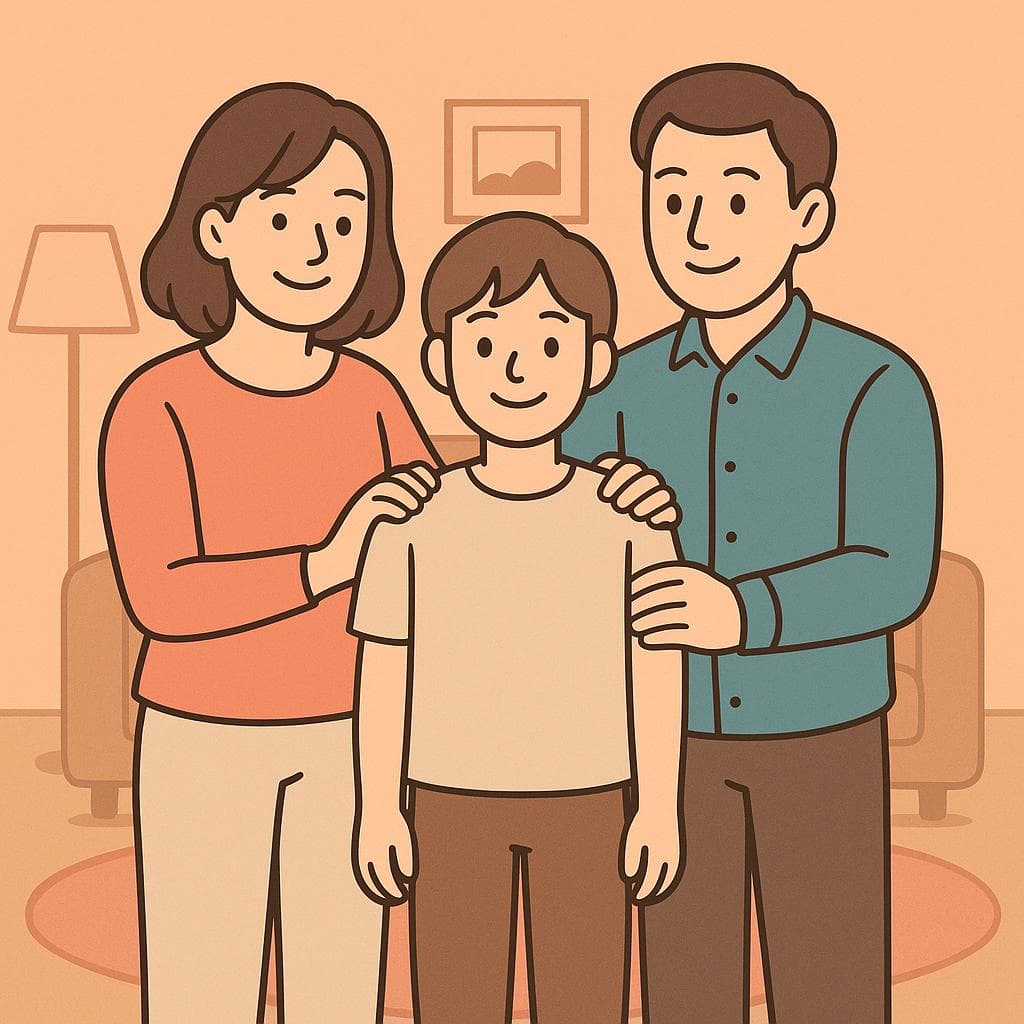
Whether you say 'Soy hijo único' or 'Soy hija única,' you're describing your special place in the family.
I am an only child — in Spanish
soy EE-hah OO-nee-kah
This is the grammatically required version for a female speaker. In Spanish, nouns and adjectives that describe people must match their gender.
noh TEN-goh er-MAH-nohs
This phrase means 'I don't have siblings.' It's an extremely common and natural way to express the same idea, and it avoids the need for gender agreement.
SOH-mohs SOH-loh mees PAH-dres ee yoh
Meaning 'It's just my parents and me,' this is a warmer, more descriptive way to talk about your family structure. It focuses on who is in your immediate family.
fwee EE-hoh / EE-hah OO-nee-koh / OO-nee-kah
This is the past tense version, 'I was an only child.' While grammatically correct, most people use the present tense ('Soy...') even when talking about their childhood.
Here's a quick comparison of the two most common ways to express that you're an only child.
| Phrase | Literal Meaning | Best For | Nuance |
|---|---|---|---|
| Soy hijo/a único/a | Neutral | Stating your family status directly, as a defining characteristic. | It can feel slightly more formal or definitive than the alternative. |
| No tengo hermanos | Neutral | Directly answering the question 'Do you have siblings?' in a very natural way. | Never, it's always a great and safe option for any context. |
Generally easy for English speakers. The 'h' in 'hijo/a' is silent, and the vowels are pure. The 'j' sound is a soft 'h' from the back of your throat.
The concept is simple, but the mandatory gender agreement for both the noun and adjective ('hija única') is the main grammatical hurdle for learners.
The concept is straightforward and universal. There are no significant cultural traps to worry about when using this phrase.
Mi novio es hijo único y a veces le cuesta compartir.
My boyfriend is an only child and sometimes he has a hard time sharing.
¿Tienes una familia grande? — No, de hecho, soy hija única.
Do you have a big family? — No, actually, I'm an only child.
Mucha gente piensa que los hijos únicos son consentidos, pero no siempre es el caso.
A lot of people think that only children are spoiled, but that's not always the case.
Al no tener hermanos, aprendí a ser muy independiente desde pequeña.
By not having siblings, I learned to be very independent from a young age.
Unlike in English, you cannot say 'only child' in a gender-neutral way. You must specify 'hijo único' (only son) or 'hija única' (only daughter). This is a fundamental rule in Spanish, and getting it right will make you sound much more natural.
Family is a central part of life and conversation in most Spanish-speaking cultures. Don't be surprised if people ask about your siblings early on when getting to know you. It's a sign of friendly interest, not of being nosy.
Just like in English, stereotypes about only children exist. You might hear jokes about them being 'consentido/a' (spoiled) or 'mimado/a' (pampered). It's usually lighthearted, but it's a cultural stereotype that sometimes comes up in conversation.
Mistake: “A female speaker saying 'Soy hijo único' or a male speaker saying 'Soy hija única'.”
Correction: Always match both words to your gender: 'Soy hijo único' (male) or 'Soy hija única' (female).
Mistake: “Saying 'Soy solo niño' or 'Soy una niña sola'.”
Correction: Soy hijo/hija único/a.
Mistake: “Saying 'Soy un hijo único.'”
Correction: Soy hijo único.
From day one, figure out which version applies to you ('Soy hijo único' or 'Soy hija única') and practice it until it's automatic. This will help you avoid the common gender-agreement mistake.
'No tengo hermanos' (I don't have siblings) is a fantastic, all-purpose alternative. It's 100% correct, natural, and you don't have to worry about gender agreement. It's the perfect answer to '¿Tienes hermanos?'
Since family is a popular topic, after you say you're an only child, people might ask if you liked it ('¿Y te gustaba?') or if it was lonely ('¿No te sentías solo/a?'). Having a simple answer ready can help the conversation flow smoothly.
This is a very standardized phrase across the entire Spanish-speaking world. The vocabulary and structure do not change, which makes it easy to learn and use everywhere.
Usage is identical to Latin America. Any differences are purely phonetic based on the speaker's regional accent.
The vocabulary is the same, but the intonation (singsong rhythm) and the 'sh' sound for 'y' and 'll' are distinctive markers of the Rioplatense accent.
¿En serio? ¿Y te gustaba serlo?
Really? And did you like being one?
Sí, la verdad es que sí, tenía sus ventajas.
Yes, I actually did, it had its advantages.
¡Ah, qué bien! ¡No tenías que compartir tus cosas!
Oh, that's great! You didn't have to share your things!
Jaja, ¡exacto! Todo era para mí.
Haha, exactly! Everything was for me.
¿Nunca te sentiste solo/a?
Did you never feel lonely?
A veces un poco, pero tenía muchos amigos.
Sometimes a little, but I had a lot of friends.
The biggest difference is the mandatory gender agreement. English uses the gender-neutral term 'child,' but Spanish forces a choice between 'hijo' (son) and 'hija' (daughter). Furthermore, the adjective 'único' (only/unique) must also change to 'única' to match the gender, a concept that doesn't exist for most English adjectives.
The phrase is just as direct in Spanish as it is in English. It's a simple statement of fact with no hidden meanings or levels of politeness.
Why it''s different: In Spanish, the word for 'single' is 'soltero/a,' which refers to being unmarried. Saying you are a 'niño soltero' would sound very strange, as if you're a child who isn't married.
Use instead: Always use 'Soy hijo/a único/a' to mean you have no siblings.
This is the question that most often prompts you to say you're an only child.
It's the natural next step in learning to describe your family.
A great way to generally describe your family after stating you're an only child.
Expands on the topic of family, allowing you to introduce the people you mentioned.
Question 1 of 3
A woman named Ana is talking about her family. How should she say 'I am an only child'?
Knowing a phrase is one thing — using it at the right moment is another. Read 200+ illustrated and narrated Spanish stories to see phrases in the contexts where they actually belong.
Yes, in standard Spanish you must choose. 'Hijo' is for males and 'hija' is for females. While there are modern movements for gender-neutral language (like using 'hije'), it is not widespread, and 'hijo/a único/a' remains the standard and universally understood way to say this.
Not at all! Both are 100% correct and natural. 'No tengo hermanos' (I don't have siblings) is often a more direct answer to the question '¿Tienes hermanos?'. Think of them as two equally good ways to express the same idea.
This is a general rule in Spanish. When you're stating a profession, nationality, or a core identity trait right after the verb 'ser' (to be), you usually omit the article ('a' or 'an'). For example, you say 'Soy doctor' (I am a doctor), not 'Soy un doctor'.
Absolutely! You just need to change the verb. For example, 'Mi amigo es hijo único' (My male friend is an only child) or 'Mi amiga es hija única' (My female friend is an only child).
Besides 'only,' 'único/a' also means 'unique.' The context makes the meaning clear. For example, 'Es una oportunidad única' means 'It's a unique opportunity.' When used with 'hijo/a,' it always means 'only'.
Strengthen the grammar behind this phrase:
Dive deeper into related topics:
Find similar phrases to expand your Spanish vocabulary:
Browse our complete collection of Spanish phrases organized by situation, from basic greetings to advanced conversations. Perfect for travelers, students, and anyone learning Spanish.
View All Spanish Phrases →