



Confusing 'Regalo' and 'Don'
Mistake: “Using 'don' to talk about a physical present.”
Correction: Use 'regalo' or 'obsequio' for objects.
ehs PAH-rah reh-GAH-loh
The most common phrase used in stores to tell a cashier that you are buying the item for someone else, implying you want the price removed or the item wrapped.
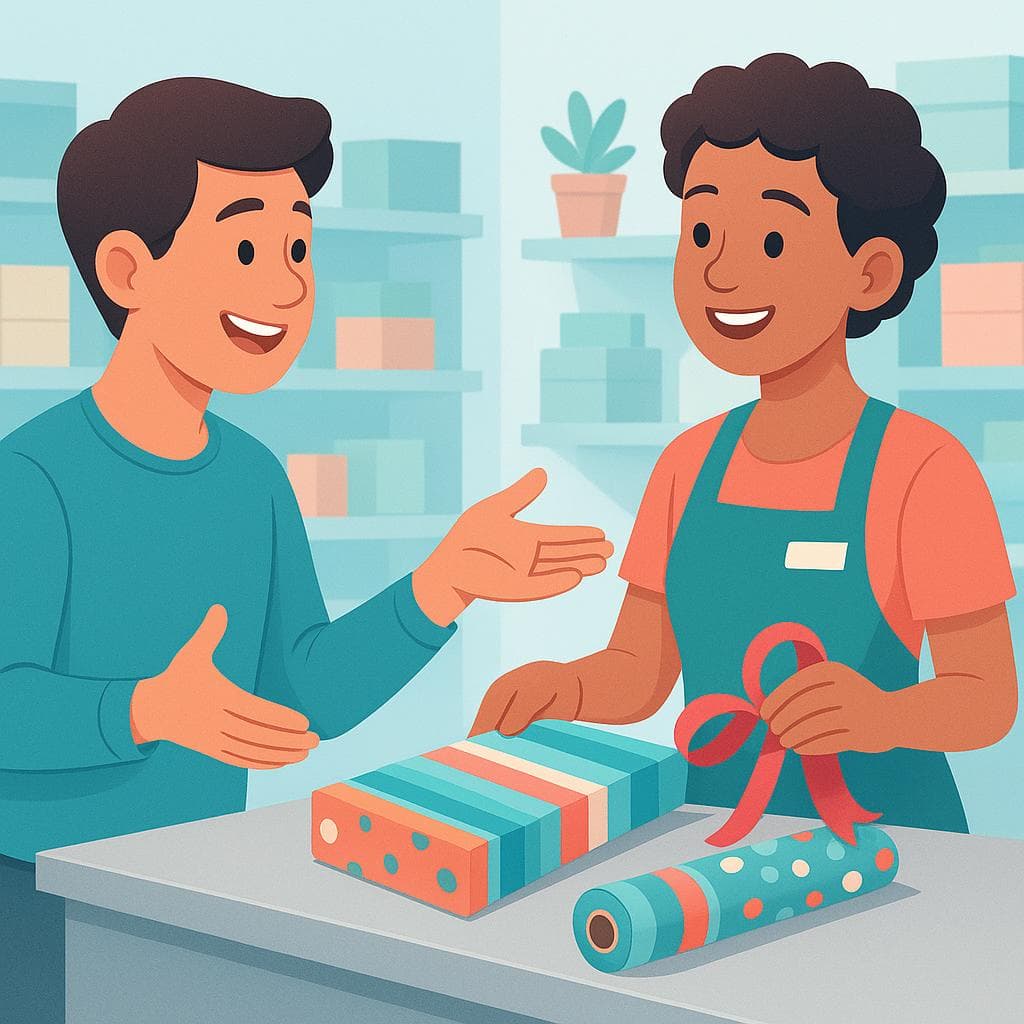
Use 'Es para regalo' at the checkout counter to let the cashier know you need the item wrapped or the price removed.
It is a gift — in Spanish
ehs oon reh-GAH-loh
The literal translation. Use this when handing the object to someone or describing what the object is.
ehs oon deh-TAH-yeh
Literally 'It is a detail.' A humble, polite way to downplay the value of a gift so the receiver doesn't feel overwhelmed.
meh loh PWEH-deh ehn-bohl-BEHR
Directly asks 'Can you wrap it for me?' Focuses on the action of wrapping rather than the nature of the item.
ehs oon ohb-SEH-kyoh
A more elegant, slightly formal word for 'gift' or 'present.' often used in business or formal invitations.
ehs oon dohn
Refers to a 'gift' in the sense of a talent or ability, not a physical object.
Choose the right phrase depending on whether you are buying the item, handing it over, or trying to be modest.
| Phrase | Formality | Best For | Avoid When |
|---|---|---|---|
| Es para regalo | Neutral | Shopping / Talking to cashiers | Handing the gift to a friend |
| Es un regalo | Neutral | Identifying the object / Giving it | Asking for wrapping (less clear) |
| Es un detalle | Polite/Humble | Giving a gift modestly | Talking to a cashier |
Standard Spanish sounds. The 'r' in 'regalo' requires a slight trill, but is generally understood even if soft.
Simple 'Ser' + Noun structure. The only trick is remembering 'para' vs 'un'.
Knowing when to use 'detalle' vs 'regalo' takes some social awareness, but mistakes aren't offensive.
Por favor, cóbrelo aparte, es para regalo.
Please ring this up separately, it is for a gift.
No tenías que molestarte. — Tranquila, es solo un detalle.
You didn't have to bother. — Relax, it's just a little gesture (small gift).
¿Me podría dar un ticket regalo, por favor?
Could you give me a gift receipt, please?
¡Feliz cumpleaños! Esto es un regalo de parte de todos nosotros.
Happy birthday! This is a gift from all of us.
In Spanish-speaking cultures, calling a gift 'un detalle' (a detail/gesture) is a very common way to be modest. Even if the gift is expensive or thoughtful, the giver will often say, 'Es solo un detalle' to ensure the receiver doesn't feel indebted or embarrassed by the generosity.
In many Spanish and Latin American department stores (like El Corte Inglés in Spain or Liverpool in Mexico), gift wrapping is taken very seriously. There is often a dedicated counter called 'Empaquetado' where they will wrap your items beautifully for free or a small fee if you say 'Es para regalo.'
Social norms vary, but generally in Hispanic cultures, if you are handed a gift in person, it is polite to open it right there in front of the giver and express enthusiasm. Setting it aside to open later can sometimes be seen as a lack of interest.
Mistake: “Using 'don' to talk about a physical present.”
Correction: Use 'regalo' or 'obsequio' for objects.
Mistake: “Saying 'Es regalo' to a cashier.”
Correction: Es PARA regalo.
If you are buying clothes or something that might need to be returned, memorize the phrase 'ticket regalo' (Spain) or 'ticket de regalo' (Latin America). This is a receipt that proves purchase but hides the price.
Say 'es para regalo' BEFORE the cashier finishes scanning. This alerts them to remove price stickers or put the item in a special box before they bag it.
In Spain, 'ticket regalo' is the specific term for a gift receipt. It is very common to ask for this.
Service is very polite. You might hear '¿Gusta que se lo envuelva?' (Would you like me to wrap it?).
You may hear 'presente' used slightly more often as a synonym for gift in formal contexts.
¿Quiere ticket regalo?
Do you want a gift receipt?
Sí, por favor. Y si puede quitar el precio.
Yes, please. And if you can remove the price.
¡Muchas gracias! Me encanta.
Thank you so much! I love it.
Espero que te guste / Que lo disfrutes.
I hope you like it / Enjoy it.
Think of 'REGAL' (royal). A 'regalo' is something fit for a king. Don't confuse it with 'regalía' (royalty payment). Just remember: You give a REGALo.
Think of 'PARA' as 'PURPOSE'. When you are at the store, the purpose of the item is a gift. 'Es PARA regalo.'
In English, we often say 'It's a gift' for both the object and the shopping action. Spanish distinguishes slightly by adding 'para' (for) when talking about the intention/wrapping service at a store.
Why it''s different: 'Presente' exists in Spanish but usually means 'present time' or 'here/present'. While it can mean gift, 'regalo' is used 95% of the time.
Use instead: Use 'regalo' instead of 'presente' to sound natural.
The most common occasion for using the phrase 'it is a gift'.
Essential shopping vocabulary to use before asking for gift wrapping.
To respond politely after someone thanks you for the gift.
Question 1 of 3
You are at a store checkout and want the price tag removed because you are buying it for a friend. What do you say?
Knowing a phrase is one thing — using it at the right moment is another. Read 200+ illustrated and narrated Spanish stories to see phrases in the contexts where they actually belong.
You can, and they will likely understand, but 'Es para regalo' is the complete and natural sentence. Simply saying 'regalo' might sound a bit abrupt, like shouting 'Gift!' at them.
'Regalo' is the everyday word used 90% of the time. 'Obsequio' is much more formal, often used in business contexts, on formal invitations, or by store staff trying to sound very polite.
In Spain, ask for a 'ticket regalo.' In Latin America, it is often 'ticket de regalo' or 'recibo de regalo.' This allows the recipient to exchange the item without seeing the price.
It can be, but it is rare and sounds quite old-fashioned or overly formal in daily conversation. It's safer and more natural to stick with 'regalo'.
Strengthen the grammar behind this phrase:
Dive deeper into related topics:
Find similar phrases to expand your Spanish vocabulary:
Browse our complete collection of Spanish phrases organized by situation, from basic greetings to advanced conversations. Perfect for travelers, students, and anyone learning Spanish.
View All Spanish Phrases →