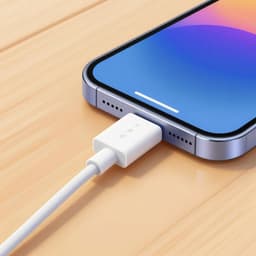





Confusing 'Cargador' with 'Enchufe'
Mistake: “Asking a friend, '¿Me prestas tu enchufe?' when you want to borrow their charger.”
Correction: ¿Me prestas tu cargador?
car-gah-DOR deh seh-loo-LAR
This is the most common and widely understood way to say 'phone charger' throughout Latin America. It literally means 'charger of cellphone' and is a safe bet in most countries outside of Spain.

Finding a 'cargador' when your battery is low is a great feeling. Knowing the right word to ask for one is a traveler's superpower.
phone charger — in Spanish
car-gah-DOR deh MOH-beel
This is the standard and most correct term for 'phone charger' in Spain. Using 'móvil' instead of 'celular' is the key difference.
el car-gah-DOR
Just like saying 'the charger' in English, this shortened version is extremely common when the context makes it obvious you're talking about a phone.
car-gah-DOR del teh-LEH-foh-noh
A slightly more formal or explicit way to say 'the phone's charger'. It's universally understood and a good, clear option if you're ever unsure.
el KAH-bleh
Often, people will just refer to the cable part of the charger, especially since the plug or 'brick' part is sometimes separate. This is a very common informal shortcut.
el ah-lee-men-tah-DOR
This is a more technical term, literally meaning 'the feeder' or 'power supply'. You won't use it in everyday conversation, but you might see it on packaging or in instruction manuals.
Here’s a quick guide to choosing the best term for 'phone charger' based on where you are and who you're talking to.
| Phrase | Formality | Best For | Avoid When |
|---|---|---|---|
| cargador de celular | Neutral | In Spain, where 'cargador de móvil' is the standard. | |
| cargador de móvil | Neutral | In Latin America, as it sounds distinctly foreign (Spanish). | |
| el cargador | Casual | In a store or when you need to be very specific about what you need. | |
| cargador del teléfono | Neutral | In very casual conversation, where it might sound a bit too formal. |
Fairly easy. The main challenge is stressing the final syllable in 'cargador' (car-gah-DOR) and the tapped 'r' sound.
Very simple. It's a masculine noun phrase, so you just need to remember to use 'el' or 'un'.
The main complexity is regional: knowing to use 'celular' in Latin America and 'móvil' in Spain is key to sounding natural.
¿Me prestas tu cargador de celular? Mi batería está muerta.
Can I borrow your phone charger? My battery is dead.
Disculpe, olvidé mi cargador de móvil en casa. ¿Sabe dónde puedo comprar uno?
Excuse me, I forgot my phone charger at home. Do you know where I can buy one?
Necesito un cargador con entrada tipo C, por favor.
I need a charger with a Type-C input, please.
¡No encuentro mi cargador por ninguna parte!
I can't find my charger anywhere!
The biggest difference you'll find is 'móvil' (Spain) vs. 'celular' (Latin America). While people in Latin America will understand 'móvil', it will instantly mark you as a foreigner, likely from Spain. Stick to 'celular' in the Americas to sound more natural.
A common point of confusion for learners is the difference between 'cargador' (the charger device) and 'enchufe' (the electrical socket in the wall). If you need a charger, ask for a 'cargador'. If you have a charger and need a place to plug it in, ask '¿Dónde hay un enchufe?'
When traveling, remember that Spain (and the rest of Europe) uses a different plug type (Type F) and voltage (230V) than most of the Americas (Types A/B, 110-120V). A 'cargador' from one region might need an adapter to work in the other, so it's a very practical word to know!
Mistake: “Asking a friend, '¿Me prestas tu enchufe?' when you want to borrow their charger.”
Correction: ¿Me prestas tu cargador?
Mistake: “Saying 'Necesito un cargador de móvil' in Mexico or Colombia.”
Correction: Necesito un cargador de celular.
Mistake: “La cargador or una cargador.”
Correction: El cargador or un cargador.
If you're holding your phone and look panicked, simply asking '¿Un cargador?' will get your point across anywhere in the Spanish-speaking world. Context is your best friend, and this simple, shortened version is universally understood.
Chargers aren't one-size-fits-all. Be ready to specify what you need by saying, for example, 'un cargador para iPhone' (a charger for iPhone) or 'un cargador con cable tipo C' (a charger with a type C cable).
A great, polite phrase to have ready is 'Disculpa, ¿tendrías un cargador que me prestes?' (Excuse me, would you have a charger you could lend me?). It's softer and more polite than demanding one.
Spain is the only major region that exclusively uses 'móvil' for cellphone. Using 'celular' will immediately mark you as a non-native or as someone who learned Spanish in the Americas.
Usage is very straightforward. 'Celular' is the standard, and the shortened 'cargador' is extremely common in everyday speech.
'Celular' is the universal term here. The main regional flavor comes from the accent and melody of the speech, not the vocabulary for this item.
The pronunciation is the most unique feature. The vocabulary is standard Latin American Spanish, but the rhythm and sound are distinct to the Caribbean.
Sí, ¿de qué tipo lo necesitas?
Yes, what type do you need?
Uno para iPhone / Uno tipo C, por favor.
One for an iPhone / A type C one, please.
Claro, aquí tienes.
Of course, here you go.
¡Mil gracias! Te lo devuelvo en un momento.
A thousand thanks! I'll give it back to you in a moment.
Lo siento, no tengo uno compatible.
I'm sorry, I don't have a compatible one.
No te preocupes, gracias de todos modos.
Don't worry, thanks anyway.
This connects the Spanish word to a familiar English root, making it easier to remember that a 'cargador' is what carries the power.
This is the logical next question after you find a charger.
This explains why you need a charger in the first place.
This provides the polite structure ('¿Me prestas...?') for asking for a charger or anything else.
It's another essential tech-related question for any traveler or visitor.
Question 1 of 3
You're in a cafe in Madrid and your phone is about to die. What's the most natural way to ask the person next to you if they have a charger?
Knowing a phrase is one thing — using it at the right moment is another. Read 200+ illustrated and narrated Spanish stories to see phrases in the contexts where they actually belong.
The single most important thing is the regional difference: use 'cargador de móvil' in Spain and 'cargador de celular' everywhere in Latin America. Getting this right will make you sound much more natural.
Yes, absolutely! In 9 out of 10 situations, the context will make it clear you're talking about a phone. Just asking '¿Tienes un cargador?' is perfectly normal and common everywhere.
It's masculine. Always remember to say 'un cargador' (a charger) or 'el cargador' (the charger). A common mistake is to use 'una' or 'la'.
You would be more specific. You can say 'el cargador de mi laptop' or 'el cargador de mi computadora portátil'. In this case, just saying 'el cargador' might cause confusion.
You can ask, '¿Qué tipo de entrada tiene?' (What type of input does it have?) or more simply, '¿Es para iPhone o Android?' (Is it for iPhone or Android?).
'Alimentador' is a technical term for a power supply. You might see it on packaging or in a manual, but it's very rare in everyday conversation. Stick with 'cargador'.
Strengthen the grammar behind this phrase:
Find similar phrases to expand your Spanish vocabulary:
Browse our complete collection of Spanish phrases organized by situation, from basic greetings to advanced conversations. Perfect for travelers, students, and anyone learning Spanish.
View All Spanish Phrases →