



Using the Wrong Word for 'Room'
Mistake: “Learners sometimes say 'servicio de sala'. 'Sala' means living room, which isn't correct in a hotel context.”
Correction: Use 'servicio de habitaciones' or 'servicio al cuarto'.
sehr-VEE-see-oh deh ah-bee-tah-SYOH-nehs
This is the most standard and universally understood term for 'room service'. It literally translates to 'service of rooms' and is appropriate in any hotel setting.
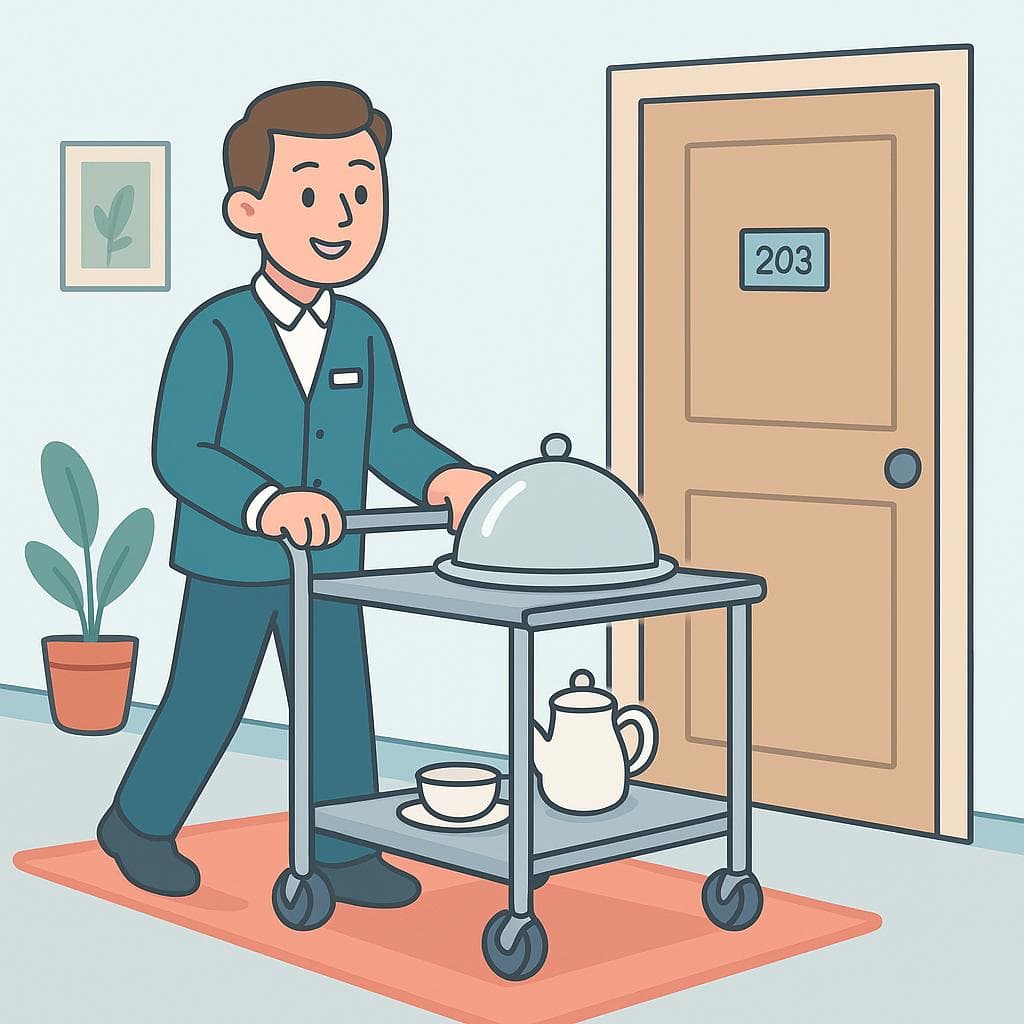
Whether you call it 'servicio de habitaciones' or 'servicio al cuarto', getting food delivered to your room is a great travel perk.
room service — in Spanish
sehr-VEE-see-oh ahl KWAHR-toh
Meaning 'service to the room', this is an extremely common alternative, especially throughout Latin America. In many places, it's used more frequently than 'servicio de habitaciones'.
ehl ROOM sehr-vees
Due to the global nature of tourism, simply using the English term is very common and widely understood, especially in hotels that cater to international guests. It's treated as a masculine noun, hence 'el'.
sehr-VEE-see-oh ah lah ah-bee-tah-SYOHN
This is a slight variation of the primary translation, meaning 'service to the room' (singular). It's perfectly correct and used interchangeably with the plural form.
Here’s a quick comparison to help you choose the best phrase for your situation.
| Phrase | Formality | Best For | Avoid When |
|---|---|---|---|
| servicio de habitaciones | Neutral | Universal use in any hotel; it's the most 'textbook correct' term. | Never necessary to avoid, but 'servicio al cuarto' might sound more common in parts of Latin America. |
| servicio al cuarto | Neutral | Sounding like a local in Mexico and much of Latin America. | No need to avoid, but might be slightly less common than the alternative in Spain. |
| el room service | Casual | When you're in a hurry, forgot the Spanish, or in a very international/touristy hotel. | In very formal, high-end, or traditional establishments where using the proper Spanish term shows more respect. |
Mostly straightforward. The main challenges are the silent 'h' in 'habitaciones' and the soft 'c' sound (like 's' in Latin America or 'th' in Spain).
It's a simple noun phrase. You just need to know the phrase itself, with no complex grammar rules involved in using it.
The main cultural point is knowing the local tipping customs. The concept of room service is globally understood.
Hola, ¿podría llamar al servicio de habitaciones, por favor?
Hello, could I call room service, please?
Disculpe, ¿tienen un menú de servicio al cuarto?
Excuse me, do you have a room service menu?
¿Hasta qué hora está disponible el room service?
Until what time is room service available?
Vamos a pedir algo del servicio a la habitación esta noche, no quiero salir.
We're going to order something from room service tonight, I don't want to go out.
Tipping culture for room service varies. In countries like Mexico and many parts of Latin America, it's customary to give a cash tip to the person who delivers your food. In Spain, tipping is less obligatory but is always a welcome gesture for good service.
Unlike many hotels in the United States, 24-hour room service is not always a given, especially in smaller, independent, or more traditional hotels. Always check the 'horario' (schedule) in your room's information booklet to see when it's available.
The widespread use of 'el room service' is a perfect example of an 'anglicismo'—an English word adopted into Spanish. You'll find many of these in the worlds of technology, business, and travel, making some things a little easier for English speakers to navigate.
Mistake: “Learners sometimes say 'servicio de sala'. 'Sala' means living room, which isn't correct in a hotel context.”
Correction: Use 'servicio de habitaciones' or 'servicio al cuarto'.
Mistake: “Saying 'servicio cuarto' or 'servicio habitaciones' without the small connecting words.”
Correction: It should be 'servicio al cuarto' or 'servicio de habitaciones'.
Mistake: “Because 'service' might seem neutral or feminine, some learners say 'la room service'.”
Correction: Always use 'el room service'.
When you call to order, a great way to start is by saying, 'Hola, quisiera pedir servicio al cuarto' (Hello, I'd like to order room service). This is polite and gets straight to the point.
The first thing they will almost always ask is your room number. Be ready to say it clearly. For example, 'Es para la habitación tres-cero-cinco' (It's for room 305).
Before calling, locate the room service menu in your room. It will likely be labeled 'Menú de Servicio al Cuarto' or 'Carta de Servicio de Habitaciones'. Knowing what you want to order beforehand makes the call much smoother.
While 'el room service' is understood, the proper Spanish terms are more commonly used by locals. Tipping is appreciated but not as expected as in the Americas.
'Servicio al cuarto' feels slightly more common in everyday speech than 'servicio de habitaciones'. The English term 'el room service' is extremely common in tourist areas like Cancún, Puerto Vallarta, and Los Cabos.
The distinctive 'sh' pronunciation is the most notable feature. The vocabulary is similar to other Latin American countries for this term.
¿Qué le gustaría ordenar?
What would you like to order?
Quisiera el sándwich club y un agua, por favor.
I would like the club sandwich and a water, please.
¿Para qué habitación es?
For what room is it?
Para la cuatrocientos veinte (420).
For room four-twenty (420).
¿Algo más?
Anything else?
No, eso es todo, gracias.
No, that's all, thank you.
This connection makes 'habitación' easy to remember as the word for your hotel room, linking it directly to the service you're requesting.
This links the Spanish word 'cuarto' to the English concept of personal space or quarters, making it easier to recall in a hotel context.
This is the most common way to politely order or request something after you've asked for room service.
Useful for asking about specific items on the menu or other hotel amenities.
Expands on the vocabulary needed for room service to cover any dining situation during your travels.
A crucial phrase for any transaction, including finalizing your room service order or checking out.
Question 1 of 3
You're in a hotel in Cancún, Mexico, and want to order dinner to your room. What is the most common and natural way to ask for room service?
Knowing a phrase is one thing — using it at the right moment is another. Read 200+ illustrated and narrated Spanish stories to see phrases in the contexts where they actually belong.
Functionally, there is no difference; they both mean 'room service'. The main distinction is regional preference. 'Servicio de habitaciones' is a bit more universal and standard in Spain, while 'servicio al cuarto' is extremely common throughout Latin America, especially Mexico.
Yes, in most hotels that cater to tourists, simply saying 'room service' will be perfectly understood. It's often adopted into Spanish as 'el room service'. However, using the Spanish phrase is more polite and will be helpful in smaller or less tourist-focused hotels.
In a hotel context, they are virtually interchangeable for 'room'. 'Habitación' is perhaps slightly more formal or standard in writing (like on a hotel sign), while 'cuarto' is very common in everyday speech, particularly in Latin America.
The most polite and common way to start your order is with 'Quisiera...' or 'Me gustaría...', which both mean 'I would like...'. For example: 'Quisiera una hamburguesa y una Coca-Cola, por favor'.
In almost all cases, the cost of the room service will be charged directly to your room bill, which you'll pay at checkout. You typically don't need to pay with cash or a card upon delivery, though you might want to have some small bills for a tip.
It's not considered rude, especially in international hotels where staff are accustomed to speaking English. However, making an effort to use 'servicio de habitaciones' or 'servicio al cuarto' is always appreciated and shows respect for the local language and culture.
Strengthen the grammar behind this phrase:
Dive deeper into related topics:
Find similar phrases to expand your Spanish vocabulary:
Browse our complete collection of Spanish phrases organized by situation, from basic greetings to advanced conversations. Perfect for travelers, students, and anyone learning Spanish.
View All Spanish Phrases →