

Using 'Cuarto' or 'Habitación'
Mistake: “Asking for 'el cuarto de probar' or 'la habitación'.”
Correction: El probador
DOHN-deh ehs-TAHN lohs proh-bah-DOH-rehs
This is the most standard, universally understood way to ask for the fitting rooms in any Spanish-speaking country. It works in everything from department stores to small boutiques.
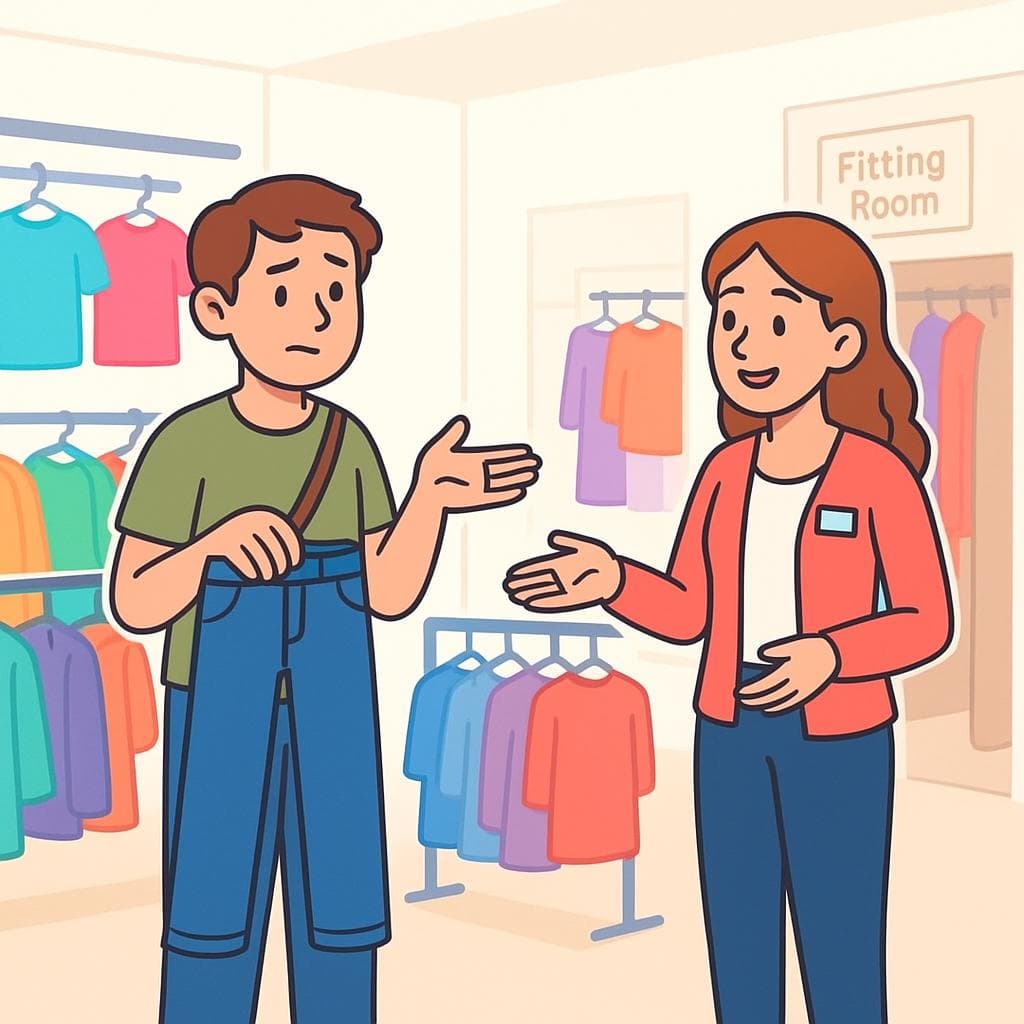
When you have clothes in hand but don't see the booths, simply ask: '¿Dónde están los probadores?'
DOHN-deh ehs-TAHN lohs vehs-tee-DOH-rehs
A very common alternative, especially in Mexico. While 'probador' comes from 'testing,' 'vestidor' comes from 'dressing/clothing.'
DOHN-deh meh PWEH-doh proh-BAHR EHS-toh
Instead of asking for the room, this asks 'Where can I try this on?' It feels very natural and action-oriented.
dees-KOOL-peh, eye proh-bah-DOH-rehs
Literally 'Excuse me, are there fitting rooms?' Used when the changing area isn't immediately visible.
TYEH-nehn proh-bah-DOH-rehs
Meaning 'Do you have fitting rooms?' Simple and direct.
There are three main ways to refer to the place you change clothes, depending on context.
| Word | Literal Meaning | Best For | Avoid When |
|---|---|---|---|
| Probador | Testing place | Retail stores, shops, malls (Universal) | Talking about a sports locker room |
| Vestidor | Dressing place | Mexico (retail) or Home (walk-in closet) | You are in Spain (where it sounds more like a locker room or walk-in closet) |
| Camerino | Small chamber | Theater/TV backstage dressing rooms | Shopping at a regular clothing store |
The word 'probadores' is fairly phonetic, but rolling the 'r' slightly and hitting the stress on 'DO' is key.
The question structure is simple. The challenge comes if you try to use the verb 'probarse' correctly with reflexive pronouns.
Straightforward, but remember the custom of counting items before entering.
Disculpe, ¿dónde están los probadores?
Excuse me, where are the fitting rooms?
Me gustaría probarme estos pantalones. ¿Dónde están los vestidores?
I would like to try on these pants. Where are the dressing rooms?
¿El probador está ocupado?
Is the fitting room occupied?
Por favor, deja la ropa en el probador cuando termines.
Please leave the clothes in the fitting room when you finish.
In many Spanish and Latin American department stores (like Zara or El Corte Inglés), there is often an attendant at the entrance of the fitting rooms. You must show them your items, and they will give you a plastic card with a number indicating how many items you have. You hand this back when you leave.
Even if you see the fitting rooms and they look open, it is considered polite in smaller boutiques to catch the shop assistant's eye and ask, '¿Me lo puedo probar?' (Can I try it on?) before walking in. It shows respect for their space.
While both mean 'fitting room,' the root words tell a story. 'Probador' comes from 'probar' (to test/try), emphasizing checking if it fits. 'Vestidor' comes from 'vestir' (to dress). In sports contexts, 'vestidor' or 'vestuario' refers to the locker room where players change.
Mistake: “Asking for 'el cuarto de probar' or 'la habitación'.”
Correction: El probador
Mistake: “Saying 'Quiero probar esto' (I want to taste/test this).”
Correction: Quiero probarme esto
Mistake: “Assuming the fitting room is in the bathroom.”
Correction: ¿Dónde están los probadores?
If you're shy about speaking, look for signs hanging from the ceiling. They will usually say 'Probadores' or sometimes have a simple icon of a hanger or a person changing.
If you forget the word 'probador,' simply holding up the piece of clothing, pointing to it, and asking '¿Dónde?' (Where?) is perfectly acceptable and will get you pointed in the right direction.
In Spain, 'vestidor' is almost exclusively used for a walk-in closet in a house or a sports locker room. Use 'probadores' for shops.
Both terms are widely understood and used interchangeably in retail contexts here.
You will often hear the 'voseo' form used by staff: '¿Querés probártelo?' (Do you want to try it on?).
Al fondo a la derecha.
In the back to the right.
Gracias.
Thank you.
¿Qué tal le queda?
How does it fit you?
Me queda bien / Me queda pequeño.
It fits well / It fits small.
Think of a space probe 'testing' a new planet. A 'probador' is where you 'test' (probe) the clothes to see if they work.
The word 'Vestidor' starts like 'Vest'. You put a vest on in the vestidor.
In English, we often use 'fitting room', 'dressing room', and 'changing room' interchangeably. Spanish is slightly more specific: 'probador' implies a store context (testing clothes), while 'vestidor' implies a place to get dressed (like a closet or locker room), though usage overlaps in Mexico.
Why it''s different: English speakers sometimes look for a bathroom to change in. In Spanish culture, these are strictly separate functions.
Use instead: Use 'baño' for toilet, 'probador' for clothes.
Once you're in the fitting room, you'll need to describe how the clothes feel.
Essential if the item you tried on doesn't fit correctly.
The logical next step after finding clothes that fit is buying them.
Question 1 of 3
You are in a store in Madrid and want to find the place to try on a shirt. What is the best phrase to use?
Knowing a phrase is one thing — using it at the right moment is another. Read 200+ illustrated and narrated Spanish stories to see phrases in the contexts where they actually belong.
Yes! If you make it a question by raising your voice tone—'¿Probadores?'—while holding clothes, it is perfectly understood and acceptable in casual contexts.
'Probador' is strictly for testing clothes in a store. 'Vestidor' can mean fitting room (especially in Mexico), but it also refers to a walk-in closet at home or a locker room in sports.
You can say '¿Están abiertos los probadores?' (Are the fitting rooms open?) or simply point and ask '¿Puedo pasar?' (Can I go in?).
Generally no. 'Camerino' refers to a dressing room for artists, actors, or performers backstage. If you use it in a store, people might think you are being dramatic or funny.
Strengthen the grammar behind this phrase:
Dive deeper into related topics:
Find similar phrases to expand your Spanish vocabulary:
Browse our complete collection of Spanish phrases organized by situation, from basic greetings to advanced conversations. Perfect for travelers, students, and anyone learning Spanish.
View All Spanish Phrases →