Creerse el ombligo del mundo
kreh-ER-seh el om-BLEE-goh del MOON-doh
🎨 Literal vs. Figurative

Literally, this means 'to believe you are the belly button of the world'.
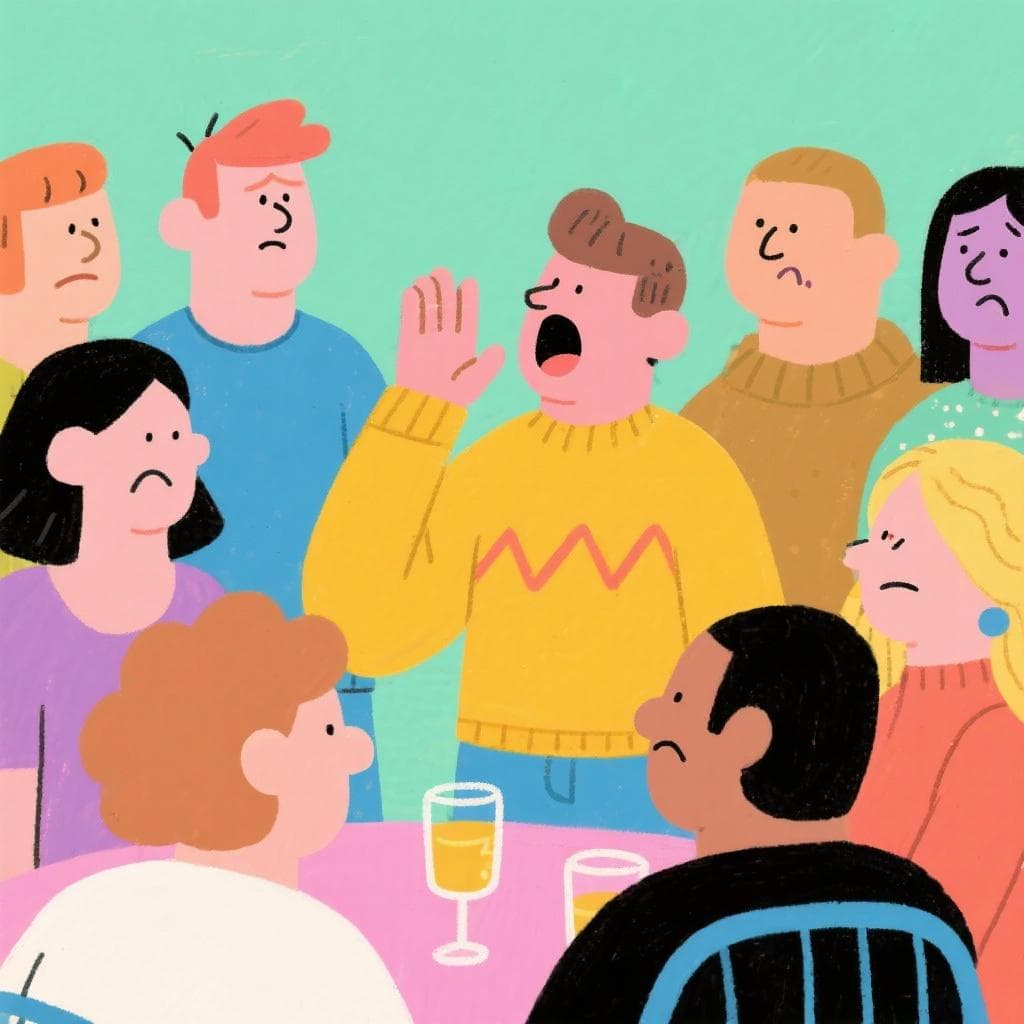
It describes someone who is self-centered and thinks they're more important than anyone else.
Key Words in This Idiom:
📝 In Action
Deja de hablar solo de ti, ¡no te creas el ombligo del mundo!
B2Stop talking only about yourself, don't think the world revolves around you!
Desde que lo ascendieron, se cree el ombligo del mundo y ya no saluda a nadie.
B2Since he got promoted, he thinks he's the center of the universe and doesn't say hello to anyone anymore.
Es una buena jugadora, pero a veces se cree el ombligo del mundo y no juega en equipo.
B2She's a good player, but sometimes she acts like she's the center of attention and doesn't play as a team.
📜 Origin Story
This idea comes from ancient cultures. Many civilizations, from the Greeks with their 'omphalos' (navel) stone in Delphi to the Incas in Cusco, had a concept of a 'navel of the world'—a sacred spot they believed was the absolute center of the Earth. This idiom takes that grand, cosmic idea and applies it sarcastically to a person who acts like they are the center of everything, turning a sacred concept into a critique of arrogance.
⭐ Usage Tips
It's a Criticism, Not a Compliment
This phrase is always used to criticize someone for being self-absorbed or egotistical. The tone can range from a lighthearted tease among friends to a serious accusation of arrogance.
Remember 'Creerse'
The key verb here is 'creerse,' not just 'creer.' 'Creer' means 'to believe' a fact, but 'creerse' means 'to believe something about yourself,' often something that isn't true. You always need to include the part that matches the person: (yo) me creo, (tú) te crees, (él/ella) se cree.
❌ Common Pitfalls
Forgetting the 'se'
Mistake: “Using 'creer' instead of 'creerse'. For example, saying 'Él cree el ombligo del mundo'.”
Correction: This is incorrect because the idiom is about a person's belief about themselves. You must use the reflexive form: 'Él SE cree el ombligo del mundo'. This 'se' shows the belief is directed inward.
📚 Related Grammar
Want to understand the grammar behind this idiom? Explore these lessons for a deep dive:
Advanced Uses of 'se'
The core of the idiom is the pronominal verb 'creerse' (to believe oneself), which is different from 'creer' (to believe a fact). The 'se' shows the belief is directed inward, as seen in 'se cree el ombligo'.
Negative and Affirmative Commands with Pronouns
One example uses the negative command form: '¡no te creas el ombligo del mundo!' Notice how the reflexive pronoun 'te' must come before the verb in a negative command.
🌎 Where It''s Used
Spain
Extremely common and universally understood.
Latin America
Very common and widely understood across almost all countries, from Mexico to Argentina.
✏️ Quick Practice
Quick Quiz: Creerse el ombligo del mundo
Question 1 of 1
If your friend says, 'Mi jefe se cree el ombligo del mundo,' what does she mean?
🗣️ Practice Pronunciation
Want to sound more natural when using this idiom? Practice your Spanish pronunciation with our collection of tongue twisters.
Browse Spanish Tongue Twisters →🏷️ Tags
Hear idioms come alive
Idioms make sense in context. Read 200+ illustrated and narrated Spanish stories to see idioms used naturally by characters — and build the ear native speakers have.
Frequently Asked Questions
Can I use 'ser el ombligo del mundo' instead of 'creerse'?
While people would understand you if you said 'Tú eres el ombligo del mundo,' it's far more common and natural to use the verb 'creerse.' The idiom's focus is on the person's mistaken *belief* about their own importance, which 'creerse' captures perfectly.