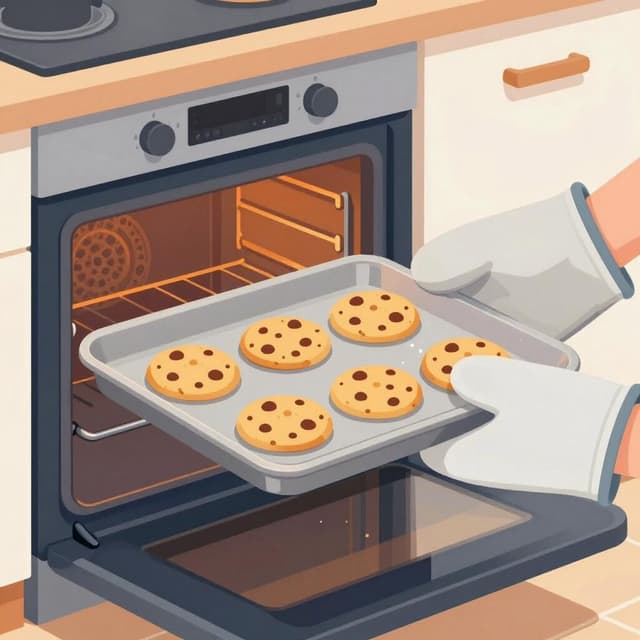
Koniugacja hornear Tryb warunkowy
hornear — to bake
Would bake: 'Hornearía un pastel' (I would bake a cake) if I had time.
Formy hornear Tryb warunkowy
Kiedy używać Tryb warunkowy
Use the conditional for hypothetical situations ('I would bake if...'), polite requests, or to express what was going to happen in the past. For 'hornear,' examples include: 'Hornearía galletas, pero no tengo harina' (I would bake cookies, but I don't have flour) or 'Me dijo que hornearía el pan' (He told me he would bake the bread).
Uwagi dotyczące hornear w czasie Tryb warunkowy
'Hornear' is regular in the conditional tense. The stem is the infinitive ('hornear-'), and the standard conditional endings are added.
Przykładowe zdania
Yo hornearía un pastel si tuviera más tiempo.
I would bake a cake if I had more time.
yo
¿Tú hornearías la cena si te lo pidiera?
Would you bake dinner if I asked you to?
tú
Él hornearía pan para todos si pudiera.
He would bake bread for everyone if he could.
él/ella/usted
Nosotros hornearíamos lasañas para la fiesta.
We would bake lasagnas for the party.
nosotros
Ellos hornearían galletas si supieran la receta.
They would bake cookies if they knew the recipe.
ellos/ellas/ustedes
Częste błędy
Błąd: Using the conditional for a definite future action.
Poprawnie: Use the future tense ('hornearé') for certainty. Use the conditional ('hornearía') for hypotheticals or politeness.
Dlaczego: The conditional expresses uncertainty or non-reality, unlike the directness of the future tense.
Błąd: Confusing the conditional stem with the present stem.
Poprawnie: The conditional stem for 'hornear' is the full infinitive 'hornear-'.
Dlaczego: Similar to the future tense, regular verbs use their infinitive as the base for the conditional.
Opanuj hiszpańskie czasowniki w kontekście
Zapamiętywanie tabel to dopiero początek. Przeczytaj ponad 200 ilustrowanych i udźwiękowionych hiszpańskich historii, aby zobaczyć czasowniki takie jak 'hornear' używane naturalnie — w czasach, których się uczysz.
Powiązane czasy
Czas teraźniejszy
yo: horneo
Habits and current actions: 'Horneo pan' (I bake bread) often.
Czas przeszły prosty
yo: horneé
Completed actions: 'Horneé el pastel' (I baked the cake) yesterday.
Czas przeszły niedokonany
yo: horneaba
Past habits/descriptions: 'Horneaba pan' (I used to bake bread) daily.
Czas przyszły
yo: hornearé
Will bake: 'Hornearé pan' (I will bake bread) tomorrow.
Tryb Subj. teraźniejszy
yo: hornee
Subjunctive used after wishes, doubts, emotions: 'Espero que hornees' (I hope you bake).
Tryb Subj. przeszły niedokonany
yo: horneara
Past subjunctive uses like 'si horneara' (if I baked) or 'ojalá horneara' (I wish he/she baked).
Tryb rozkazujący (twierdzący)
yo: hornea
Commands like '¡Hornea!' (you bake!) and '¡Horneen!' (you all bake!).
Tryb rozkazujący (przeczący)
yo: no hornees
Negative commands like '¡No hornees!' (don't bake!) and '¡No horneen!' (you all don't bake!).