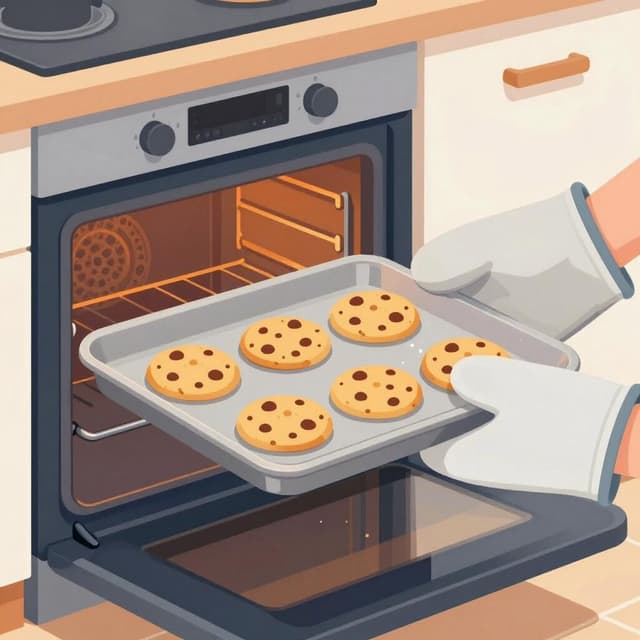
Koniugacja hornear Czas teraźniejszy
hornear — to bake
Habits and current actions: 'Horneo pan' (I bake bread) often.
Formy hornear Czas teraźniejszy
Kiedy używać Czas teraźniejszy
Use the present indicative for actions happening right now, habitual actions, or general truths. For 'hornear,' it's what you do regularly: 'Yo horneo pan cada mañana' (I bake bread every morning) or 'Ella hornea pasteles para su negocio' (She bakes cakes for her business).
Uwagi dotyczące hornear w czasie Czas teraźniejszy
'Hornear' is a regular -ar verb and is completely regular in the present indicative tense. All conjugations follow the standard pattern.
Przykładowe zdania
Yo horneo galletas cuando tengo tiempo libre.
I bake cookies when I have free time.
yo
¿Tú horneas postres a menudo?
Do you bake desserts often?
tú
Él hornea pan casero para su familia.
He bakes homemade bread for his family.
él/ella/usted
Nosotros horneamos pan dulce los fines de semana.
We bake sweet bread on weekends.
nosotros
Ellos hornean pasteles para bodas.
They bake cakes for weddings.
ellos/ellas/ustedes
Częste błędy
Błąd: Using the present tense for actions that just finished.
Poprawnie: If the action is completed, use the preterite (e.g., 'horneé'). The present is for ongoing or habitual actions.
Dlaczego: The preterite indicates a finished action in the past, while the present indicates something happening now or regularly.
Błąd: Incorrectly conjugating the 'vosotros' form.
Poprawnie: The 'vosotros' present indicative is 'horneáis'.
Dlaczego: This follows the regular -ar verb pattern: infinitive minus -ar plus -áis.
Opanuj hiszpańskie czasowniki w kontekście
Zapamiętywanie tabel to dopiero początek. Przeczytaj ponad 200 ilustrowanych i udźwiękowionych hiszpańskich historii, aby zobaczyć czasowniki takie jak 'hornear' używane naturalnie — w czasach, których się uczysz.
Powiązane czasy
Czas przeszły prosty
yo: horneé
Completed actions: 'Horneé el pastel' (I baked the cake) yesterday.
Czas przeszły niedokonany
yo: horneaba
Past habits/descriptions: 'Horneaba pan' (I used to bake bread) daily.
Czas przyszły
yo: hornearé
Will bake: 'Hornearé pan' (I will bake bread) tomorrow.
Tryb warunkowy
yo: hornearía
Would bake: 'Hornearía un pastel' (I would bake a cake) if I had time.
Tryb Subj. teraźniejszy
yo: hornee
Subjunctive used after wishes, doubts, emotions: 'Espero que hornees' (I hope you bake).
Tryb Subj. przeszły niedokonany
yo: horneara
Past subjunctive uses like 'si horneara' (if I baked) or 'ojalá horneara' (I wish he/she baked).
Tryb rozkazujący (twierdzący)
yo: hornea
Commands like '¡Hornea!' (you bake!) and '¡Horneen!' (you all bake!).
Tryb rozkazujący (przeczący)
yo: no hornees
Negative commands like '¡No hornees!' (don't bake!) and '¡No horneen!' (you all don't bake!).