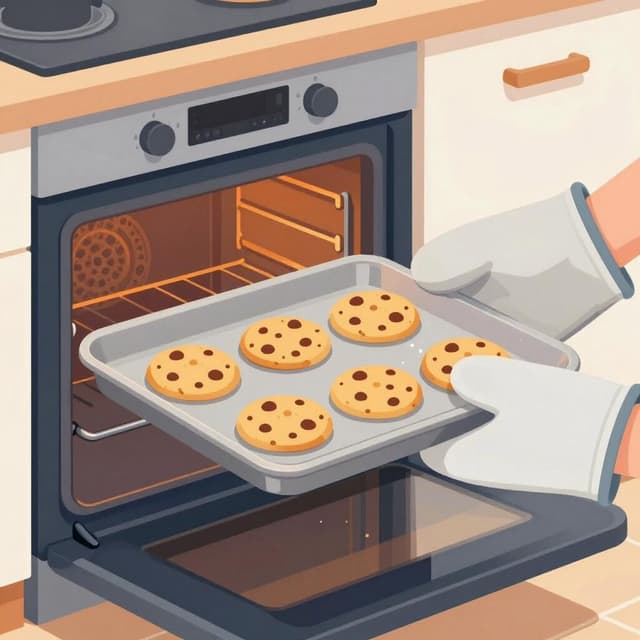
Koniugacja hornear Tryb rozkazujący (twierdzący)
hornear — to bake
Commands like '¡Hornea!' (you bake!) and '¡Horneen!' (you all bake!).
Formy hornear Tryb rozkazujący (twierdzący)
Kiedy używać Tryb rozkazujący (twierdzący)
Use the affirmative imperative to give direct commands or instructions. For 'hornear,' this is useful for telling someone to bake something specific, like '¡Hornea el pastel!' (Bake the cake!).
Uwagi dotyczące hornear w czasie Tryb rozkazujący (twierdzący)
The affirmative imperative for 'hornear' is regular for all persons except 'vosotros', which follows the regular -ar pattern.
Przykładowe zdania
¡Hornea las galletas a 180 grados!
Bake the cookies at 180 degrees!
tú
Señora, hornee el pan por 30 minutos.
Madam, bake the bread for 30 minutes.
usted
¡Horneemos un pastel para la fiesta!
Let's bake a cake for the party!
nosotros
Chicos, hornead la cena temprano.
Guys, bake dinner early.
vosotros
Por favor, horneen el pollo hasta que esté dorado.
Please, bake the chicken until it's golden.
ustedes
Częste błędy
Błąd: Using the present subjunctive instead of the affirmative imperative for 'tú'.
Poprawnie: Use 'hornea' for 'tú', not 'hornees'.
Dlaczego: The affirmative imperative and present subjunctive forms are different for the 'tú' command.
Błąd: Forgetting the 'vosotros' ending.
Poprawnie: The 'vosotros' imperative is 'hornead'.
Dlaczego: This is the standard ending for regular -ar verbs in the vosotros affirmative imperative.
Opanuj hiszpańskie czasowniki w kontekście
Zapamiętywanie tabel to dopiero początek. Przeczytaj ponad 200 ilustrowanych i udźwiękowionych hiszpańskich historii, aby zobaczyć czasowniki takie jak 'hornear' używane naturalnie — w czasach, których się uczysz.
Powiązane czasy
Czas teraźniejszy
yo: horneo
Habits and current actions: 'Horneo pan' (I bake bread) often.
Czas przeszły prosty
yo: horneé
Completed actions: 'Horneé el pastel' (I baked the cake) yesterday.
Czas przeszły niedokonany
yo: horneaba
Past habits/descriptions: 'Horneaba pan' (I used to bake bread) daily.
Czas przyszły
yo: hornearé
Will bake: 'Hornearé pan' (I will bake bread) tomorrow.
Tryb warunkowy
yo: hornearía
Would bake: 'Hornearía un pastel' (I would bake a cake) if I had time.
Tryb Subj. teraźniejszy
yo: hornee
Subjunctive used after wishes, doubts, emotions: 'Espero que hornees' (I hope you bake).
Tryb Subj. przeszły niedokonany
yo: horneara
Past subjunctive uses like 'si horneara' (if I baked) or 'ojalá horneara' (I wish he/she baked).
Tryb rozkazujący (przeczący)
yo: no hornees
Negative commands like '¡No hornees!' (don't bake!) and '¡No horneen!' (you all don't bake!).