Koniugacja hornear Czas przeszły niedokonany
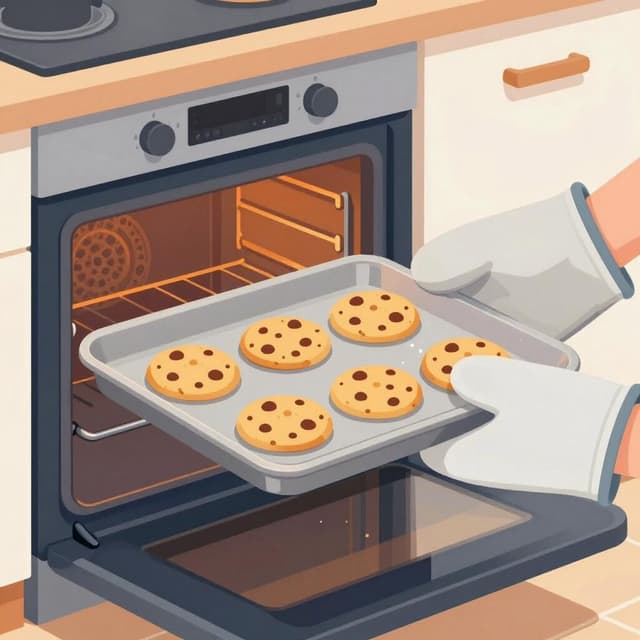
hornear — to bake
Past habits/descriptions: 'Horneaba pan' (I used to bake bread) daily.
Formy hornear Czas przeszły niedokonany
Kiedy używać Czas przeszły niedokonany
Use the imperfect for ongoing or habitual actions in the past, or to describe background settings. For 'hornear,' think of routines: 'Cuando era niño, mi abuela horneaba galletas todos los días' (When I was a child, my grandmother baked cookies every day) or 'El horno horneaba de manera uniforme' (The oven baked evenly - describing its characteristic).
Uwagi dotyczące hornear w czasie Czas przeszły niedokonany
'Hornear' is a regular -ar verb and is completely regular in the imperfect indicative tense. All conjugations follow the standard pattern.
Przykładowe zdania
Yo horneaba pan casero cuando vivía en el campo.
I used to bake homemade bread when I lived in the countryside.
yo
¿Tú horneabas pasteles para la escuela?
Did you used to bake cakes for the school?
tú
Él horneaba galletas de jengibre en Navidad.
He baked gingerbread cookies at Christmas.
él/ella/usted
Nosotros horneábamos postres para el café.
We used to bake desserts for the café.
nosotros
Ellos horneaban pan en un horno de leña.
They baked bread in a wood-fired oven.
ellos/ellas/ustedes
Częste błędy
Błąd: Using the imperfect for a single, completed baking event.
Poprawnie: For a specific, finished action in the past, use the preterite (e.g., 'horneé'). The imperfect describes ongoing or repeated past actions.
Dlaczego: The imperfect sets a scene or describes a past routine, while the preterite marks a specific event with a clear beginning and end.
Błąd: Confusing the imperfect 'horneábamos' (we baked) with the present 'horneamos' (we bake).
Poprawnie: Pay attention to context. Past actions or descriptions require the imperfect.
Dlaczego: These forms sound similar, so understanding the time frame is crucial.
Opanuj hiszpańskie czasowniki w kontekście
Zapamiętywanie tabel to dopiero początek. Przeczytaj ponad 200 ilustrowanych i udźwiękowionych hiszpańskich historii, aby zobaczyć czasowniki takie jak 'hornear' używane naturalnie — w czasach, których się uczysz.
Powiązane czasy
Czas teraźniejszy
yo: horneo
Habits and current actions: 'Horneo pan' (I bake bread) often.
Czas przeszły prosty
yo: horneé
Completed actions: 'Horneé el pastel' (I baked the cake) yesterday.
Czas przyszły
yo: hornearé
Will bake: 'Hornearé pan' (I will bake bread) tomorrow.
Tryb warunkowy
yo: hornearía
Would bake: 'Hornearía un pastel' (I would bake a cake) if I had time.
Tryb Subj. teraźniejszy
yo: hornee
Subjunctive used after wishes, doubts, emotions: 'Espero que hornees' (I hope you bake).
Tryb Subj. przeszły niedokonany
yo: horneara
Past subjunctive uses like 'si horneara' (if I baked) or 'ojalá horneara' (I wish he/she baked).
Tryb rozkazujący (twierdzący)
yo: hornea
Commands like '¡Hornea!' (you bake!) and '¡Horneen!' (you all bake!).
Tryb rozkazujący (przeczący)
yo: no hornees
Negative commands like '¡No hornees!' (don't bake!) and '¡No horneen!' (you all don't bake!).