
Con vs De
Con = with (together). De = of (made of / belongs to).
con
With (accompaniment, instrument, manner, included items)
kohnde
Of / From (possession, origin, material, main content)
dehQuick Rule
Con = with (together). De = of (made of / belongs to).
Think: Con = Company. De = Description.
- Soñar con (to dream about) uses 'con' but doesn't mean 'with'.
- Depende de (it depends on) uses 'de' to mean 'on'.
Comparison Table
| Context | con | de | Why? |
|---|---|---|---|
| Drinks | Café con leche | Vaso de leche | Con for added ingredients (milk added to coffee). De for the main content (the glass is full of milk). |
| Describing Containers | Una caja con libros | Una caja de cartón | Con for what's inside the box. De for what the box is made of. |
| Food Items | Tacos con queso | Tacos de pollo | Con for toppings or extras. De for the main filling or type. |
| People | Estoy con Juan | El coche de Juan | Con means you are together. De shows that Juan owns the car. |
When to Use "con / de"
con
With (accompaniment, instrument, manner, included items)
kohn
Accompaniment (who or what is with you)
Voy al cine con mis amigos.
I'm going to the movies with my friends.
Instrument or tool (what you use)
Escribo con un bolígrafo.
I write with a pen.
Added ingredients or contents
Quiero un café con leche.
I want a coffee with milk.
Manner (how something is done)
Habla con cuidado.
He speaks with care.
de
Of / From (possession, origin, material, main content)
deh
Possession (who owns it)
Es el coche de Ana.
It's Ana's car.
Origin (where it's from)
Somos de Argentina.
We are from Argentina.
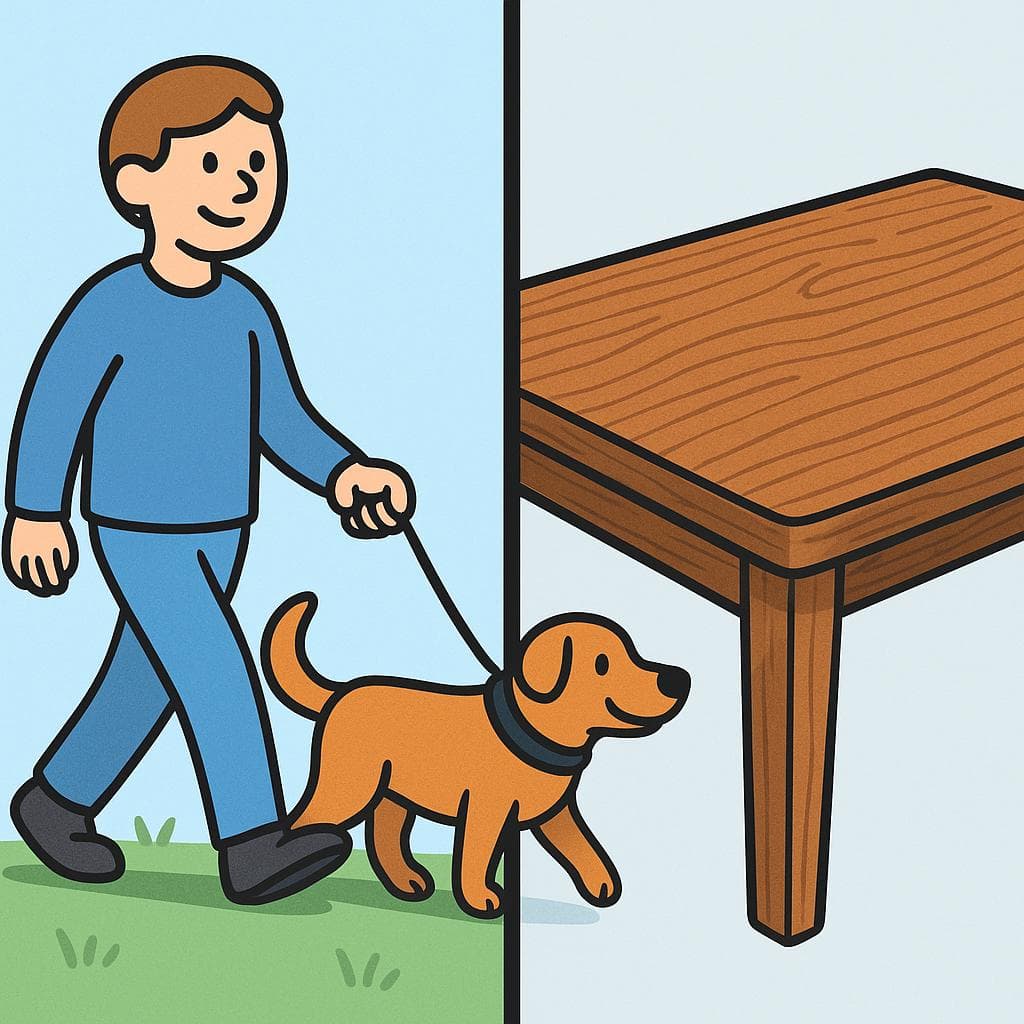
Material (what it's made of)
Una mesa de madera.
A wooden table.
Main content or type
Un vaso de agua.
A glass of water.
Contrast Examples
With "con":
Tacos de pollo con guacamole.
Chicken tacos with guacamole.
With "de":
Tacos de pollo y de guacamole.
Chicken tacos and guacamole tacos (two separate types).
The Difference: 'De' defines the main type or filling of the taco. 'Con' adds a topping or side to that taco.
With "con":
Una bolsa con papas.
A bag with some potatoes in it.
With "de":
Una bolsa de papas.
A bag of potatoes (as a product you buy).
The Difference: 'Con' simply states that potatoes are inside. 'De' describes the item's purpose or standard content, like 'a bag of chips' or 'a can of beans'.
With "con":
El hombre con el sombrero.
The man with the hat (he's wearing a hat).
With "de":
El hombre del sombrero.
The man of the hat (he's known for his hat).
The Difference: 'Con' is a simple physical description. 'De' can imply a defining characteristic or a title, making the hat part of his identity.
Common Mistakes
Una camisa con algodón.
Una camisa de algodón.
To describe what something is made of, always use 'de'. 'Con algodón' would imply the shirt comes with some cotton on the side, not that it's made from it.
Quiero una taza con té.
Quiero una taza de té.
When asking for a serving of something, 'de' is used to describe the main content. 'Una taza de té' means 'a cup of tea'. 'Con té' is not wrong, but much less common.
Quick Practice
Quick Quiz: Con vs De
Question 1 of 3
Which is correct for 'a glass of milk'?
Related Grammar
Want to understand the grammar behind this pair? Explore these lessons for a deep dive:
Key Words



Tags
Build the instinct, not just the rule
Rules help you get it right; context makes it automatic. Read 200+ illustrated and narrated Spanish stories to see confusing pairs chosen correctly — over and over — until you stop thinking about it.
Frequently Asked Questions
Can I ever say 'un vaso con agua'?
Yes, but it's less common and has a slightly different feel. It emphasizes that water is *in* the glass, perhaps along with other things, like 'un vaso con agua y hielo' (a glass with water and ice). If you're just asking for a glass of water, 'un vaso de agua' is what you want.
Why is it 'café con leche' but 'vaso de leche'?
This is a classic point of confusion! Think of it this way: 'con' is for ingredients you mix together ('coffee with milk'). 'De' is for the main substance filling a container ('glass of milk'). The coffee is still the main event in 'café con leche'; milk is just added to it.