
Conditional of Courtesy vs Imperfect of Courtesy
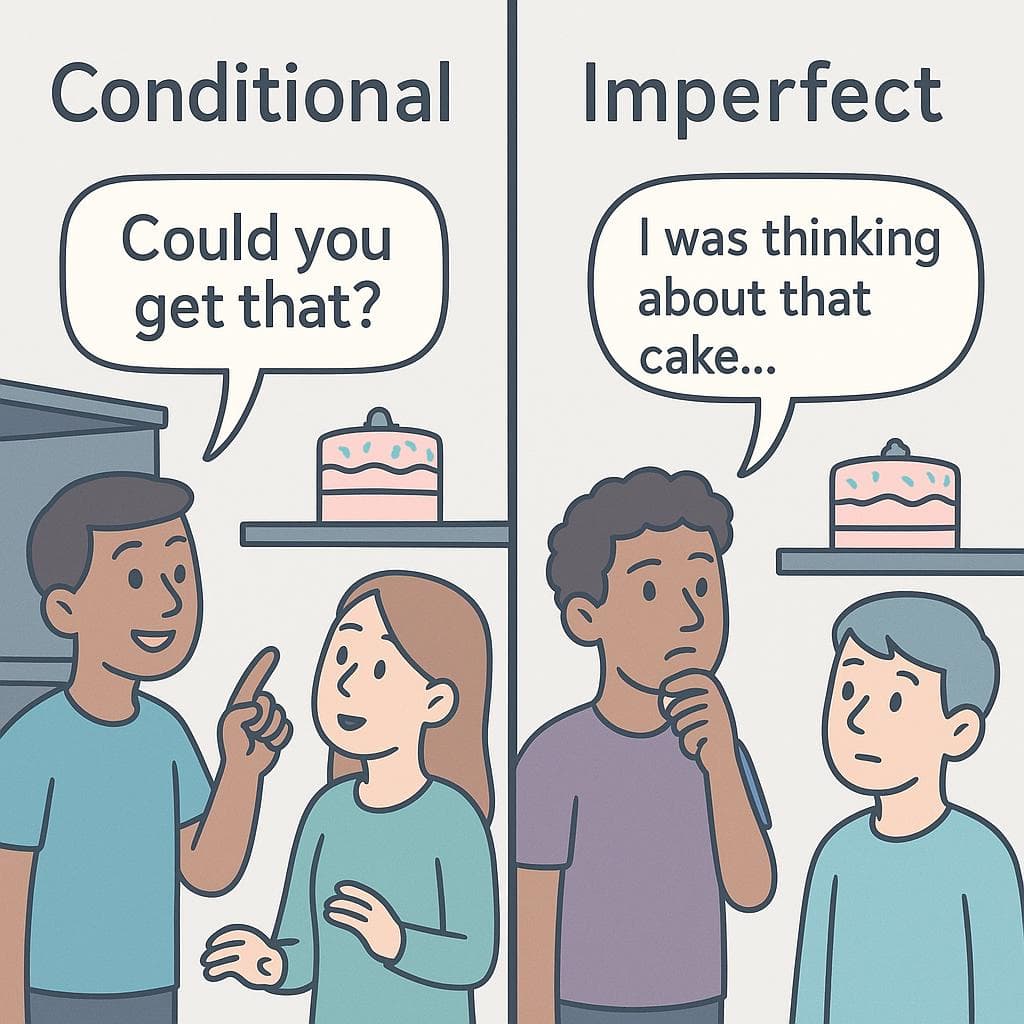
Conditional is a polite 'would/could'. Imperfect is a softer 'I was wondering...'
conditional of courtesy
Used to soften a direct request, question, or piece of advice to make it more polite. It's the equivalent of 'would' or 'could' in English.
Conditional de Cortesíaimperfect of courtesy
Used to make a request or suggestion sound even more indirect and tentative. It frames the request as a pre-existing thought, like 'I was wondering...' or 'I wanted to ask...'
Imperfecto de CortesíaQuick Rule
Conditional is a polite 'would/could'. Imperfect is a softer 'I was wondering...'
Think: Conditional is a direct question ('Could you?'). Imperfect is a soft statement ('I wanted to ask...').
- With verbs like 'querer' and 'gustar', they are often interchangeable, with the imperfect sounding slightly more hesitant or deferential.
Comparison Table
| Context | conditional of courtesy | imperfect of courtesy | Why? |
|---|---|---|---|
| Asking for an item | Me gustaría un vaso de agua. | Quería un vaso de agua. | Conditional ('I would like') is a direct, polite statement. Imperfect ('I wanted') is slightly more common and frames it as the reason you're talking to them. |
| Requesting an action | ¿Podrías cerrar la ventana? | Te iba a pedir si cerrabas la ventana. | Conditional is a straightforward polite question ('Could you...?'). Imperfect is much more indirect, framing it as a thought you were about to have ('I was going to ask...'). |
| Making a suggestion | ¿Te gustaría ir al cine? | Pensaba que podíamos ir al cine. | Conditional directly asks for the other person's preference. Imperfect presents the idea as a thought you've been having, making it less direct. |
| Asking for information | ¿Sabrías decirme la hora? | Quería saber qué hora era. | Conditional ('Would you know...?') politely questions their ability to help. Imperfect ('I wanted to know...') states your pre-existing desire for the information. |
When to Use "conditional of courtesy / imperfect of courtesy"
conditional of courtesy
Used to soften a direct request, question, or piece of advice to make it more polite. It's the equivalent of 'would' or 'could' in English.
kohn-dee-syoh-NAHL deh kor-teh-SEE-ah
Making a polite request
¿Podrías pasarme la sal, por favor?
Could you pass me the salt, please?
Expressing a polite desire
Me gustaría un café con leche.
I would like a latte.
Giving gentle advice
Yo en tu lugar, hablaría con el jefe.
If I were in your shoes, I would speak with the boss.
Making a polite invitation
¿Te interesaría venir al cine con nosotros?
Would you be interested in coming to the movies with us?
imperfect of courtesy
Used to make a request or suggestion sound even more indirect and tentative. It frames the request as a pre-existing thought, like 'I was wondering...' or 'I wanted to ask...'
eem-pehr-FEK-toh deh kor-teh-SEE-ah
Making a very soft request
Quería pedirte un favor.
I wanted to ask you a favor.
Asking for something in a store
Hola, buscaba una camisa azul.
Hi, I was looking for a blue shirt.
Making a tentative suggestion
Pensaba que podíamos cenar fuera esta noche.
I was thinking we could eat out tonight.
Stating the reason for a call politely
Te llamaba para ver cómo estabas.
I was just calling to see how you were.
Contrast Examples
With "conditional of courtesy":
¿Me harías un favor?
Would you do me a favor? (Direct, polite question)
With "imperfect of courtesy":
Quería pedirte un favor.
I wanted to ask you a favor. (Indirect, softer statement)
The Difference: The conditional is a direct question asking for a future commitment. The imperfect is a statement about a past intention that you're now acting on, which feels less demanding.
With "conditional of courtesy":
Me gustaría la sopa de tomate.
I would like the tomato soup. (A polite, clear order)
With "imperfect of courtesy":
Quería la sopa de tomate.
I wanted the tomato soup. (A very common, slightly softer way to order)
The Difference: Both are perfectly polite and common. The conditional ('would like') is a classic polite construction. The imperfect ('wanted') is a slightly more conversational, indirect way to state your order.
With "conditional of courtesy":
¿Te gustaría cenar conmigo el sábado?
Would you like to have dinner with me on Saturday? (A direct invitation)
With "imperfect of courtesy":
Pensaba si querías cenar conmigo el sábado.
I was wondering if you wanted to have dinner with me on Saturday. (A more tentative, less direct invitation)
The Difference: The conditional puts the other person on the spot to answer yes or no. The imperfect frames it as a thought, which can feel like less pressure and gives the other person more room to decline.
Common Mistakes
Usando el presente de forma muy directa: ¿Puedes ayudarme?
¿Podrías ayudarme?
While '¿Puedes...?' isn't grammatically wrong, it can sound blunt, like you're questioning their ability. '¿Podrías...?' is a much more polite and common way to ask for help.
Pensar que el imperfecto siempre se refiere al pasado: Un dependiente dice '¿Qué buscaba?' y el cliente piensa que le pregunta por algo que ya no busca.
Entender que '¿Qué buscaba?' es una forma educada de preguntar '¿Qué busca ahora?'
In a service context, the imperfect tense is used for politeness in the present moment. It doesn't mean the action is over. It's a soft way to ask what you are currently looking for.
Quick Practice
Quick Quiz: Conditional of Courtesy vs Imperfect of Courtesy
Question 1 of 3
You're in a shop and want to ask for a different size. What's the most natural, polite way to say it?
Related Grammar
Want to understand the grammar behind this pair? Explore these lessons for a deep dive:
Conditional Tense
To form the conditional correctly and understand its other uses.
Imperfect Tense
To form the imperfect tense and contrast its courtesy use with its main use for past actions.
Preterite vs Imperfect Overview
Understanding the core difference between the past tenses helps isolate this special use of the imperfect.
Key Words


Tags
Build the instinct, not just the rule
Rules help you get it right; context makes it automatic. Read 200+ illustrated and narrated Spanish stories to see confusing pairs chosen correctly — over and over — until you stop thinking about it.
Frequently Asked Questions
So, is it wrong to use the present tense for requests, like '¿Puedes ayudarme?'
It's not grammatically wrong, but it can sound very direct or even demanding depending on the context and your tone. Using the conditional ('¿Podrías...?') or imperfect ('Quería...') is a simple way to guarantee you sound polite.
Which one is MORE polite, the conditional or the imperfect?
It's not about one being 'more' polite, but rather about the style of politeness. The conditional is politely direct ('Would you...?'). The imperfect is politely indirect ('I was wondering...'). In many cases, like ordering food, they are virtually interchangeable in politeness level.
Can I use any verb in the imperfect for courtesy?
No, it's most common with a specific set of verbs related to wanting, thinking, or asking, such as 'querer' (to want), 'poder' (to be able), 'deber' (should), 'buscar' (to look for), 'pensar' (to think), and 'venir' (to come).