
En vs Sobre (surface)
Use 'en' for general contact ('in'/'on'/'at'). Use 'sobre' to emphasize 'on top of' something.
en
The general-purpose preposition for 'in', 'on', or 'at'. It indicates location or contact without extra emphasis.
EHNsobre
A more specific preposition meaning 'on top of', 'over', or 'about'. It emphasizes position relative to something else.
SOH-brehQuick Rule
Use 'en' for general contact ('in'/'on'/'at'). Use 'sobre' to emphasize 'on top of' something.
Think: 'En' is for general ENgagement with a surface. 'Sobre' is SUPERior (on top of).
- In everyday speech, 'en' is used for 'on' over 90% of the time. When in doubt, 'en' is usually a safe bet for flat surfaces.
Comparison Table
| Context | en | sobre | Why? |
|---|---|---|---|
| Simple object on a table | Las llaves están en la mesa. | Las llaves están sobre la mesa. | 'En' is the normal, everyday way to say it. 'Sobre' is also correct but sounds more formal or precise, emphasizing 'on top'. |
| Person in/on a vehicle | La gente está en el autobús. | El equipaje está sobre el autobús. | 'En' means inside the bus. 'Sobre' means on the physical roof of the bus, which is why it's used for luggage racks. |
| Clothing | Tiene una mancha en la camisa. | Ponte un suéter sobre la camisa. | A stain is 'on' or 'in' the fabric ('en'). A sweater goes 'on top of' the shirt as a distinct layer ('sobre'). |
When to Use "en / sobre"
en
The general-purpose preposition for 'in', 'on', or 'at'. It indicates location or contact without extra emphasis.
EHN
On a surface (most common)
El libro está en la mesa.
The book is on the table.
Inside a space
Estoy en mi cuarto.
I am in my room.
Inside or on a vehicle
Vamos en el coche.
We're going in the car.
sobre
A more specific preposition meaning 'on top of', 'over', or 'about'. It emphasizes position relative to something else.
SOH-breh
On top of a surface (emphasized)
Puso la carta sobre los otros papeles.
He put the letter on top of the other papers.
Over (without touching)
El avión vuela sobre la ciudad.
The plane flies over the city.
About a topic
Es una película sobre la guerra.
It's a movie about the war.
Contrast Examples
With "en":
El gato está en la cama.
The cat is on the bed. (He might be under the covers or just on top.)
With "sobre":
El gato está sobre la cama.
The cat is on top of the bed. (Specifically on top of the covers, not under.)
The Difference: 'En' is ambiguous and very common. 'Sobre' clarifies that the cat is on the topmost surface of the bed.
With "en":
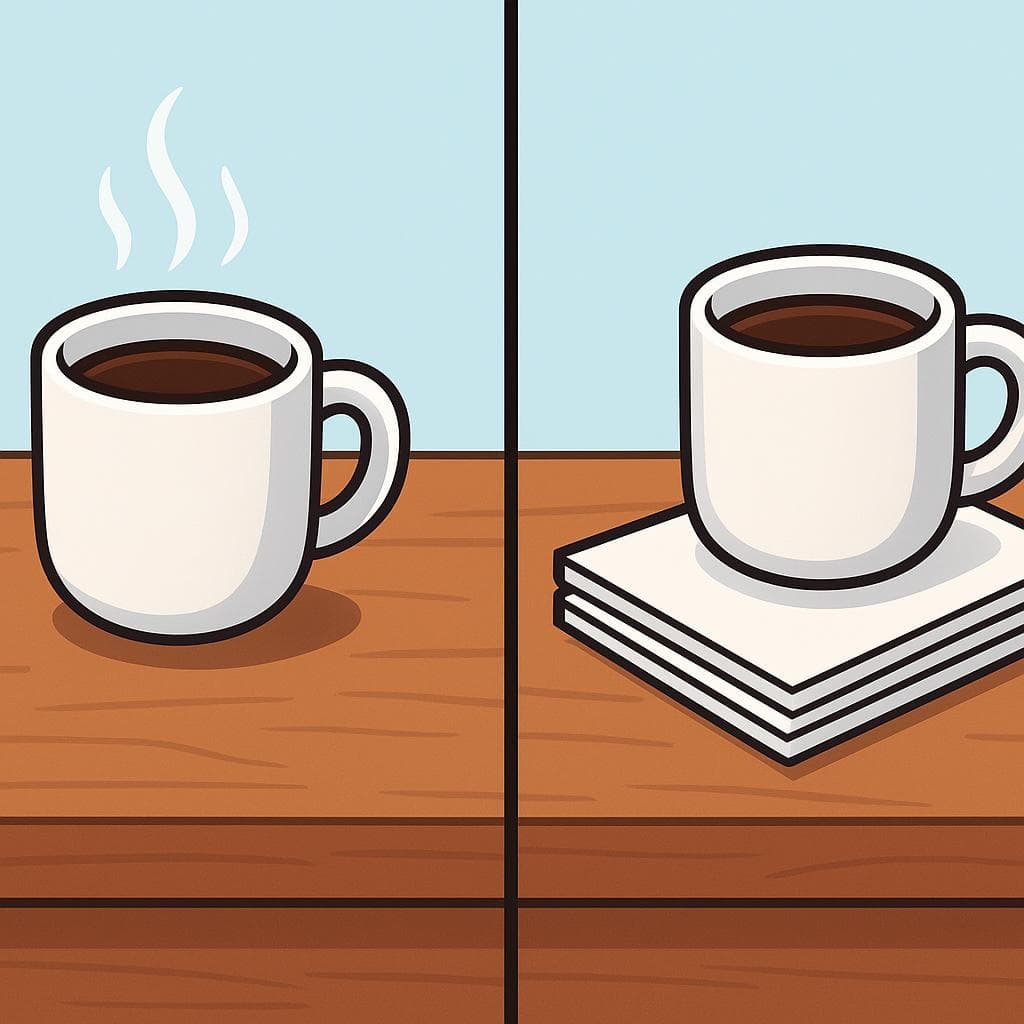
Tu café está en los papeles.
Your coffee is on the papers. (Oh no, it might spill and make a mess!)
With "sobre":
Pon el libro sobre los papeles.
Put the book on top of the papers. (A clear instruction to stack items.)
The Difference: 'En' implies simple contact, which can feel accidental. 'Sobre' often implies a deliberate action of placing one thing on top of another.
Common Mistakes
Estoy sobre el tren.
Estoy en el tren.
For being inside vehicles, always use 'en'. 'Sobre el tren' would mean you are riding on the roof!
El libro es sobre la mesa.
El libro está en la mesa.
Location always uses the verb 'estar'. 'Ser sobre' means 'to be about a topic', like 'El libro es sobre dinosaurios' (The book is about dinosaurs).
Overusing 'sobre' to sound more advanced.
Use 'en' for most simple 'on' situations.
While 'sobre' is correct for 'on top of', native speakers use 'en' far more frequently for things on tables, floors, and shelves. Overusing 'sobre' can sound unnatural.
Quick Practice
Quick Quiz: En vs Sobre (surface)
Question 1 of 2
Which is the most natural way to say 'My keys are on the table'?
Related Grammar
Want to understand the grammar behind this pair? Explore these lessons for a deep dive:
Key Words



Tags
Build the instinct, not just the rule
Rules help you get it right; context makes it automatic. Read 200+ illustrated and narrated Spanish stories to see confusing pairs chosen correctly — over and over — until you stop thinking about it.
Frequently Asked Questions
Can I just always use 'en' when I mean 'on'?
For the most part, yes! When talking about something being on a flat surface like a table, floor, or shelf, 'en' is your safest and most common choice. You only need 'sobre' when you really want to emphasize that something is 'on top of' something else, or for its other meaning, 'about'.
What about 'encima de'? How is it different?
'Encima de' is a fantastic phrase that means 'on top of'. It's a very clear and direct synonym for 'sobre' (when 'sobre' means 'on top of'). You can often use 'sobre' and 'encima de' interchangeably: 'El libro está sobre la mesa' or 'El libro está encima de la mesa'.