
Grande vs Gran
Use `gran` before the noun for 'great'. Use `grande` after the noun for 'big'.
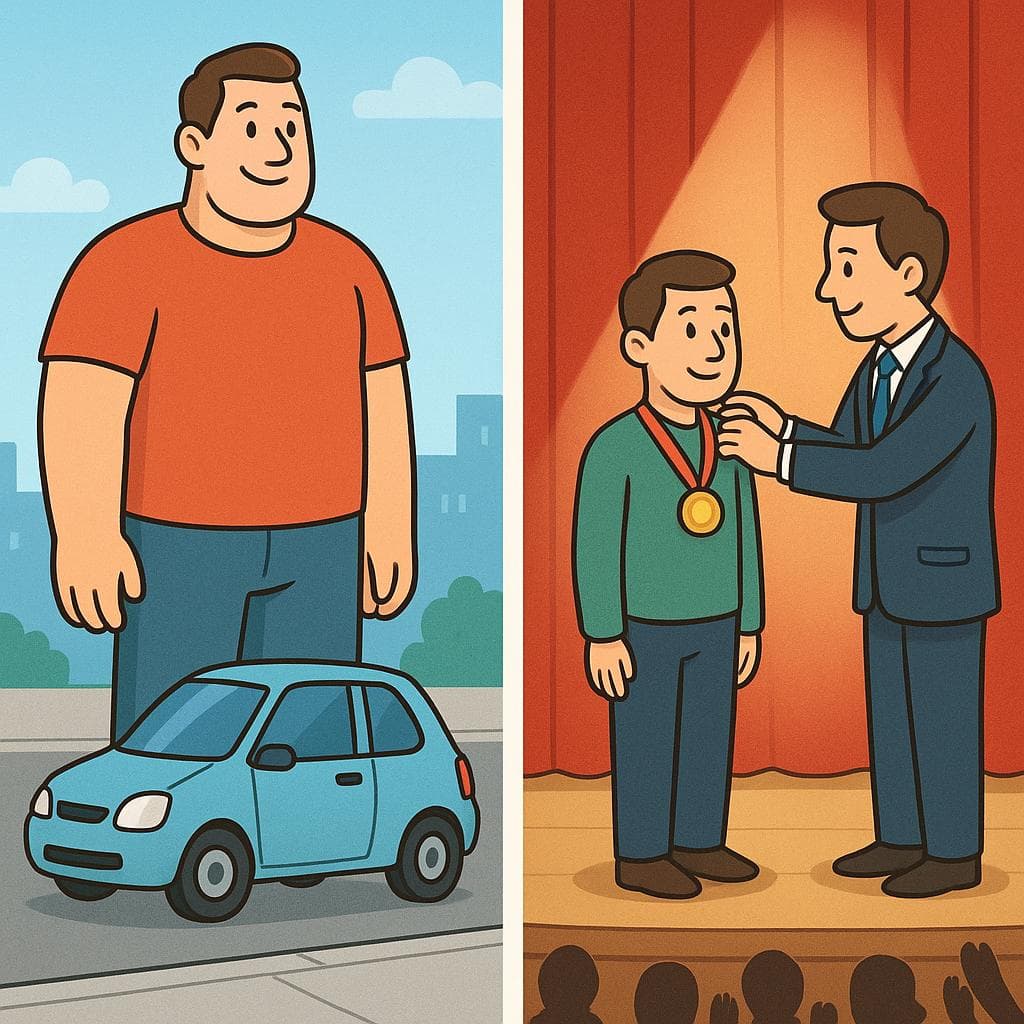
grande
Big, large (in physical size). It is placed *after* the noun.
GRAHN-dehgran
Great, impressive, grand (in quality or importance). It is placed *before* a singular noun.
GRAHNQuick Rule
Use `gran` before the noun for 'great'. Use `grande` after the noun for 'big'.
Think: 'Gran' is for 'Grandeur', 'grande' is for 'Gargantuan'.
- 'Gran' is only used before singular nouns. For plurals, you always use 'grandes' (e.g., 'grandes ideas').
Comparison Table
| Context | grande | gran | Why? |
|---|---|---|---|
| Describing a person | un hombre grande | un gran hombre | Grande (after) means physically large. Gran (before) means admirable or important. |
| Describing a house | una casa grande | una gran casa | Grande refers to the physical size. Gran refers to its magnificence or quality. |
| Describing a problem | un problema grande | un gran problema | Both mean 'a big problem', but 'gran problema' often feels more significant or serious. |
| Plural Nouns | ciudades grandes | grandes ciudades | 'Gran' cannot be used with plurals. You must use 'grandes' both before and after the noun. |
When to Use "grande / gran"
grande
Big, large (in physical size). It is placed *after* the noun.
GRAHN-deh
Describing physical size
Compramos una mesa grande.
We bought a big table.
Referring to age (older)
Mi hermano grande vive en Chile.
My big (older) brother lives in Chile.
Describing quantity or scale
Fue una fiesta grande, con muchos invitados.
It was a big party, with many guests.
gran
Great, impressive, grand (in quality or importance). It is placed *before* a singular noun.
GRAHN
Describing quality or importance
Es una gran oportunidad.
It's a great opportunity.
Describing a person's character
Mi abuela fue una gran mujer.
My grandmother was a great woman.
Used for emphasis
¡Qué gran idea!
What a great idea!
Contrast Examples
With "grande":
Es un hombre grande.
He is a big man. (physically large)
With "gran":
Es un gran hombre.
He is a great man. (admirable, important)
The Difference: The position completely changes the meaning. After the noun, `grande` describes physical size. Before the noun, `gran` describes character.
With "grande":
Tengo una amiga grande.
I have a big friend. (either physically large or older)
With "gran":
Tengo una gran amiga.
I have a great friend. (a very good friend)
The Difference: `Grande` after the noun is about size or age, while `gran` before the noun is about the quality of the friendship.
Common Mistakes
Es un grande libro.
Es un gran libro.
To mean 'a great book', you must use the shortened form 'gran' before the singular noun.
Son gran ideas.
Son grandes ideas.
'Gran' is only for singular nouns. For plurals, you must use 'grandes'.
Ella tiene una coche grande.
Ella tiene un coche grande.
This is a gender agreement mistake. 'Coche' is masculine, so it uses 'un'. 'Grande' works for both genders.
Quick Practice
Quick Quiz: Grande vs Gran
Question 1 of 3
Which sentence means 'She is a great artist'?
Related Grammar
Want to understand the grammar behind this pair? Explore these lessons for a deep dive:
Key Words


Tags
Build the instinct, not just the rule
Rules help you get it right; context makes it automatic. Read 200+ illustrated and narrated Spanish stories to see confusing pairs chosen correctly — over and over — until you stop thinking about it.
Frequently Asked Questions
Are there other words like this in Spanish?
Yes! This shortening of an adjective before a noun is called apocope. It also happens with words like 'bueno' becoming 'buen' (un buen día), 'malo' becoming 'mal' (un mal hombre), and 'primero' becoming 'primer' (el primer piso).
Can I ever use 'grande' before a noun?
Yes, but it's less common and the meaning is the same as 'gran'. For example, 'un grande hombre' and 'un gran hombre' both mean 'a great man'. To keep things simple, it's best to stick to the main rule: 'gran' before for 'great', and 'grande' after for 'big'.