
Malo vs Mal
Malo describes a noun (a thing or person). Mal describes a verb (an action).
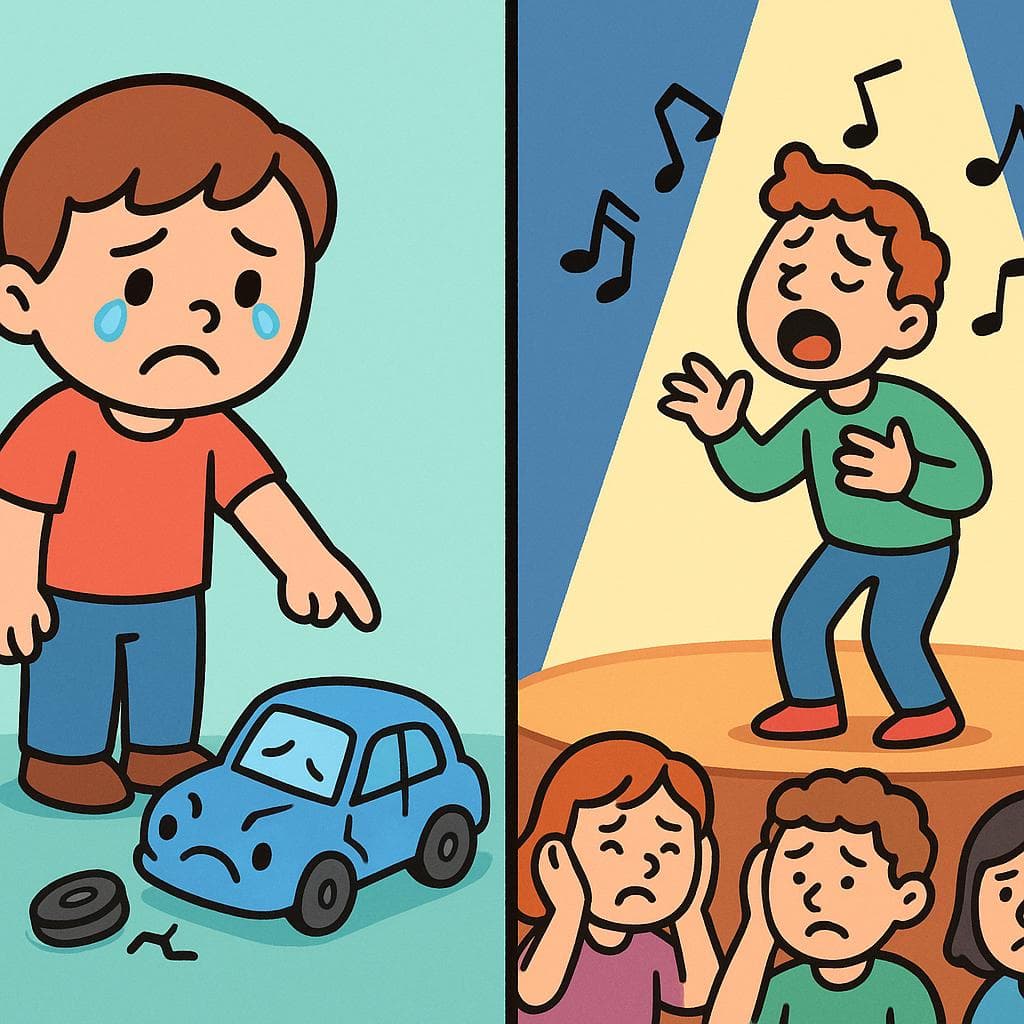
malo
Bad, poor quality, evil. It's an adjective, so it describes a noun (a person, place, or thing).
MAH-lohmal
Badly, poorly, incorrectly. It's an adverb, so it describes a verb (an action).
MAHLQuick Rule
Malo describes a noun (a thing or person). Mal describes a verb (an action).
Malo has an 'o' like 'objeto' (object). Mal is short, like a quick action.
- 'Malo' shortens to 'mal' before a masculine noun (un mal día).
- 'Estar mal' means to be sick, incorrect, or in a bad state.
Comparison Table
| Context | malo | mal | Why? |
|---|---|---|---|
| Describing Performance | Es un cantante malo. | Él canta mal. | 'Malo' describes the noun (singer). 'Mal' describes the verb (sings). |
| Talking About a Day | Fue un mal día. | El día terminó mal. | 'Mal día' uses the shortened adjective. 'Terminó mal' describes how the day ended (the verb). |
| Health vs. Quality | Es un doctor malo. | El paciente está mal. | 'Malo' describes the doctor's skill (a bad doctor). 'Mal' describes the patient's health (is unwell). |
| Results | Tuvimos un resultado malo. | Nos fue mal en el proyecto. | 'Malo' describes the noun (result). 'Mal' describes how it went for us (the verb 'ir'). |
When to Use "malo / mal"
malo
Bad, poor quality, evil. It's an adjective, so it describes a noun (a person, place, or thing).
MAH-loh
Describing a person's character
El villano de la película es muy malo.
The villain in the movie is very evil.
Describing the quality of a thing
Este café es malo, no tiene sabor.
This coffee is bad, it has no flavor.
Describing something as harmful
Comer mucha azúcar es malo para la salud.
Eating a lot of sugar is bad for your health.
Shortened to 'mal' before a masculine noun
Hoy es un mal día.
Today is a bad day.
mal
Badly, poorly, incorrectly. It's an adverb, so it describes a verb (an action).
MAHL
Describing how an action is done
Mi hermano canta muy mal.
My brother sings very badly.
With 'estar' to mean sick or incorrect
Me siento mal, creo que tengo fiebre.
I feel sick, I think I have a fever.
With verbs of perception like 'oler' (to smell)
Algo huele mal en la cocina.
Something smells bad in the kitchen.
To say something went poorly
El plan salió mal.
The plan went wrong.
Contrast Examples
With "malo":
Juan es malo.
Juan is evil / a bad person.
With "mal":
Juan está mal.
Juan is sick / unwell (or incorrect).
The Difference: This is a critical difference! 'Ser malo' is a strong judgment about someone's character. 'Estar mal' describes a temporary state of health or being wrong.
With "malo":
Es un mal estudiante.
He is a bad student. (Describes his identity as a student).
With "mal":
Estudia mal para los exámenes.
He studies poorly for exams. (Describes the action of studying).
The Difference: 'Mal' (the shortened adjective) describes the noun, 'estudiante'. The adverb 'mal' describes the verb, 'estudia'.
Common Mistakes
Yo cocino malo.
Yo cocino mal.
You need the adverb 'mal' to describe the action of cooking ('cocinar'), not the adjective 'malo'.
El equipo jugó malo.
El equipo jugó mal.
'Mal' describes HOW the team played. 'Malo' would describe the team itself ('un equipo malo').
La respuesta es mal.
La respuesta está mal.
To say something is incorrect, you use the expression 'estar mal'.
Quick Practice
Quick Quiz: Malo vs Mal
Question 1 of 2
Which is correct? 'Mi español no es muy bueno, yo hablo ___.'
Related Grammar
Want to understand the grammar behind this pair? Explore these lessons for a deep dive:
Key Words




Tags
Build the instinct, not just the rule
Rules help you get it right; context makes it automatic. Read 200+ illustrated and narrated Spanish stories to see confusing pairs chosen correctly — over and over — until you stop thinking about it.
Frequently Asked Questions
So 'mal' is just the short version of 'malo'?
Sometimes, yes. 'Malo' shortens to 'mal' before a masculine noun (like 'un mal día'). But 'mal' is also a completely separate word—an adverb—that means 'badly' (like 'cantar mal'). This double identity is what makes it confusing!
What's the difference between 'estar mal' and 'ser malo'?
A huge one! 'Ser malo' means to be a bad or evil person; it's a judgment of character. 'Estar mal' means to feel sick, be incorrect, or be in a bad state. You can say 'La sopa está mal' (The soup has gone bad), but 'La sopa es mala' (The soup recipe is bad).