
Medio vs Mitad
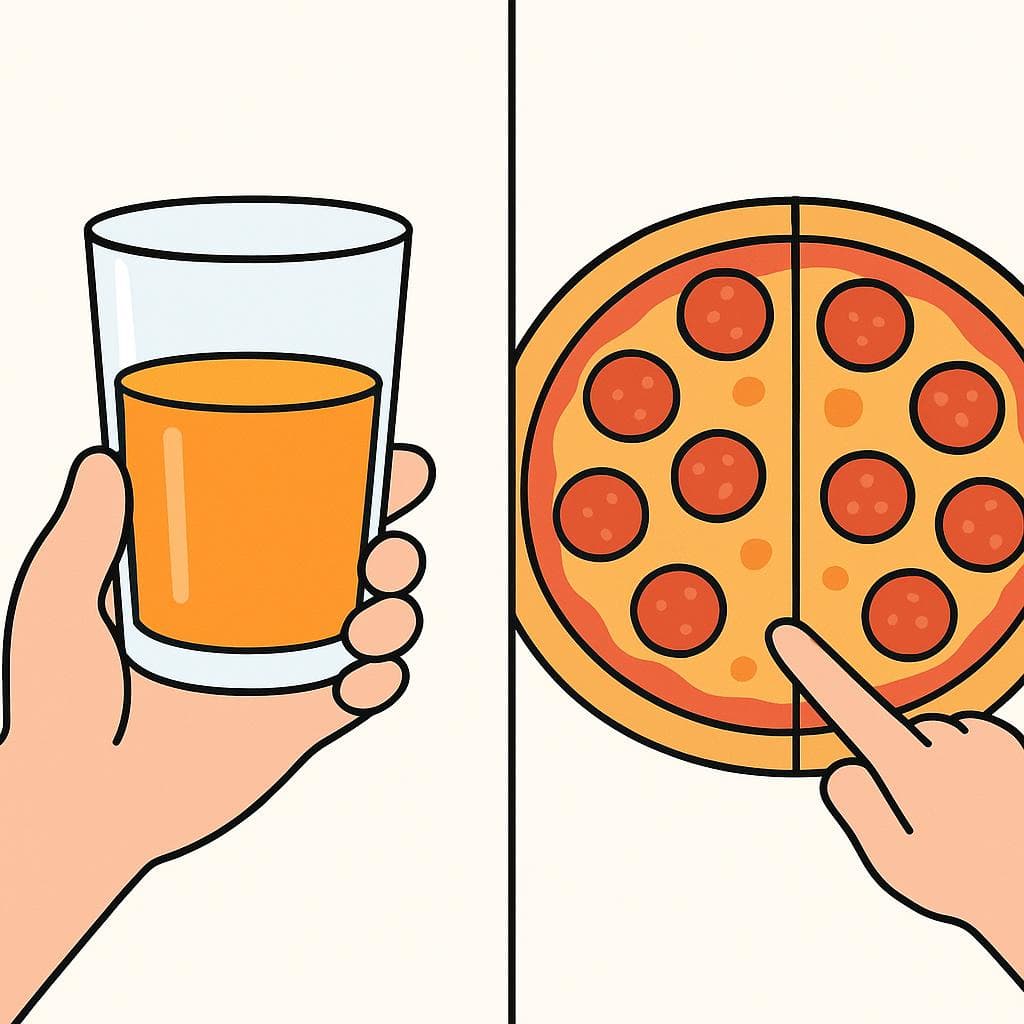
Use 'medio' before a noun (half a glass). Use 'mitad' for 'the half of' something (half of the pizza).
medio
Half (as an adjective or adverb). Used before a noun or to mean 'partly'.
MEH-dyohmitad
Half (as a noun). Refers to one of two equal parts of a whole.
mee-TAHDQuick Rule
Use 'medio' before a noun (half a glass). Use 'mitad' for 'the half of' something (half of the pizza).
Medio Modifies (like an adjective). Mitad is the Thing (a noun).
- As an adverb, 'medio' means 'partly' or 'kind of': 'Estoy medio cansado' (I'm kind of tired).
- The phrase 'a medias' means 'halfway' or 'incompletely': 'Dejó el trabajo a medias' (He left the job half-done).
Comparison Table
| Context | medio | mitad | Why? |
|---|---|---|---|
| Asking for food | Un medio pollo, por favor. | Quiero la mitad del pollo. | 'Medio' acts like 'a half' before the item. 'Mitad' is 'the half of' the item, and needs 'de'. |
| Describing a state | Estoy medio confundido. | Entendí la mitad de la lección. | 'Medio' as an adverb means 'partly' or 'kind of'. 'Mitad' as a noun refers to a quantifiable portion. |
| Talking about groups | Medio equipo está enfermo. | La mitad del equipo está enfermo. | Both are correct and mean the same thing, but show the grammatical difference. 'Medio' modifies 'equipo'. 'Mitad' is a noun followed by 'del equipo'. |
When to Use "medio / mitad"
medio
Half (as an adjective or adverb). Used before a noun or to mean 'partly'.
MEH-dyoh
As an adjective before a noun
Quiero medio sándwich.
I want half a sandwich.
With units of measurement
Necesito media taza de azúcar.
I need half a cup of sugar.
As an adverb meaning 'partly'
La ventana está medio abierta.
The window is half open.
In time expressions
Nos vemos a mediodía.
See you at midday/noon.
mitad
Half (as a noun). Refers to one of two equal parts of a whole.
mee-TAHD
As a noun, 'the half of something'
Comí la mitad de la pizza.
I ate half of the pizza.
Referring to a specific half
La primera mitad del libro es lenta.
The first half of the book is slow.
To talk about dividing something
Pagamos a mitades.
We paid halves (we split it 50/50).
With the preposition 'de'
La mitad de los estudiantes no vinieron.
Half of the students didn't come.
Contrast Examples
With "medio":
¿Me da medio litro de vino?
Can you give me half a liter of wine?
With "mitad":
Bebimos la mitad del litro de vino.
We drank half of the liter of wine.
The Difference: 'Medio' is an adjective that modifies the unit ('litro'). 'Mitad' is a noun that refers to the portion of the whole that was consumed.
With "medio":
Es mi medio hermano.
He is my half-brother.
With "mitad":
Él se lleva la mitad de la herencia.
He gets half of the inheritance.
The Difference: 'Medio' works as a prefix-like adjective in set phrases. 'Mitad' is used to talk about dividing a whole (like money or property).
With "medio":
El tanque está a medio llenar.
The tank is half full.
With "mitad":
Llenamos la mitad del tanque.
We filled half of the tank.
The Difference: 'Medio' is used in the expression 'a medio + infinitive' to mean something is half-done. 'Mitad' is the noun object that receives the action.
Common Mistakes
Quiero mitad de la manzana.
Quiero la mitad de la manzana.
'Mitad' is a noun, so it almost always needs an article like 'la' or 'una' before it.
Dame el medio del pastel.
Dame medio pastel. / Dame la mitad del pastel.
To ask for 'half a cake,' use 'medio' before the noun. To ask for 'the half of the cake,' use 'la mitad de'.
La película fue media aburrida.
La película fue medio aburrida.
When used as an adverb ('partly' or 'kind of'), 'medio' does not change for gender. It's always 'medio', never 'media'.
Quick Practice
Quick Quiz: Medio vs Mitad
Question 1 of 3
Solo necesito ___ limón para la receta.
Related Grammar
Want to understand the grammar behind this pair? Explore these lessons for a deep dive:
Key Words


Tags
Build the instinct, not just the rule
Rules help you get it right; context makes it automatic. Read 200+ illustrated and narrated Spanish stories to see confusing pairs chosen correctly — over and over — until you stop thinking about it.
Frequently Asked Questions
Can I ever use 'mitad' before a noun?
No, you can't say 'mitad vaso'. 'Mitad' is a noun, so it needs 'de' to connect to another noun, as in 'la mitad del vaso' (the half of the glass). 'Medio' is the adjective you put directly before a noun.
Does 'medio' always have to match the gender of the noun?
When it's an adjective, yes: 'medio kilo' (masculine), 'media hora' (feminine). But when it's an adverb meaning 'partly' or 'kind of', it never changes. You always say 'La puerta está medio abierta,' not 'media abierta'.