
Ser Aburrido vs Estar Aburrido
Ser aburrido = you ARE boring. Estar aburrido = you FEEL bored.
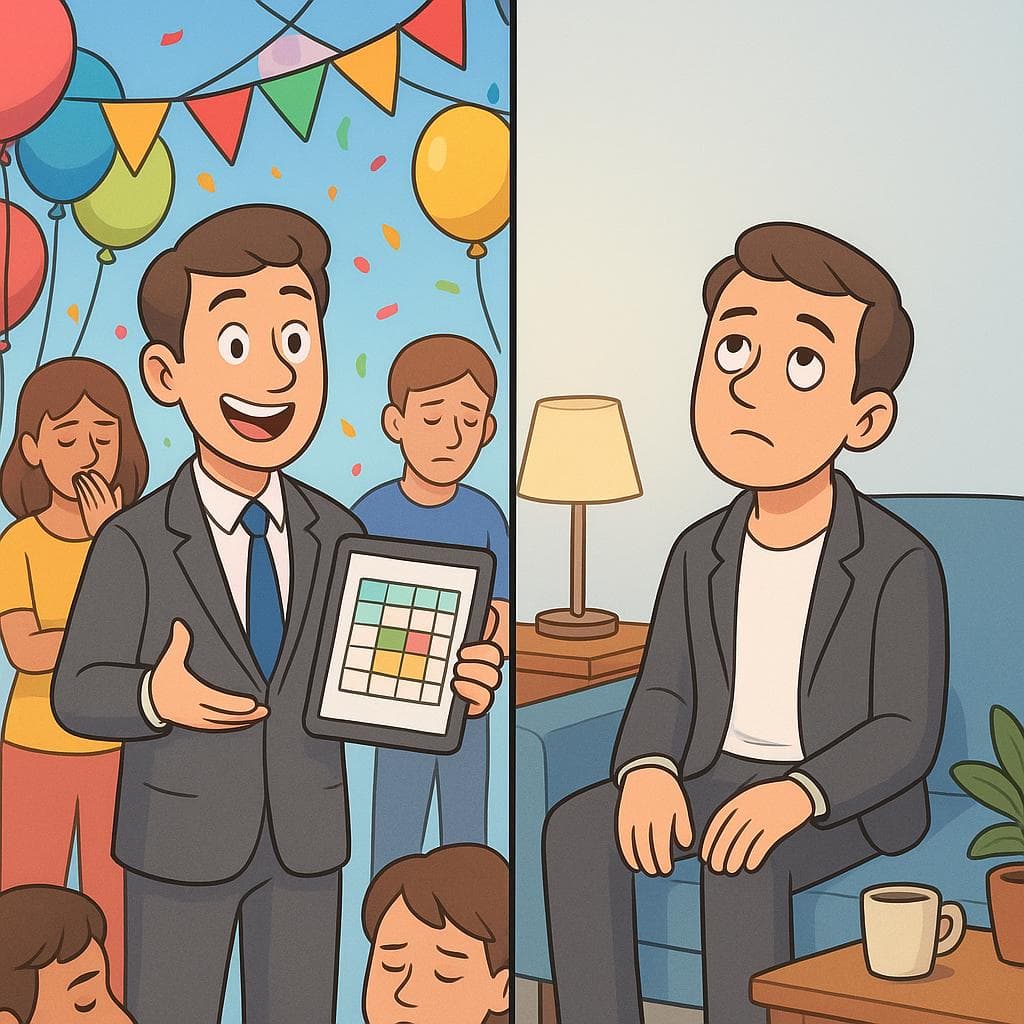
ser aburrido
To be boring. Describes an inherent, defining characteristic of a person, thing, or situation.
SEHR ah-boo-RREE-dohestar aburrido
To be bored. Describes a temporary feeling or emotional state.
ehs-TAR ah-boo-RREE-dohQuick Rule
Ser aburrido = you ARE boring. Estar aburrido = you FEEL bored.
Think: Ser = Someone's personality trait. Estar = Emotion of the moment.
- This pattern applies to many adjectives like 'listo' (ser=clever / estar=ready) and 'vivo' (ser=sharp / estar=alive).
Comparison Table
| Context | ser aburrido | estar aburrido | Why? |
|---|---|---|---|
| Describing a person | Él es aburrido. | Él está aburrido. | Ser describes his personality (He's a boring person). Estar describes his current feeling (He feels bored). |
| Talking about a class | La clase de química es aburrida. | Estoy aburrido en la clase de química. | Ser describes the class itself as boring. Estar describes the student's temporary feeling during the class. |
| Responding at a party | No me hables, soy aburrido. | No quiero hablar, estoy aburrido. | Ser is a statement about your character ('I'm a boring person'). Estar is an explanation for your behavior right now ('I feel bored'). |
When to Use "ser aburrido / estar aburrido"
ser aburrido
To be boring. Describes an inherent, defining characteristic of a person, thing, or situation.
SEHR ah-boo-RREE-doh
Describing a person's personality
Mi profesor de historia es muy aburrido.
My history professor is very boring.
Describing a thing's nature
La película fue muy aburrida.
The movie was very boring.
Making a general statement
Para mí, los domingos por la tarde son aburridos.
For me, Sunday afternoons are boring.
estar aburrido
To be bored. Describes a temporary feeling or emotional state.
ehs-TAR ah-boo-RREE-doh
Describing your current feeling
Estoy aburrido en casa. ¿Quieres hacer algo?
I'm bored at home. Want to do something?
Expressing a temporary state in a situation
Los niños están aburridos porque no pueden salir a jugar.
The kids are bored because they can't go out to play.
Asking about someone's mood
¿Estás aburrido? Podemos cambiar de película si quieres.
Are you bored? We can change the movie if you want.
Contrast Examples
With "ser aburrido":
Mi amigo Juan es aburrido.
My friend Juan is boring. (He's a boring person.)
With "estar aburrido":
Mi amigo Juan está aburrido.
My friend Juan is bored. (He feels bored right now.)
The Difference: Using 'ser' is an insult to Juan's personality. Using 'estar' just describes his temporary mood and is not a judgment on his character.
With "ser aburrido":
Este libro es aburrido.
This book is boring. (It's an inherently dull book.)
With "estar aburrido":
Estoy aburrido con este libro.
I am bored with this book. (I'm feeling bored while reading it.)
The Difference: 'Ser' describes the book's quality. 'Estar' describes your personal reaction to it. You could be bored by an exciting book if you're not in the mood!
With "ser aburrido":
No soy una persona aburrida.
I am not a boring person.
With "estar aburrido":
No estoy aburrido, solo estoy cansado.
I'm not bored, I'm just tired.
The Difference: Use 'ser' to defend your character and permanent traits. Use 'estar' to clarify your current feeling or state.
Common Mistakes
La fiesta es divertida, pero soy aburrido.
La fiesta es divertida, pero estoy aburrido.
Unless you mean to say 'I am a boring person,' use 'estoy' to express the feeling of being bored. You are describing your current state, not your identity.
Esta película está muy aburrida.
Esta película es muy aburrida.
When you describe the movie itself as the source of boredom, you're talking about its inherent quality. Use 'es'. If you wanted to focus on your feeling, you'd say 'Estoy aburrido con esta película'.
Quick Practice
Quick Quiz: Ser Aburrido vs Estar Aburrido
Question 1 of 3
Choose the correct sentence to say 'The movie is boring.'
Related Grammar
Want to understand the grammar behind this pair? Explore these lessons for a deep dive:
Key Words



Tags
Build the instinct, not just the rule
Rules help you get it right; context makes it automatic. Read 200+ illustrated and narrated Spanish stories to see confusing pairs chosen correctly — over and over — until you stop thinking about it.
Frequently Asked Questions
Can I ever say 'la película está aburrida'?
While less common for learners, a native speaker might say 'la película está aburrida' to mean 'I'm finding this movie boring right now' or 'it's getting boring.' However, as a learner, the safest and clearest way to describe the movie itself is with 'ser' ('es aburrida') and your feeling with 'estar' ('estoy aburrido').
Do other adjectives change meaning like this with ser and estar?
Yes, many do! It's a key concept in Spanish. For example, 'ser listo' is 'to be clever,' but 'estar listo' is 'to be ready.' 'Ser rico' is 'to be rich,' while 'estar rico' means something 'is delicious.' Learning these pairs is a big step toward sounding more natural.